




Evaluation models
The 1-step vs 2-step prop firm challenge question comes down to one trade-off: a single evaluation with less room for error, or two evaluations with more room and a longer road. This guide compares the two models on targets, loss limits, speed and pressure, shows why the way the loss floor moves matters more than the number of stages, and ends with three questions that settle the choice.
What 1-step and 2-step challenges are
In a 2-step challenge you pass two evaluation stages before you are funded. The first stage usually carries the larger profit target, and the second confirms that the result was not a one-off. Both stages run under the same loss limits.
A 1-step challenge compresses that into a single stage: hit one target, stay inside the limits, and you move straight to a funded account. To make up for the missing second check, firms that sell 1-step models often set a tighter overall loss limit, and some make it trailing rather than fixed.
Everything else, from minimum trading days to payout conditions, varies by firm rather than by model. If the basic mechanics are new to you, start with what a prop firm challenge is.
1-step vs 2-step prop firm challenge, side by side
The two models test the same skill in different ways. A 1-step asks you to be right once, on a short leash. A 2-step asks you to be steady twice, with more slack each time.
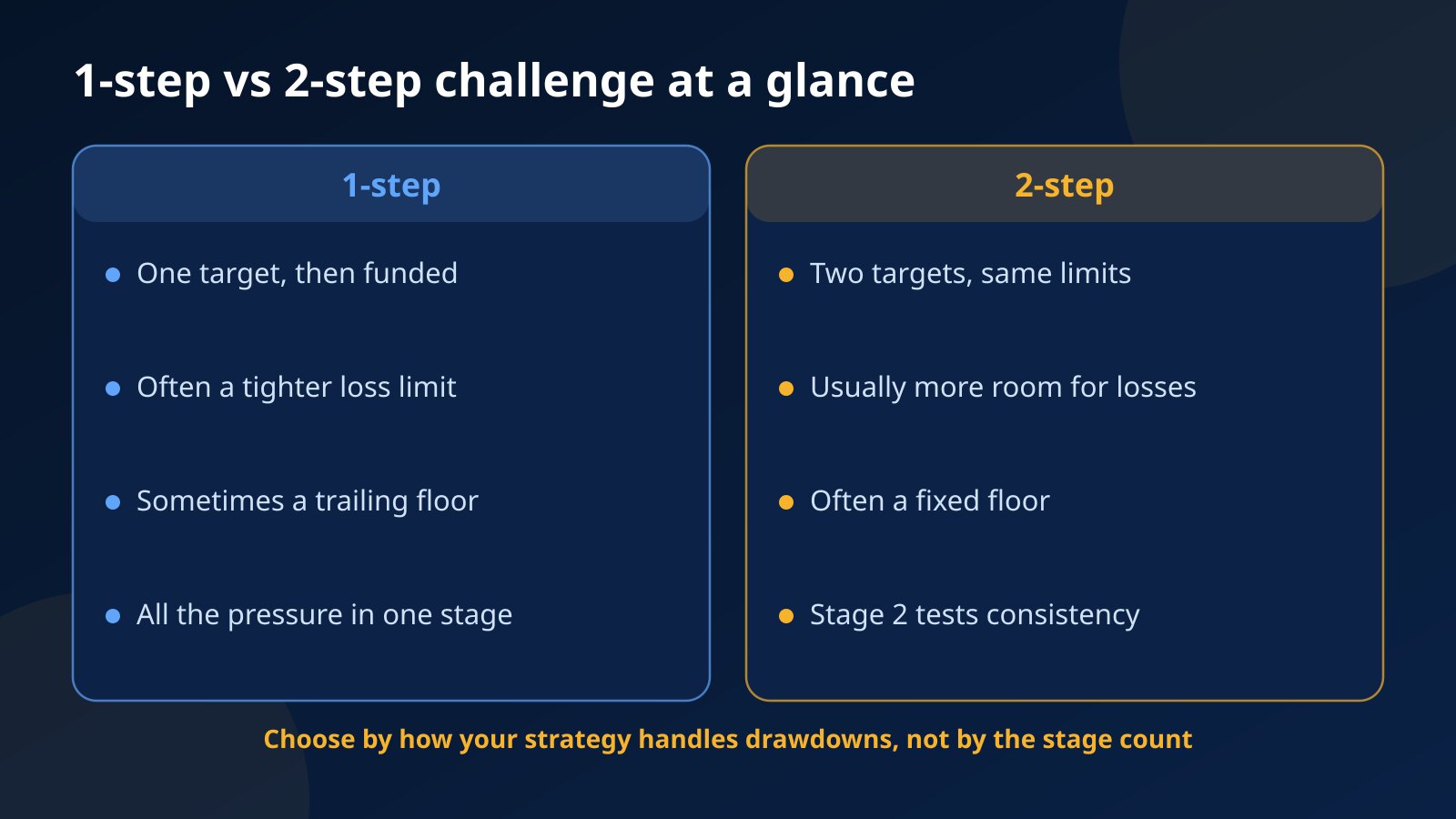
- Stages: one versus two. A 2-step adds a second pass, typically with a smaller target.
- Loss limit: often tighter, and sometimes trailing, in a 1-step; usually wider and often fixed in a 2-step.
- Time to funding: shorter in a 1-step when everything goes right; longer in a 2-step because of the second stage and its own trading-day minimum.
- Pressure: concentrated in a 1-step, where one bad day can end the attempt; spread out in a 2-step, where the usual danger is complacency in stage 2.
Neither model is easier in general. Which one is easier for you depends on how your strategy behaves during a drawdown, and that is the subject of the next section.
The detail that matters most: how the loss floor moves
Traders compare the number of stages, but the rule that decides most attempts is the shape of the maximum loss limit. A fixed floor stays where it started. A trailing floor rises with your highest balance or equity, so every new peak also lifts the level you must not touch.
Create your Fundex24 account
Takes a few seconds. You can pick a challenge and add your phone number later.
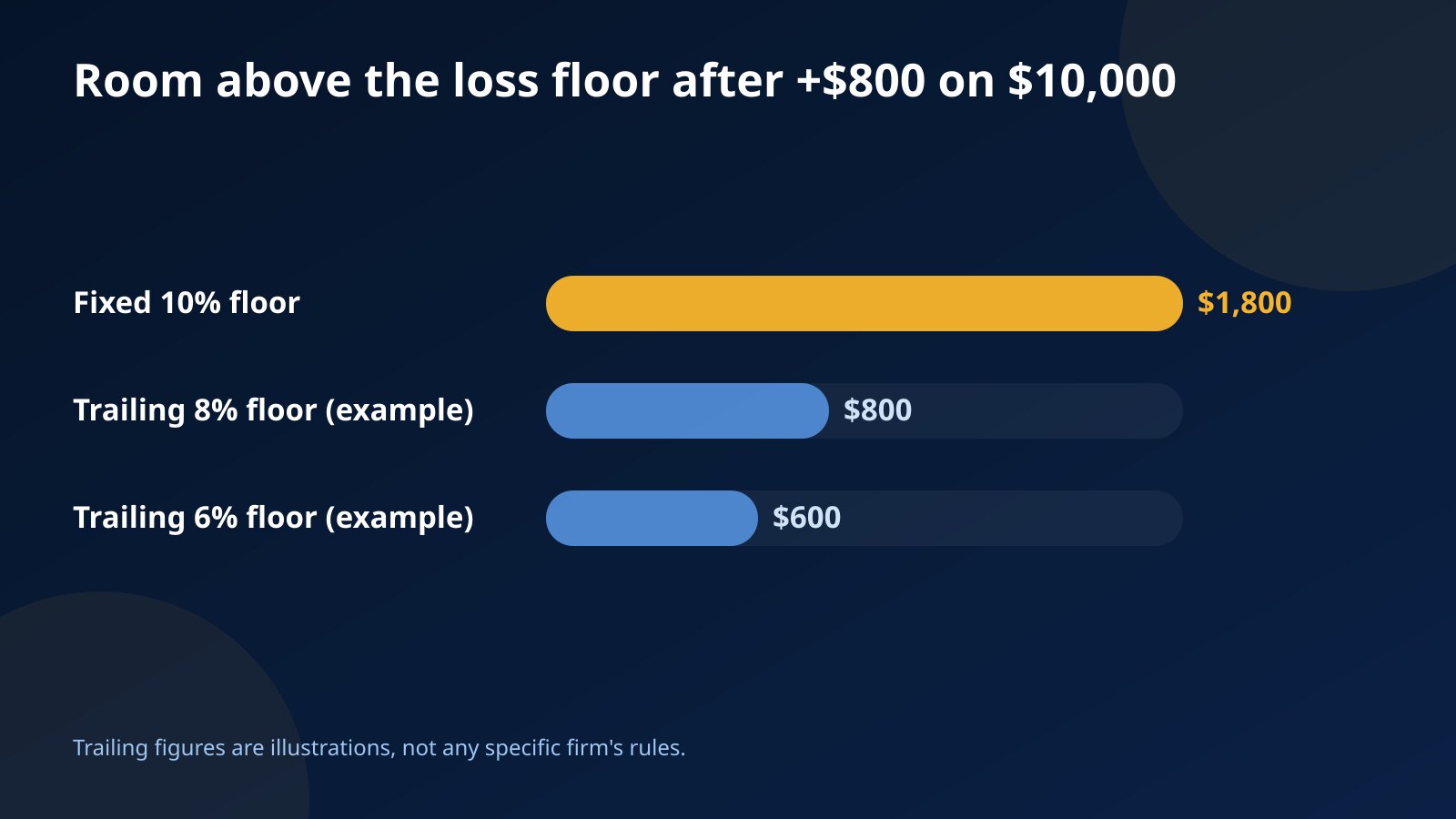
Take a $10,000 account that runs up $800 of profit. With a fixed 10% floor, the limit stays at $9,000 and you have $1,800 of room below the current balance. With a hypothetical trailing limit of 6%, the floor has followed the peak up to $10,200, so your room is still only $600: the profit bought you no extra space. That is why a strategy with ordinary pullbacks can pass a fixed-floor 2-step and still fail a trailing 1-step with exactly the same edge.
Check one more detail on either model: whether the limits are measured on closed balance only or on equity as well. When equity counts, an open trade’s floating loss can breach the limit before the stop is ever hit. How the daily limit and the overall limit interact is covered in daily drawdown vs max loss.
Where Fundex24 fits: a 2-step model with a fixed floor
Fundex24 runs a 2-step challenge and does not sell a 1-step version. Stage 1 asks for 10% and stage 2 for 8%, each with at least 5 trading days. The daily limit is 5% of the day’s starting balance, and the maximum limit is 10% of the initial balance and never trails: on $10,000 the floor is $9,000 from the first trade to the last.
There is no deadline for reaching either target, so the longer road of a 2-step does not come with a clock. Plans cost $29 for $3,000, $59 for $6,000 and $89 for $10,000, paid once. The stage-by-stage mechanics are in the two-step challenge explained, and the exact wording of every limit is on the Fundex24 rules page.
One rule shapes how a 2-step is passed here. During the challenge stages, a single position that makes more than 60% of the stage target counts as a high-risk trade, and its profit is not counted. A fast one-trade finish, the natural goal in many 1-step plans, is not an option.
How to choose the model that fits you
Start from your own trading record, not from the marketing. Three questions settle most cases.
- How deep are your normal pullbacks? If a routine losing week takes 3–4% off your account, a tight or trailing floor will eventually catch you, and a fixed-floor 2-step fits better.
- How often do you trade? A strategy with few, large winners reaches a single target faster, but check whether the firm caps how much one trade may contribute.
- How do you handle a second test? Many traders relax after stage 1 and give the gains back in stage 2. If that sounds like you, plan stage 2 with smaller risk from the first day.
Before you buy either model, read the rule sheet for four things: whether the floor is fixed or trailing, whether equity counts, whether there is a deadline, and what the payout conditions are. The ways traders most often fail are collected in common challenge mistakes. When you are ready, compare the Fundex24 challenge plans or ask support about a rule.
Funded accounts at Fundex24 are simulated accounts for evaluation purposes, and no earnings are promised. Choose a model for how you actually trade, and only pay a fee you can afford to lose.
Pick a challenge and start trading
Two-step evaluation, transparent rules, profit split up to 80%.
Not sure which size fits? Read the rules · Common questions
Frequently asked questions
Is a 1-step challenge easier than a 2-step?
Not in general. A 1-step has fewer stages but usually less room for losses, while a 2-step gives more room but asks you to repeat the result. Which is easier depends on how your strategy behaves in a drawdown.
Does Fundex24 offer a 1-step challenge?
No. Fundex24 offers a 2-step challenge with a 10% target in stage 1 and 8% in stage 2, a 5% daily limit and a fixed 10% maximum limit.
Is stage 2 easier because the target is lower?
The target is lower, but the loss limits are identical and at least 5 trading days are still required. Traders who raise their risk after passing stage 1 are the ones stage 2 tends to catch.
Does a 1-step get me funded faster?
It can, because there is one stage instead of two. Minimum trading days and the account request step still apply, so compare the whole path rather than the stage count alone.
Questions about the Fundex24 challenges?
Open the support chat and ask — the team replies right there.
Chat with supportPrefer to read first? Browse the FAQ · Compare the challenges
Continue your learning path
Move from this article to the next useful action or topic.