




Account sizes
Funded account size is the headline number on every plan: $10K, $25K, $50K, $100K. It decides how many dollars move when you win or lose, but not the rules you have to follow. This guide shows what actually scales with size, what stays the same, and how to pick the size you can trade at your best rather than the one that looks most impressive.
Account size changes the dollars, not the rules
Prop firm rules are written as percentages. A daily loss limit of 5% and a maximum loss of 10% mean the same thing on every account; only the dollar amounts differ. On $10,000 the daily limit is $500. On $100,000 it is $5,000.
The same goes for profit targets. A 10% target is $1,000 on a $10K account and $10,000 on a $100K account. In percentage terms the job is identical: you need the same edge, the same discipline and the same run of good days.
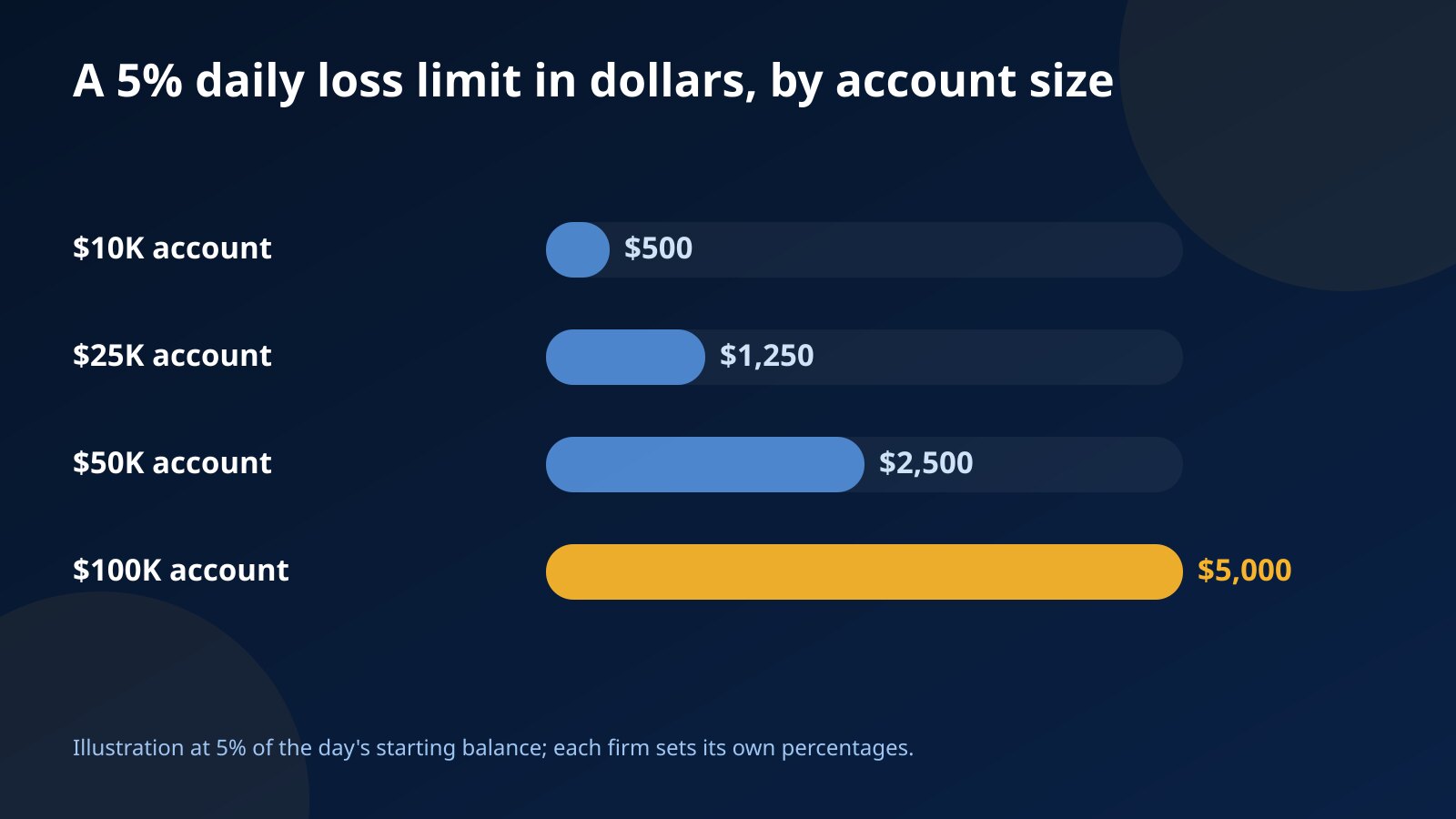
Many firms sell sizes like these, and their percentages vary from one rulebook to the next. Whatever the size, read the rule sheet as percentages first and dollars second, the way it is laid out in what a prop firm challenge is.
What really changes as the account grows
Three things scale with account size, and only one of them is good news.
Create your Fundex24 account
Takes a few seconds. You can pick a challenge and add your phone number later.
- Dollar risk per trade. Risking 1% is $100 on $10K and $1,000 on $100K. The chart does not care, but most traders do: a $1,000 loss feels different from a $100 one, and fear changes how people manage an open position.
- The fee. Evaluation prices generally rise with account size, so a failed attempt costs more on a bigger account.
- Profit in dollars. The same 5% month is $500 on $10K and $5,000 on $100K, before the profit split.
What does not scale is skill. A strategy that cannot pass on $10,000 will not pass on $100,000, because the percentages are the same and the pressure is higher. Sizing each trade correctly matters more than the size of the account, and crypto prop risk management covers how.
How to choose a funded account size
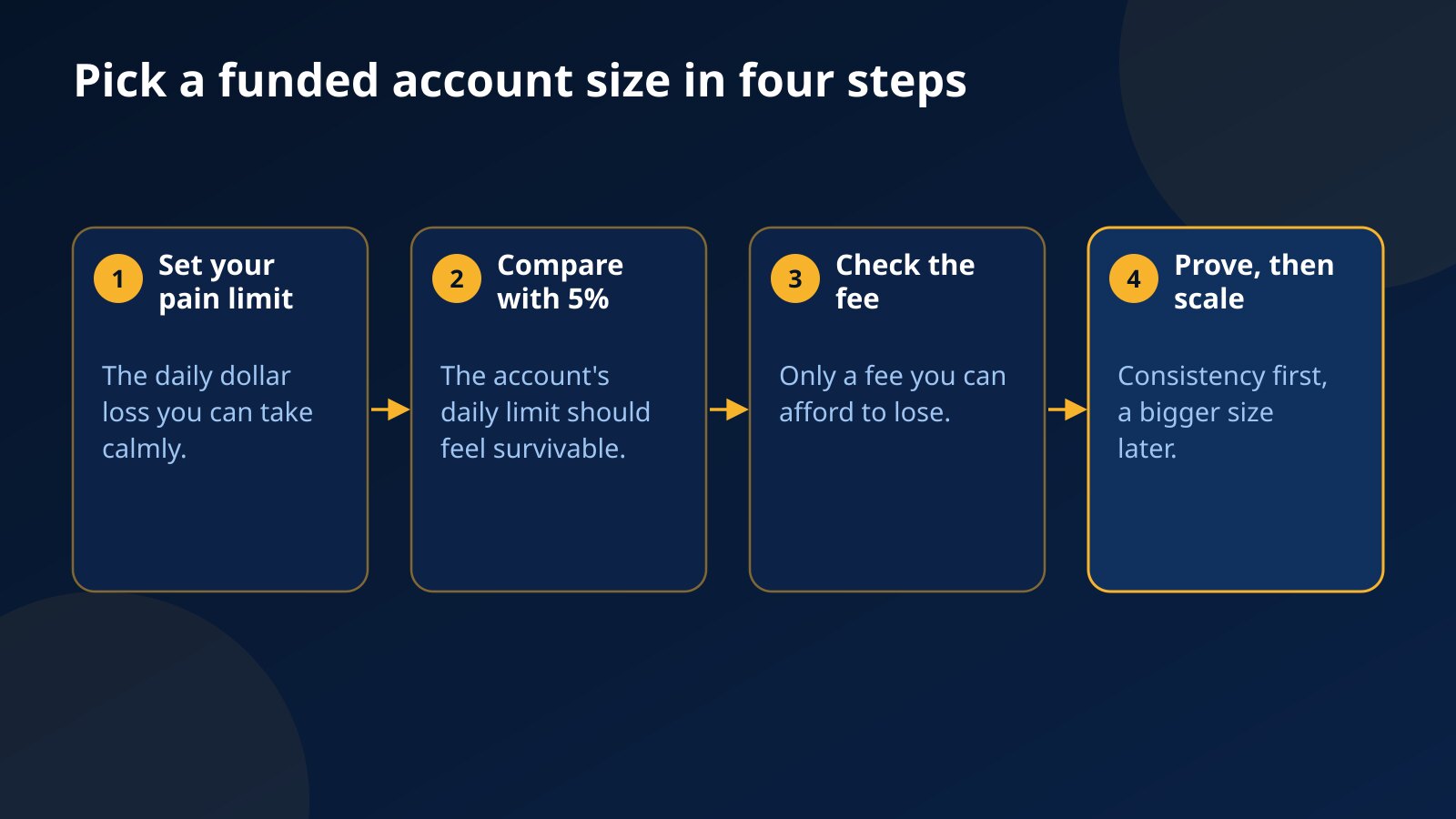
Choose the size you can trade exactly the way you trade now. Four questions settle it for most people.
- What daily loss in dollars can you watch without breaking your plan? If a $2,500 losing day would push you into revenge trading, a $50K account is too big for now, whatever the headline says.
- What fee can you lose without it hurting? Treat the evaluation fee as money you may not get back.
- Does your strategy fit the size? In crypto perpetuals you can trade small positions, so a small account does not limit a well-sized plan.
- What does your record say? Plenty of traders start smaller, prove they can follow the rules, and only then move up.
Is a $100K funded account worth more than a $10K one?
In dollars, a bigger account pays more when things go well. In every other respect it is the same test at higher stakes: the pass criteria are percentages, the fee is higher, and a failed attempt costs more to repeat.
That is why the sensible order is usually small first. A trader who passes on a smaller account learns the rules under lower pressure, and moving up later changes only the dollar figures, not the habits that got them there.
Account sizes at Fundex24
Fundex24 sells three sizes: $3,000 for $29, $6,000 for $59 and $10,000 for $89, each paid once in USDT. It does not sell $25K, $50K or $100K accounts, so the larger figures in this guide are there for comparison only.
The rules are identical on all three sizes: a 10% target in stage 1 and 8% in stage 2, at least 5 trading days per stage, a 5% daily limit and a fixed 10% maximum limit. On the funded account the profit split starts at 80%. How the funded account itself works is covered in crypto funded accounts explained, and the two-stage structure in 1-step vs 2-step challenges.
If you are unsure, the free practice account gives you $10,000 in virtual balance for a short run (currently 3 days), with leverage up to 1:10, so you can see how the dollar swings feel before you pay anything. When you are ready, compare the Fundex24 plans or ask support which size fits.
Pick a challenge and start trading
Two-step evaluation, transparent rules, profit split up to 80%.
Not sure which size fits? Read the rules · Common questions
Funded accounts at Fundex24 are simulated accounts for evaluation purposes, and no earnings are promised. Pick a size for how you trade, not for the headline.
Frequently asked questions
Is it easier to pass a challenge on a smaller account?
The rules are the same percentages on every size, so the task is the same. Many traders find a smaller account easier to trade calmly because the dollar swings are smaller.
Does Fundex24 offer $25K, $50K or $100K accounts?
No. Fundex24 currently offers $3,000, $6,000 and $10,000 accounts, priced at $29, $59 and $89.
Can I run several small accounts instead of one large one?
Yes, several challenges can run at the same time at Fundex24. Copying identical trades across them is prohibited and fails every challenge involved.
Questions about the Fundex24 challenges?
Open the support chat and ask — the team replies right there.
Chat with supportPrefer to read first? Browse the FAQ · Compare the challenges
Continue your learning path
Move from this article to the next useful action or topic.