




Risk per trade
How much should you risk per trade on a prop firm funded account? A range you will often see recommended is 0.25% to 1% of the account, but the right number for you comes from the rules, not from how confident you feel about a setup. This guide shows how to work back from the drawdown limits, how to turn a percentage into a position size, which rules set a floor and a ceiling on risk per trade, and a simple starting plan for a Fundex24 account.
How much should you risk per trade on a funded account?
Risk per trade is the amount you lose if a trade hits your stop, written as a share of the account. On a $10,000 account, 1% is $100 and 0.5% is $50. The range above sits low for a reason: a funded account has a hard daily limit and a hard floor, and a run of ordinary losses has to fit inside both without ending the account.
The key is to keep the percentage fixed and small, and to decide it before the trade rather than during it. Raising risk because a setup looks certain is how one bad day grows into a breach, since the trades you feel surest about lose as well. If the evaluation itself is new to you, start with what a prop firm challenge is.
Work back from the drawdown limits
Start with the limits, then divide. At Fundex24 the daily drawdown limit is 5% of the day’s starting balance and the maximum drawdown is 10% of the initial balance, a fixed floor. Balance and equity are both monitored, so open losses count as well as closed ones. On a $10,000 account that means $500 of room on a day that starts at $10,000, and a floor at $9,000.
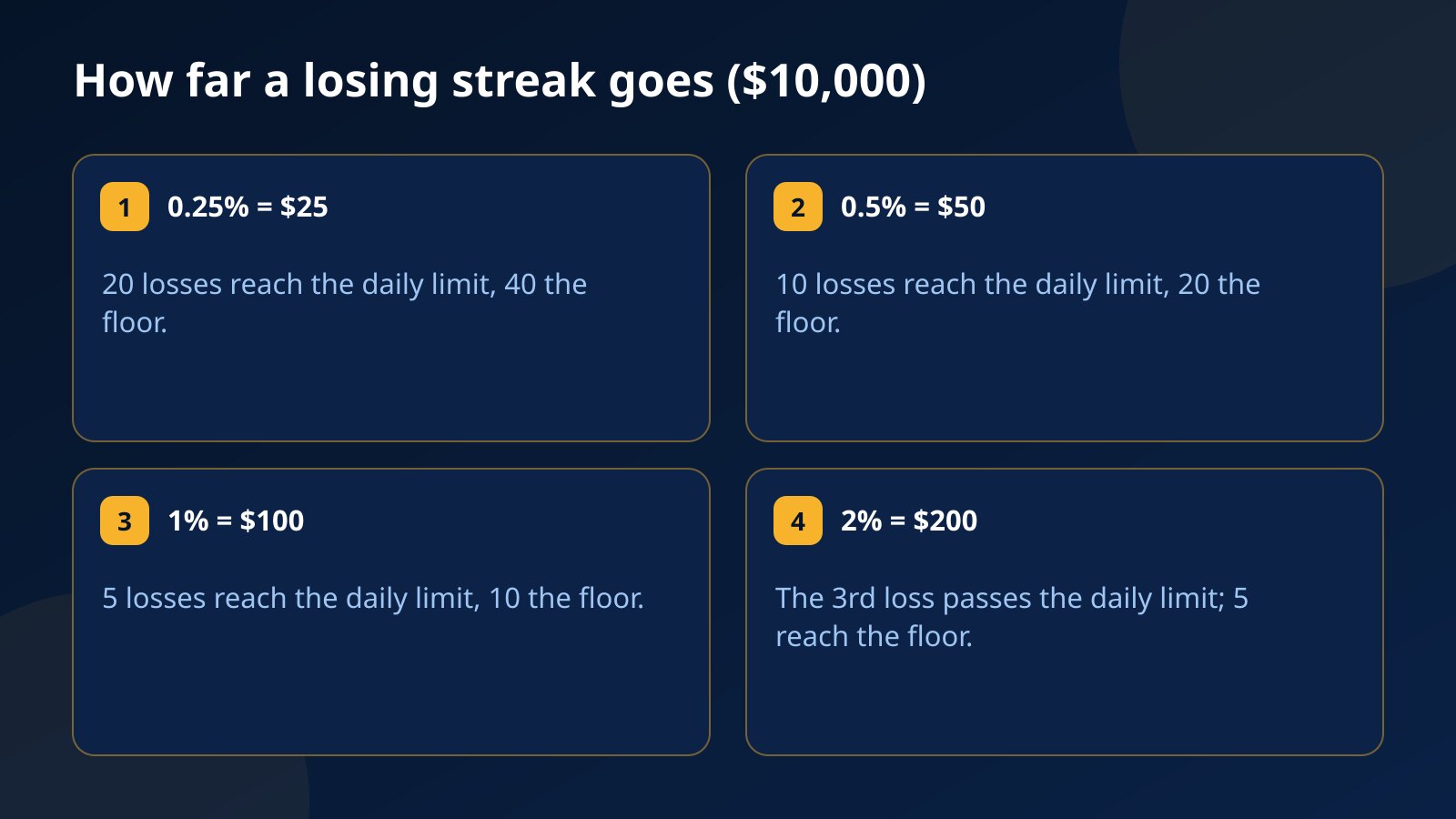
Losing streaks are normal, even for a strategy with an edge. At 0.5% per trade it takes ten losses in a row to reach the daily limit and twenty to reach the floor; at 2%, the third loss of the day takes you past the limit and five losses from the start reach the floor. Pick a level at which the longest losing run you can reasonably expect still leaves room, and remember that the daily limit applies to the day as a whole, not trade by trade.
Turn the percentage into a position size
A risk percentage only works if the position size follows from it. The formula is simple: position size equals dollar risk divided by the distance to the stop. Risking $50 with a stop 2% away from entry gives a $2,500 position; with a stop 1% away, a $5,000 position. The chart sets the stop, your plan sets the dollar risk, and the size is whatever connects the two.
Create your Fundex24 account
Takes a few seconds. You can pick a challenge and add your phone number later.
Leverage does not change this arithmetic. With isolated margin, the only mode at Fundex24, leverage decides how much margin a position ties up, not how much you lose at the stop. Make sure the stop sits well inside the liquidation price, and remember that in fast markets a stop can fill beyond its level, which is why many traders halve their risk around data releases. That case is covered in trading news on a funded account.
Rules that set a floor and a ceiling
Two Fundex24 rules make both very small and very large risk a problem. The floor comes from the trading-day rule: a day counts toward the minimum of 5 trading days per stage only if you open and close a position with a profit or loss of at least 0.25% of the initial balance, which is $25 on a $10,000 account. Risk 0.1% with a one-to-one target and your trades can be too small to count.
The ceiling comes from the single-position rule. If one position earns 60% or more of the current stage profit target, that profit remains in your account but is excluded from challenge progress. On the $1,000 first-stage target, any single winner of $600 or more doesn’t count. At 2% risk with a three-to-one target, one full winner is exactly $600, so the risk level that looks fastest is the one that cancels its own best trades.
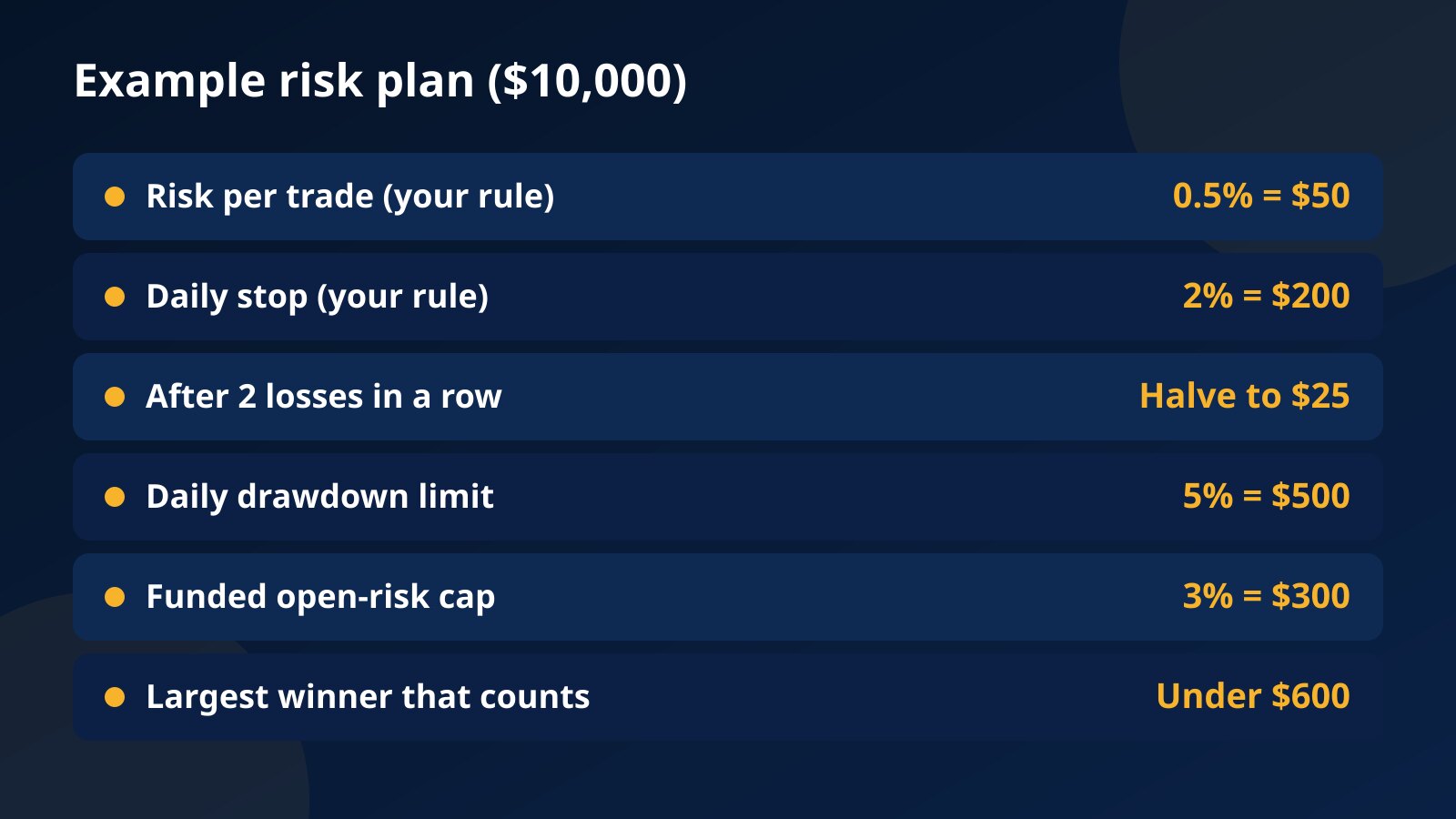
On the funded account there is a third limit: the combined open risk of all positions must stay within 3% of the day’s starting balance, or that day’s profit isn’t counted. At 1% per trade that allows three positions at full risk; at 0.5%, six. Traders who hold several fast positions at once should also read choosing an account for scalping.
A starting plan for a Fundex24 account
There is no single correct number, but a conservative starting point is easy to defend. Risk 0.5% per trade, which is $15 on the $3,000 plan, $30 on the $6,000 plan and $50 on the $10,000 plan. Stop trading for the day after losing 2%, well before the 5% limit. After two losses in a row, halve the risk until the next winner. These are personal rules, not Fundex24 rules, and they exist so that no single day can decide the account.
Automated systems need the same limits written into their settings; see EAs and trading bots on funded accounts. Before you buy, compare the limits with your plan using what to check before buying a challenge, and test your sizing on the free practice account ($10,000 virtual, currently 3 days, up to 1:10, three resets). The full conditions are on the rules page, the plans are on the challenges page, and sizing questions can go to the challenge support team.
Frequently asked questions
What is a good risk per trade for a funded account?
A range often recommended is 0.25% to 1% of the account. Start low, keep it fixed, and make sure a normal losing streak fits inside the 5% daily limit.
Pick a challenge and start trading
Two-step evaluation, transparent rules, profit split up to 80%.
Not sure which size fits? Read the rules · Common questions
How many losing trades can I take before the daily limit?
Divide the daily limit by your risk per trade. At Fundex24 the limit is 5% of the day’s starting balance, so 0.5% per trade gives about ten losses and 1% gives five.
Does higher leverage mean more risk per trade?
Not by itself. With isolated margin, the loss at your stop depends on position size and stop distance, while leverage changes the margin used. Keep the stop well inside the liquidation price.
Can a trade be too small to count?
Yes. A trading day at Fundex24 needs a position opened and closed with a profit or loss of at least 0.25% of the initial balance.
Can a winning trade be too big to count?
Its profit can be. If one position earns 60% or more of the current stage profit target, that profit stays in the account but does not count toward challenge progress.
Questions about the Fundex24 challenges?
Open the support chat and ask — the team replies right there.
Chat with supportPrefer to read first? Browse the FAQ · Compare the challenges
Continue your learning path
Move from this article to the next useful action or topic.