




Risk management
Meme coin risk management in a prop challenge comes down to one mismatch: coins that can move several times more than BTC in a day, and loss limits that do not move at all. On a $10,000 Fundex24 account that means $500 of room on a day that starts at $10,000 and a fixed floor at $9,000, with open losses counted toward both. This guide turns each rule into dollars, sizes positions from the stop distance and ends with a checklist to run before every meme coin trade.
The two loss limits in dollars
The daily drawdown is 5% of the day’s starting balance. If the day starts at $10,000, you have $500 of room; if it starts at $10,400 after a good week, the room is $520, and after a losing run that leaves you at $9,700, it is $485. The maximum drawdown works differently: it is 10% of the initial balance, so a floor at $9,000 that never moves, however much profit you make first.
Both limits apply to equity as well as balance. A floating loss that touches either one breaks the rule, even for a moment and even if price comes back, and breaking either limit closes the account. The same limits apply in stage 1, in stage 2 and on the funded account; how daily and maximum drawdown differ covers the mechanics in more depth.
This is where meme coins catch people. Say you hold a $4,000 long with a stop 8% below entry, and the coin prints a wick 13% below your entry before snapping back. With the stop in place, you lose $320 and the account lives on. Without it, or with the stop dragged lower, equity shows a $520 floating loss at the bottom of the wick, which is past the $500 daily limit, and the account closes even though the candle finishes near your entry.
Size meme coin positions by stop distance, not leverage
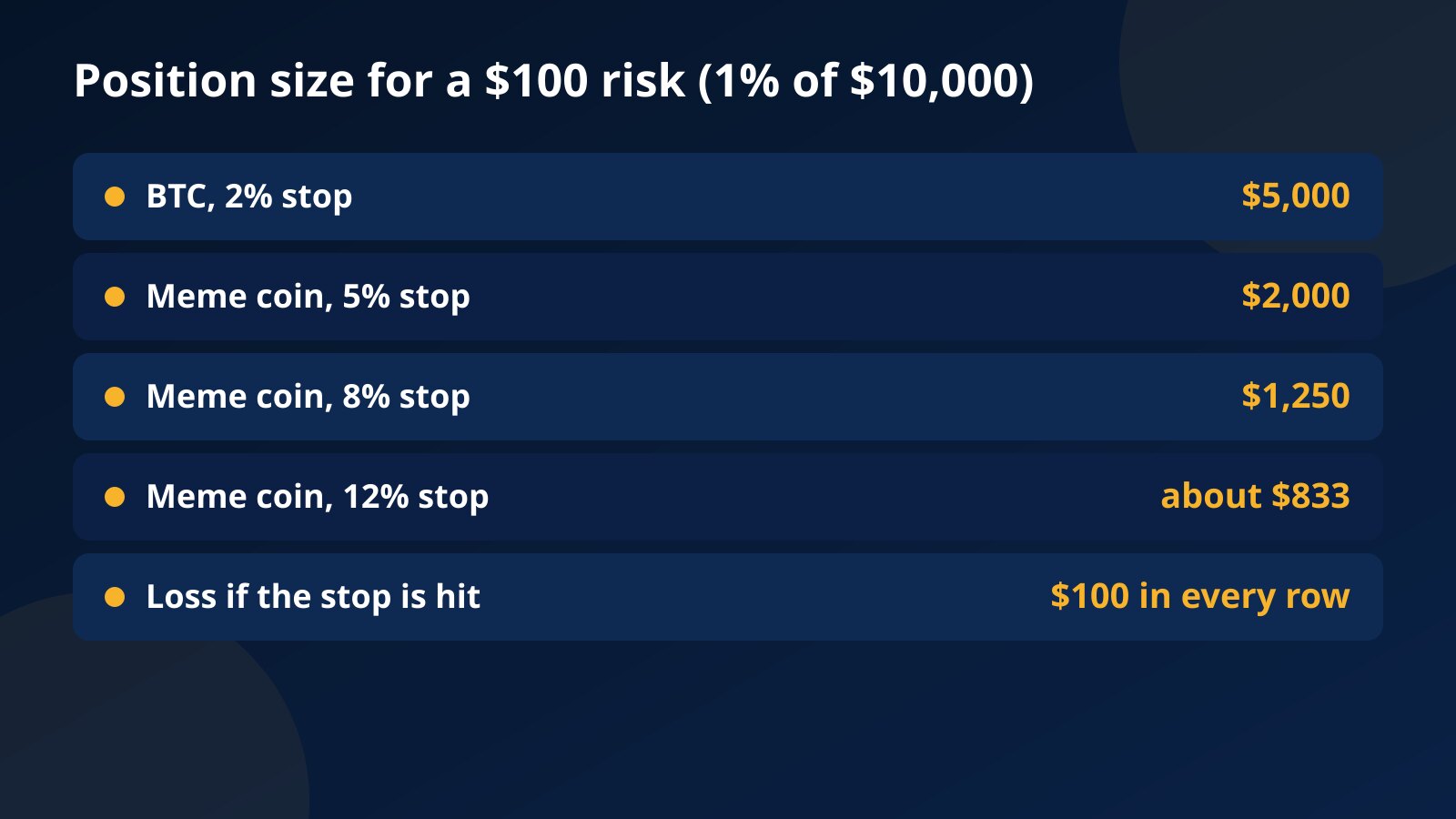
Start from the dollars you are willing to lose. On a $10,000 account, 1% is $100, and the position size is that risk divided by the stop distance. With a 2% stop on BTC the position is $5,000; with a 5% stop on a meme coin it is $2,000, with 8% it is $1,250, and with 12% it is about $833.
Leverage only changes the margin. The $1,250 position needs $250 of margin at 1:5 and $125 at 1:10, and an 8% move against it costs $100 either way. Fundex24 allows leverage up to 1:10 and only isolated margin, so each position carries its own margin; cross margin is prohibited. If you are unsure what the dollar risk should be in the first place, read how much to risk per trade.
Where the stop goes
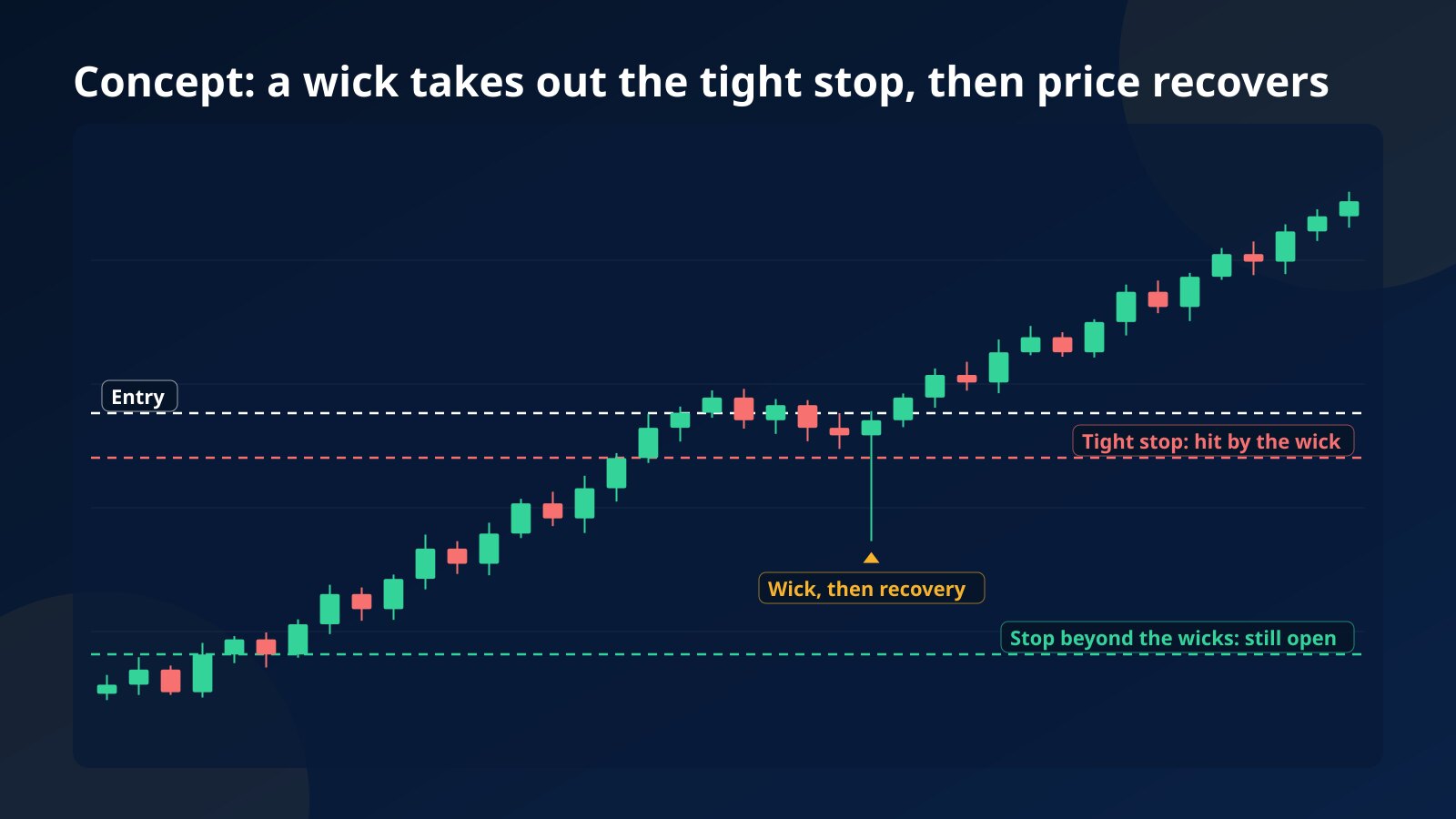
The stop belongs where your idea is wrong and beyond the wicks the coin normally prints, not at whatever distance lets you trade a bigger position. On a meme coin that can mean a stop several times wider than you would use on BTC, and the newest, thinnest markets, such as the Chinese-named meme coins, usually need the widest. Before choosing a distance, open a chart like the 1000PEPE/USDT market and look at how far its recent wicks reached.
A stop tucked just under an obvious level is exactly the one the next wick takes out. You end up with the loss and then watch the trade work without you.
The 60% rule: why one pump should not carry a prop challenge stage
In the challenge stages, a single position that makes more than 60% of the stage’s profit target is treated as a high-risk trade, and its profit is not counted. On a $10,000 account the stage 1 target is $1,000, so the line is $600; in stage 2 the target is $800 and the line is $480.
Create your Fundex24 account
Takes a few seconds. You can pick a challenge and add your phone number later.
Meme coins can cross that line in one move. A $2,000 position that catches a 35% pump makes $700, which is above $600, so none of it counts toward stage 1. The same pump on a $1,250 position makes $437.50 and counts in full. An oversized position is dangerous on the way down and wasted on the way up.
Two habits keep you clear of the rule. Size so that your planned take profit stays under 60% of the target, and close at the planned level instead of letting a pump decide for you. On a $1,250 position the $600 line sits 48% away from entry, so a normal take profit never gets near it.
Several meme coins at once are often one bet
Meme coins tend to move together when the market mood turns. Longs on DOGE, 1000PEPE and WIF can feel like three separate ideas, but in a broad sell-off they often fall at the same time, and every loss lands on the same daily limit. The Meme category has more than 60 markets, as the guide to meme coins in a Fundex24 challenge shows, but more markets do not mean more independent chances.
Do the arithmetic before you open the second position. Five meme coin trades that each risk $100 put $500 at risk together, the entire room of a day that starts at $10,000. If they all hit their stops in the same sell-off, the daily limit is touched and the account closes, even though each trade followed a 1% plan.
The funded account turns this into a written rule: the total risk of all open positions at the same time must stay within 3% of the day’s starting balance, $300 on $10,000, or that day’s profit is not counted. Keeping a similar cap during the challenge builds the habit before it matters.
Small positions and the $25 trading day
A trading day counts only when you open a position and close it with a profit or loss of at least 0.25% of the initial balance, which is $25 on a $10,000 account. Each stage needs at least 5 of them.
Smaller meme coin positions change the math. On an $833 position, $25 is a 3% move, so scratching the trade at +1% for $8.33 does not add a day, while on a $2,000 position it takes 1.25%. If you are short of trading days, plan trades whose normal outcome clears $25 rather than doubling the size to force one.
What not to do when a meme coin spikes
Exploit price errors or data delays
If a price or a data feed ever looks wrong during a spike, trading on that error is not an edge. Exploiting system errors such as wrong prices or data delays is prohibited, along with market manipulation and abusive scalping, and Fundex24’s prohibited behavior rules list the rest. The first detection brings a formal warning, and if it is found at withdrawal, the payout or the cooperation itself can be refused.
Average down into a falling meme coin
Adding to a loser turns a planned $100 loss into an unplanned $300 one. A coin with no cash flows has no level that must hold, and every addition pulls equity closer to the daily limit.
Move the stop further away
Moving a stop from 8% to 15% on a $1,250 position raises the loss from $100 to $187.50 without you ever deciding to risk that much. If the idea was wrong at 8%, it is still wrong at 15%.
Copy the trade across challenges
Running several challenges at once is allowed, but identical trades copied across them are prohibited and fail every related challenge. A meme coin setup that looks perfect is not a reason to place it three times.
Pick a challenge and start trading
Two-step evaluation, transparent rules, profit split up to 80%.
Not sure which size fits? Read the rules · Common questions
A meme coin risk management checklist for your prop challenge
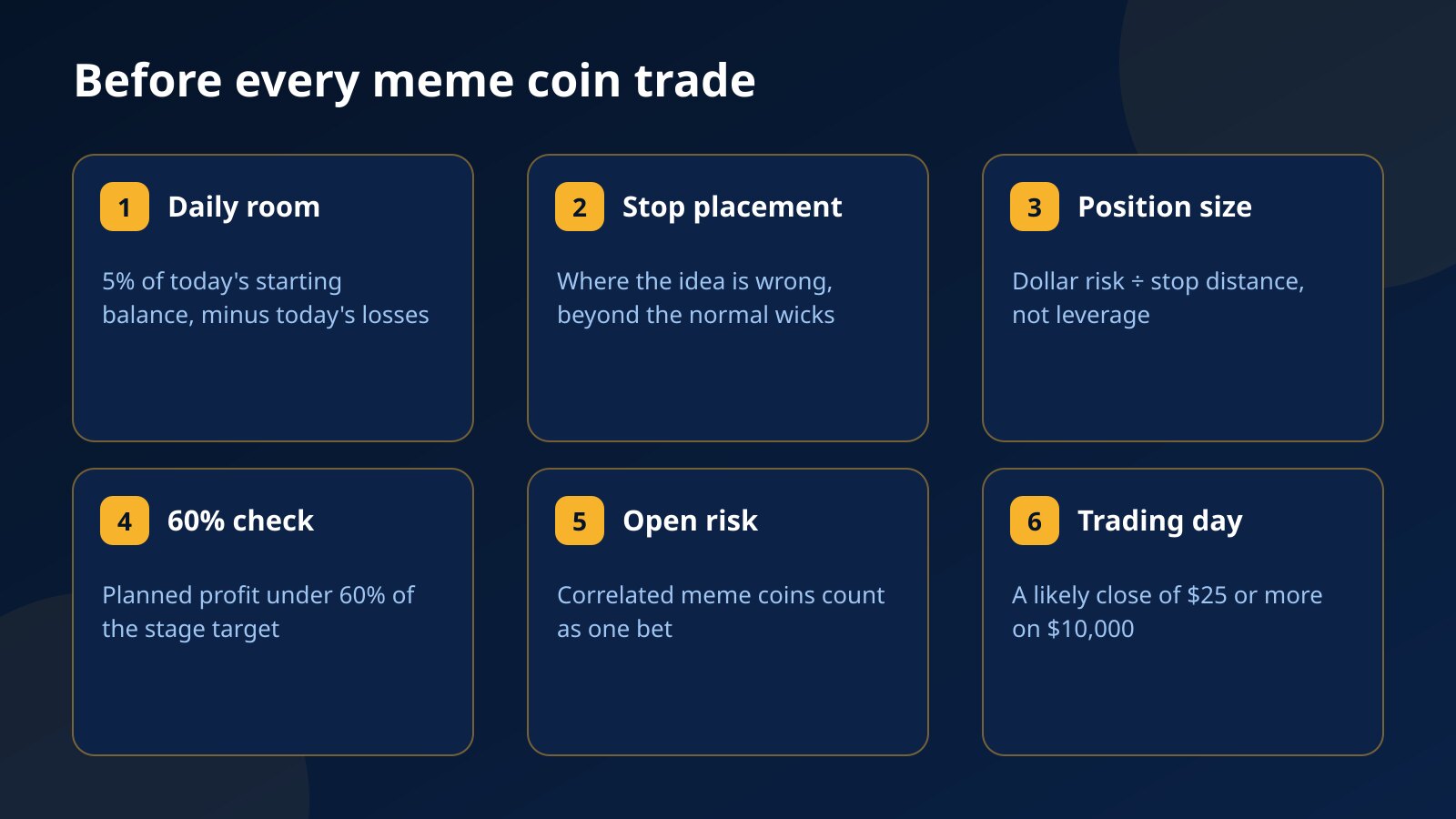
Run through these six questions before every meme coin trade. If any answer is no, the trade waits.
- How much daily room is left: 5% of the day’s starting balance, minus what today has already cost?
- Is the stop where the idea is wrong, beyond the wicks this coin normally prints?
- Is the position size your dollar risk divided by that stop distance?
- If the take profit is hit, will the profit stay under 60% of the stage target?
- What is the combined risk of everything already open, with correlated meme coins counted as one bet?
- Will a normal outcome close with at least $25 of profit or loss, so the day counts?
None of this removes risk: meme coins are highly volatile, and a challenge can still fail on one bad day. Fundex24 funded accounts are simulated funded accounts for evaluation, and no earnings are promised.
Frequently asked questions
Does leverage change how much I can lose?
Not by itself. The loss at the stop is the position size times the stop distance, and leverage, up to 1:10, only sets how much margin the position uses.
Is the daily limit always $500 on a $10,000 account?
No. It is 5% of each day’s starting balance, so it grows after profitable days and shrinks after losing ones, while the $9,000 floor stays where it is.
Are the rules stricter for meme coins than for BTC?
No, the rules are the same on every market. The extra risk comes from the coins’ larger moves and longer wicks, which is why the same dollar risk needs a smaller meme coin position.
Do the same limits apply on the funded account?
Yes, the 5% daily and 10% maximum drawdown carry over. The funded account adds the 3% cap on the combined risk of all open positions.
Questions about the Fundex24 challenges?
Open the support chat and ask — the team replies right there.
Chat with supportPrefer to read first? Browse the FAQ · Compare the challenges
Continue your learning path
Move from this article to the next useful action or topic.