




Risk management: new listings
Newly listed meme coins move the most when you know the least about them, and in a prop challenge that combination runs into loss limits that do not bend. MARSCOIN is a fresh example: in its first two weeks on Binance Futures it doubled in a single day, rose about fourfold to a peak and then fell about 60% below it. This guide uses those dated moves to show how each challenge rule plays out on a new listing, and what a sensible routine for the first days looks like.
What the first days of newly listed meme coins look like
A meme coin that has just been listed has almost no chart. There are no levels where the price has reacted before, no record of how far it usually wicks, and liquidity is thin, so a burst of attention can push it through any line you draw. Meme coins have no cash flows to anchor them, and the newest ones can swing hardest.
A new listing does not trade in isolation either. When the mood across the market turns, meme coins tend to move together, and a coin with a week of history has nothing to slow that move down. Long wicks in both directions are part of normal behavior at this stage.
Binance flags this kind of risk with its Seed Tag, a label for early-stage, higher-risk tokens. MARSCOIN, the example in this guide, carries it.
MARSCOIN’s first two weeks, day by day
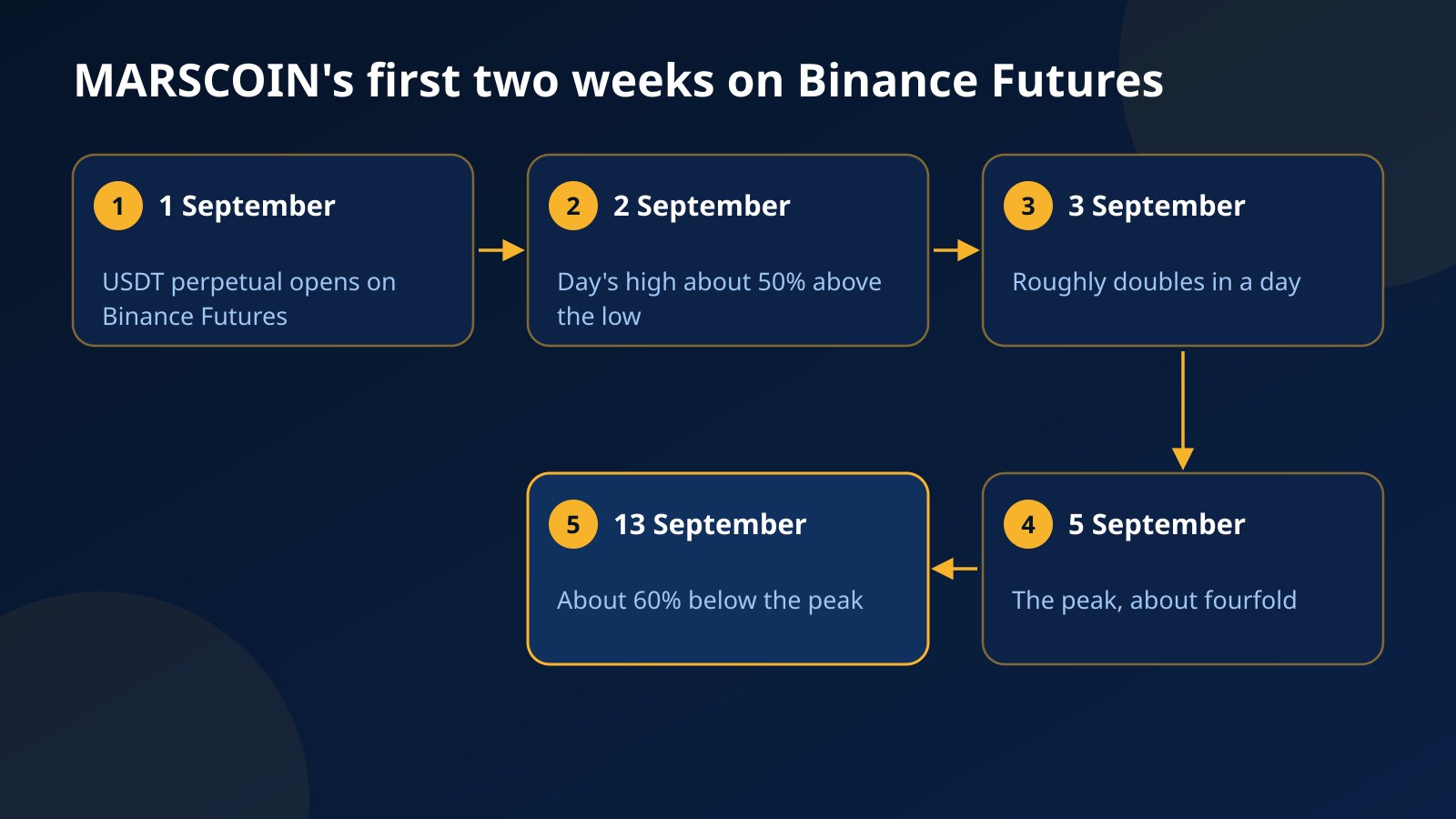
MARSCOIN is a BNB Chain meme coin. Its USDT perpetual opened on Binance Futures on 1 September 2026, and Binance spot trading followed on 4 September. On Binance Futures daily candles (UTC), its first two weeks looked like this:
- 2 September, its first full day: the day’s high was about 50% above the day’s low.
- 3 September: the price roughly doubled in one day.
- 5 September: it peaked at about four times its level on the first day.
- 13 September: it was about 60% below that peak.
In position terms, a long opened at the 5 September peak and held to 13 September would have lost about 60% of its value, which is about $600 on a $1,000 position. Traders did not stay away. Among Fundex24 challenge and funded accounts, MARSCOIN ranked fifth among meme coins by the number of accounts that traded it between 14 August and 13 September 2026, and 82% of its trades were shorts.
The prop challenge in plain words
If you arrived here from a coin search, here is the short version. A prop challenge is a paid trading test: you pay a one-time fee, $29 for a $3,000 account, $59 for $6,000 or $89 for $10,000, and trade that account under fixed rules. Reach 10% profit in stage 1 and 8% in stage 2, with at least 5 trading days in each and no time limit, without breaking the loss limits, and you can request a funded account that pays you 80% of the profit you withdraw.
The fee is the most you can lose on one challenge and is not refunded if you fail. Funded accounts at Fundex24 are simulated accounts for evaluation. Every market can be traded long or short, MARSCOIN included, with leverage up to 1:10 and isolated margin only. The structure is covered in the two-step challenge explained in full.
How the challenge rules hit a new listing
Take a $10,000 account. The rules are identical on every market, but on a coin like MARSCOIN in early September each one comes into play faster. The complete conditions are on the Fundex24 rules page.
Create your Fundex24 account
Takes a few seconds. You can pick a challenge and add your phone number later.
Equity-based drawdown during wicks
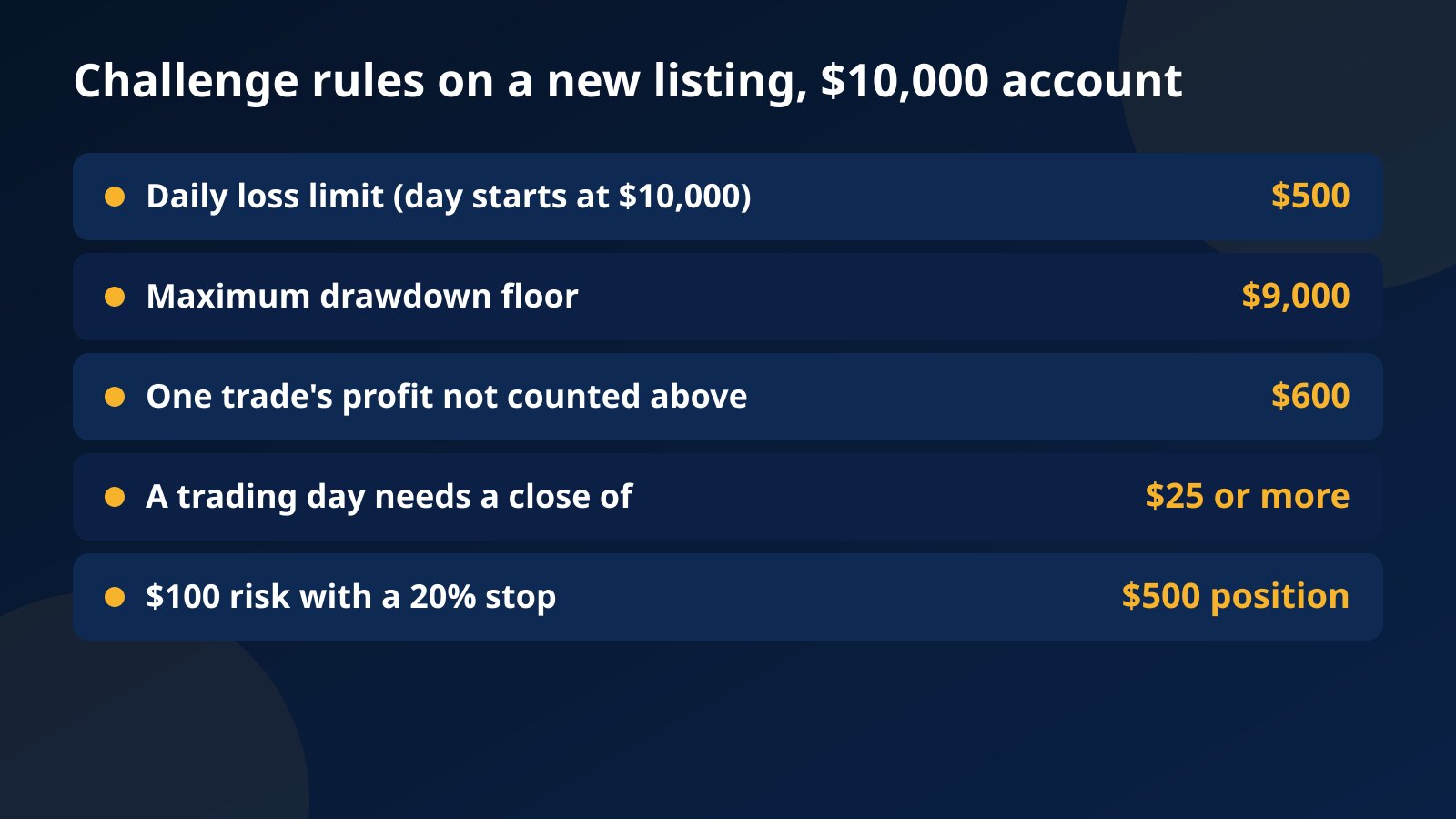
The daily drawdown is 5% of the day’s starting balance, $500 on a day that starts at $10,000, and the maximum drawdown is a fixed floor at $9,000. Both watch equity as well as balance, so a floating loss that touches either limit breaks the rule, even for a moment and even if the price comes back. Inside a day like 2 September, a $2,500 short caught by a 20% spike would show a $500 floating loss and close the account on the spot. The difference between the two limits is worth knowing before any listing.
Size by stop distance, not by conviction
Decide the dollar risk first, then divide it by the stop distance. With $100 of risk, 1% of the account, a 20% stop gives a $500 position and a 10% stop a $1,000 position. A 3% stop on a coin whose daily range reached 50% sits inside ordinary noise, so a tight stop does not make the trade safer; it only makes the stop more likely to be hit.
The high-risk trade rule and pumps
In the challenge stages, a single position that makes more than 60% of the stage’s profit target is treated as high risk, and its profit is not counted. On a $10,000 stage 1 that line is $600. A $1,000 long that caught the 3 September doubling would have made about $1,000, none of it counted toward the target, while a $500 long would have made about $500 and counted in full.
The trading-day threshold
A trading day only counts when you open a position and close it with a profit or loss of at least 0.25% of the initial balance, $25 on $10,000. Smaller positions push that threshold further out: on a $500 position the close needs a 5% move to count. That is easy to reach on a new listing, but a trade scratched near break-even adds nothing.
A practical approach for the first days
None of this puts new listings off limits. It means the first days call for a different routine from the one you would use on DOGE:
- Wait for a range. Let the first sessions print a high and a low before you trade, so the stop has a real level to sit behind.
- Trade smaller. Cut the dollar risk, for example to 0.5% or $50, until the coin has a few weeks of history.
- Use wider stops. Put the stop beyond the wicks of the last few days, then size the position from that distance.
- Keep both directions open. Longs and shorts are both allowed, so a pump that fails is as much a setup as a breakout that holds.
- Skip the first big candle. Entering after a doubling leaves the stop either very far away or nowhere sensible.
- Cap your open risk. Two positions on new meme coins can fail in the same sell-off, so count them as one bet.
Listing announcements are news, and news trading is allowed, but the limits do not loosen after a headline. You can open the MARSCOIN/USDT chart and replay its first two weeks against these steps before you try them on the next listing. Stop placement and correlated positions are covered in meme coin risk management for challenges.
Shorting a new listing: the risk that is easy to forget
Most MARSCOIN trades on Fundex24 accounts in the period were shorts, and across all meme coins about two thirds of trades were. That describes what traders did, not whether it worked, and a pump against a short on a young coin can be violent.
Look at 3 September again. A short with no stop through a day that doubles loses its whole position value: a $1,000 short would have been down about $1,000, twice the $500 daily limit, so the account would have closed well before the candle finished. With a $500 position and a stop 15% above the entry, the same idea had a planned loss of $75.
Hedging, a long and a short on the same pair at the same time, is allowed, but it freezes a floating loss rather than removing it. Both directions are worked through in long and short on meme coins, and the short share of each coin is in the September meme coin trading report.
Newly listed meme coins are highly volatile, and on a fresh listing one candle can reach a daily loss limit. A challenge can fail on a single bad day; funded accounts at Fundex24 are simulated for evaluation, and no earnings are promised.
Pick a challenge and start trading
Two-step evaluation, transparent rules, profit split up to 80%.
Not sure which size fits? Read the rules · Common questions
Frequently asked questions
Can I trade MARSCOIN in a Fundex24 challenge?
Yes. It is in the Meme category and the market search, and you can trade it long or short on challenge, funded and practice accounts.
Are the rules stricter for new listings?
No. The drawdown limits, the high-risk trade rule and the trading day definition are the same on every market; a new listing simply reaches them faster.
What does Binance’s Seed Tag mean?
It is Binance’s label for early-stage tokens that carry higher risk. MARSCOIN is one of the tokens marked with it.
Do I have to wait before trading a new listing?
No, nothing stops you trading on the first day. Waiting for a first range is a habit that gives the stop a real level, and the limits apply from the first candle either way.
Can one big pump pass stage 1 for me?
Not if a single position makes more than 60% of the stage target, which is $600 on a $10,000 stage 1. That trade’s profit is not counted, so a planned take profit works better than riding the pump.
Questions about the Fundex24 challenges?
Open the support chat and ask — the team replies right there.
Chat with supportPrefer to read first? Browse the FAQ · Compare the challenges
Continue your learning path
Move from this article to the next useful action or topic.