


Hong Kong stocks, priced in USDT
Xiaomi stock is not listed on a US exchange. The shares trade in Hong Kong under the code 1810, priced in Hong Kong dollars: about HK$25, or roughly US$3.20, at the time of writing (mid-October 2026). You can buy them through a broker with Hong Kong access, or trade the price with HK1810, a USDT contract that follows 1810 and never closes. This guide covers both routes, explains why the contract reads 24.8 rather than 3.2, and sizes a Xiaomi trade on a $3,000 challenge account.
Is Xiaomi stock on the US market? Where the shares really trade
Xiaomi listed on the Hong Kong Stock Exchange (HKEX) on July 9, 2018, at HK$17 a share, the first company under Hong Kong’s weighted-voting-rights rules. Its code is 1810, also written 01810 or 1810.HK, and the shares you can buy are Class B shares with one vote each.
The company is best known for phones, smart-home gadgets and, since 2024, electric cars such as the SU7 sedan and the YU7 SUV. On HKEX it trades in board lots of 200 shares, so the smallest standard order at around HK$25 is about HK$5,000, a little over US$600.
Buying the real shares from the US takes a broker with Hong Kong market access, and not every app has it. Some US brokers also quote XIACY, an unsponsored ADR traded over the counter: a depositary bank created it without Xiaomi taking part, each ADR stands for a bundle of 1810 shares, and OTC lines can trade thinly.
Either way, that is investing. The rest of this guide is about trading Xiaomi’s price with a contract, long or short, for hours or days.
Xiaomi stock price in USD: the one conversion you need
Hong Kong quotes are in Hong Kong dollars, a currency pegged to the US dollar: the Hong Kong Monetary Authority keeps it inside a band of HK$7.75 to HK$7.85 per US dollar, so dividing by 7.8 lands within 1% of the true dollar price. At HK$24.83, its October 13 price, Xiaomi is worth about US$3.18 a share.
For a trader the conversion matters less than it looks: a move from HK$24 to HK$26 is 8.3% in either currency, and percentages decide profit and loss. It also explains what puzzles most first-time viewers of the HK1810 chart: the contract trades at about 24.8, not 3.2.
HK1810: a contract that reads Hong Kong dollars as USDT
Binance listed HK1810USDT on July 22, 2026, as a quanto perpetual. Quanto means the contract takes the HKEX price in Hong Kong dollars and treats the same number as USDT, with no currency conversion. When 1810 trades at HK$24.83, the contract sits near 24.83 USDT.
Nothing about the percentages changes. Say you open a $1,000 long at 24.83, the October 13 level: the order form turns that into about 40.3 units of HK1810. If Xiaomi rises to HK$26.07, a 5% move, each unit gains 1.24 USDT and the position makes about $50. A 5% drop costs the same $50, and the exchange rate never enters the sum.
Be clear about what you hold. HK1810 is not a Xiaomi share: no ownership, no vote, no dividend, and Xiaomi does not issue or sponsor it. It is a perpetual futures contract with no expiry, so a short is as easy as a long, and like any leveraged product it can lose money fast.
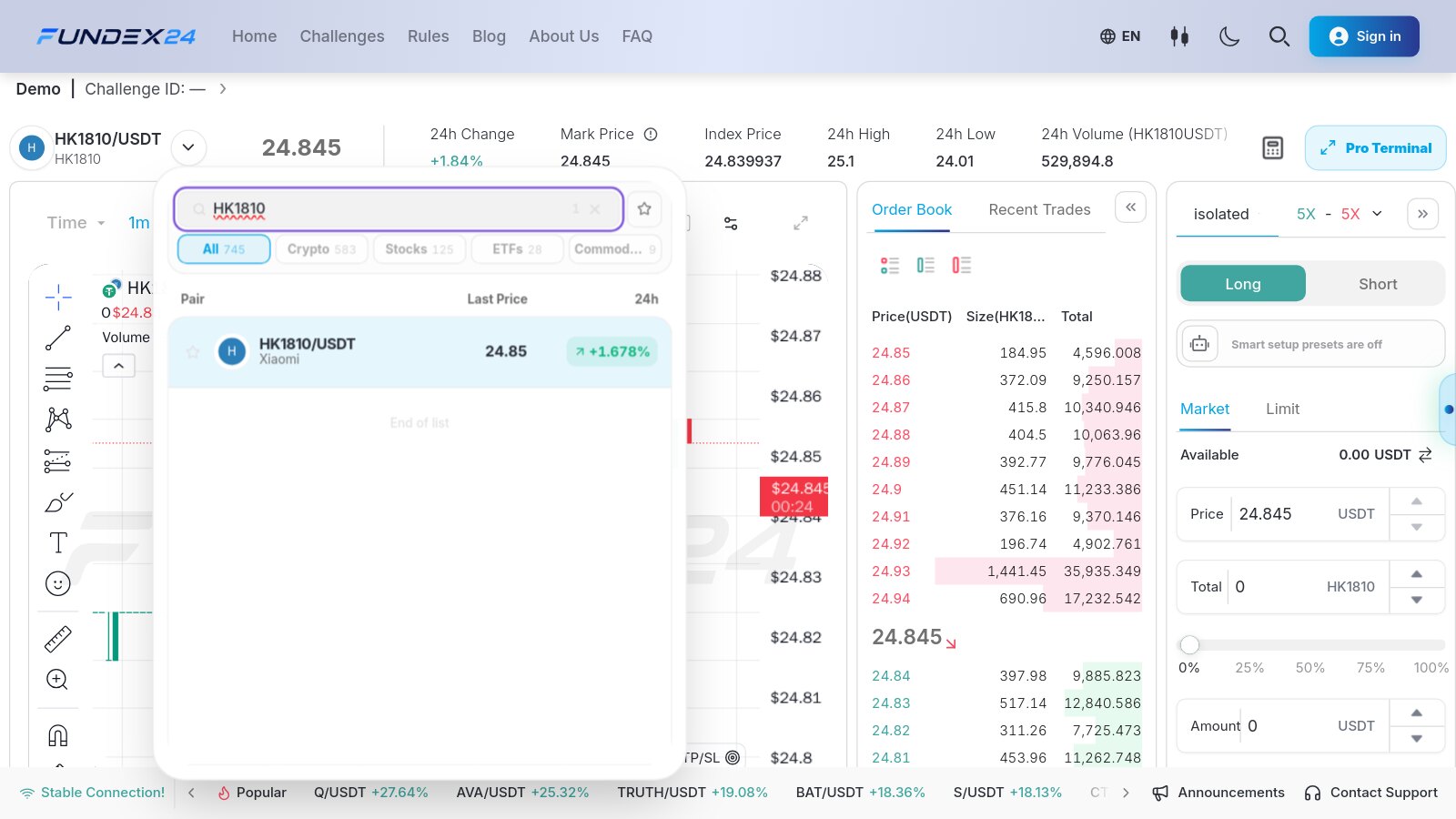
On Fundex24 it sits in the trade page’s market list under Stocks; search HK1810 or simply Xiaomi. Prices follow Binance futures, the browser terminal is the one used for crypto pairs, and leverage goes up to 1:10.
New to stock contracts? Start with our overview of stocks and gold on one prop account.
Hong Kong hours vs a contract that never closes
HKEX runs a pre-opening auction from 9:00 to 9:30 a.m. Hong Kong time, continuous trading until noon, a lunch break for ordinary stocks such as Xiaomi from noon to 1 p.m., an afternoon session from 1 to 4 p.m., and a closing auction that ends a few minutes after 4. There is no trading on weekends or Hong Kong public holidays, which are listed on the HKEX website.
Create your Fundex24 account
Takes a few seconds. You can pick a challenge and add your phone number later.
In New York terms, Hong Kong opens at 9:30 p.m. Eastern the evening before while daylight saving time is on, 8:30 p.m. after clocks fall back in November, and closes at 4 a.m. (3 a.m. in winter).
HK1810 trades around the clock, but while Hong Kong is closed there is no live share price for it to react to. We measured its average one-hour move on Binance over the 30 days to October 13, 2026:
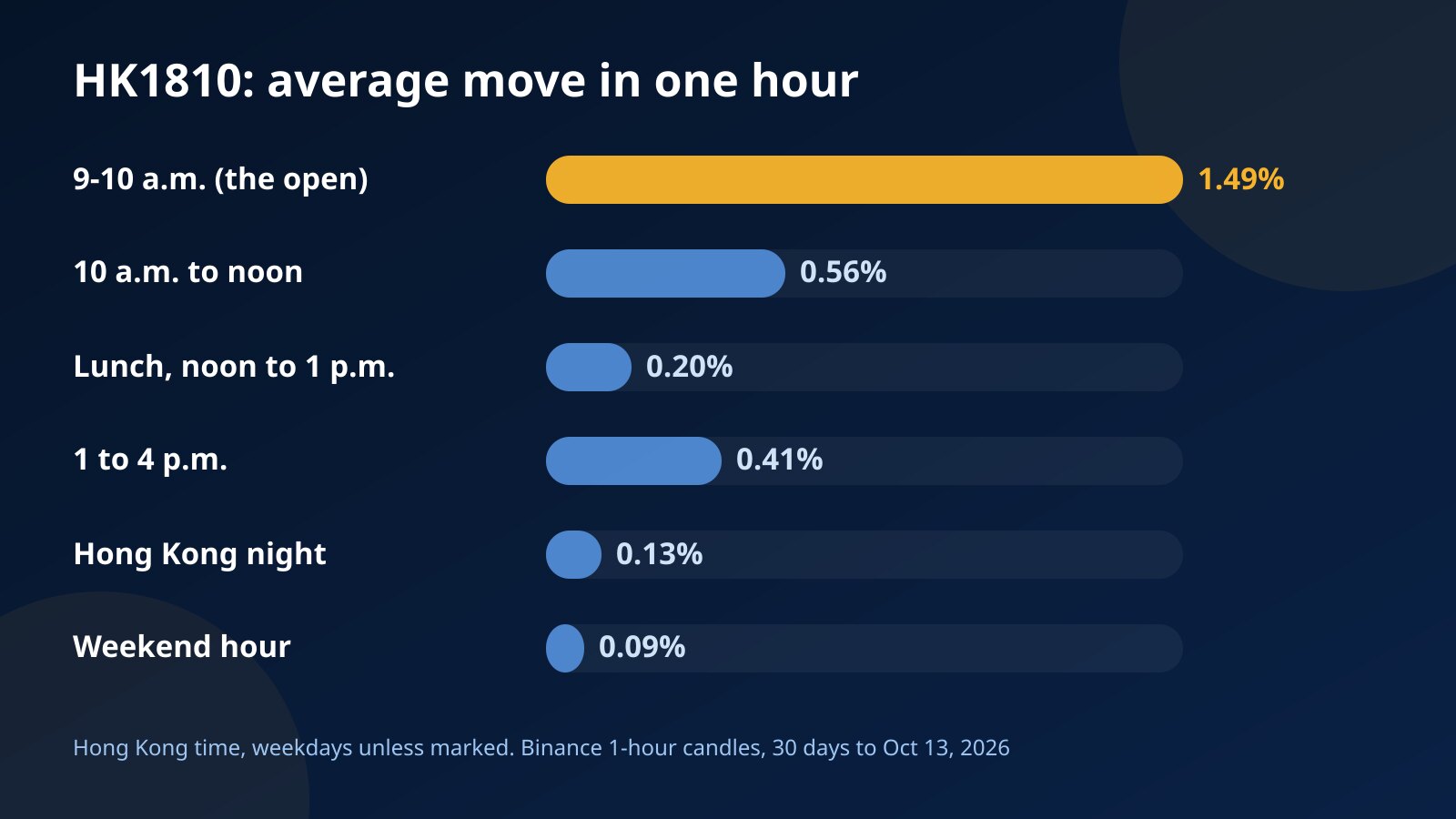
The opening hour, 9 to 10 a.m., moved 1.5% on average; a Hong Kong night hour moved 0.13% and the lunch hour 0.2%. The six trading hours of each Hong Kong weekday carried more than half of the contract’s movement, in under a fifth of the week’s hours.
The weekend is quiet, Monday is not
Over the last 60 days HK1810’s average daily range was 4.3% on weekdays and 1.2% on weekends. The calm does not last: by 11 a.m. Hong Kong time on Monday, the contract was more than 2% away from Friday’s Hong Kong close on six of the last nine Mondays, and 3.5% lower on October 12.
A stop that sat safely through a sleepy weekend can be crossed in Monday’s first hour, and in a fast move it can fill beyond its level. Hold HK1810 over a weekend only at a size that can take a few percent against you at the open.
From 33 to 23: what HK1810 has done since July
The contract opened at 27.45 on July 22. It climbed to 33.34 on July 30, the day after a gain of almost 9%, then gave back 8.5% on July 31, its worst day so far. From there it drifted lower for more than two months to 23.20 on October 8, about 30% under the July high. It ended the 30 days to October 13 down 5.8%, at 24.83.
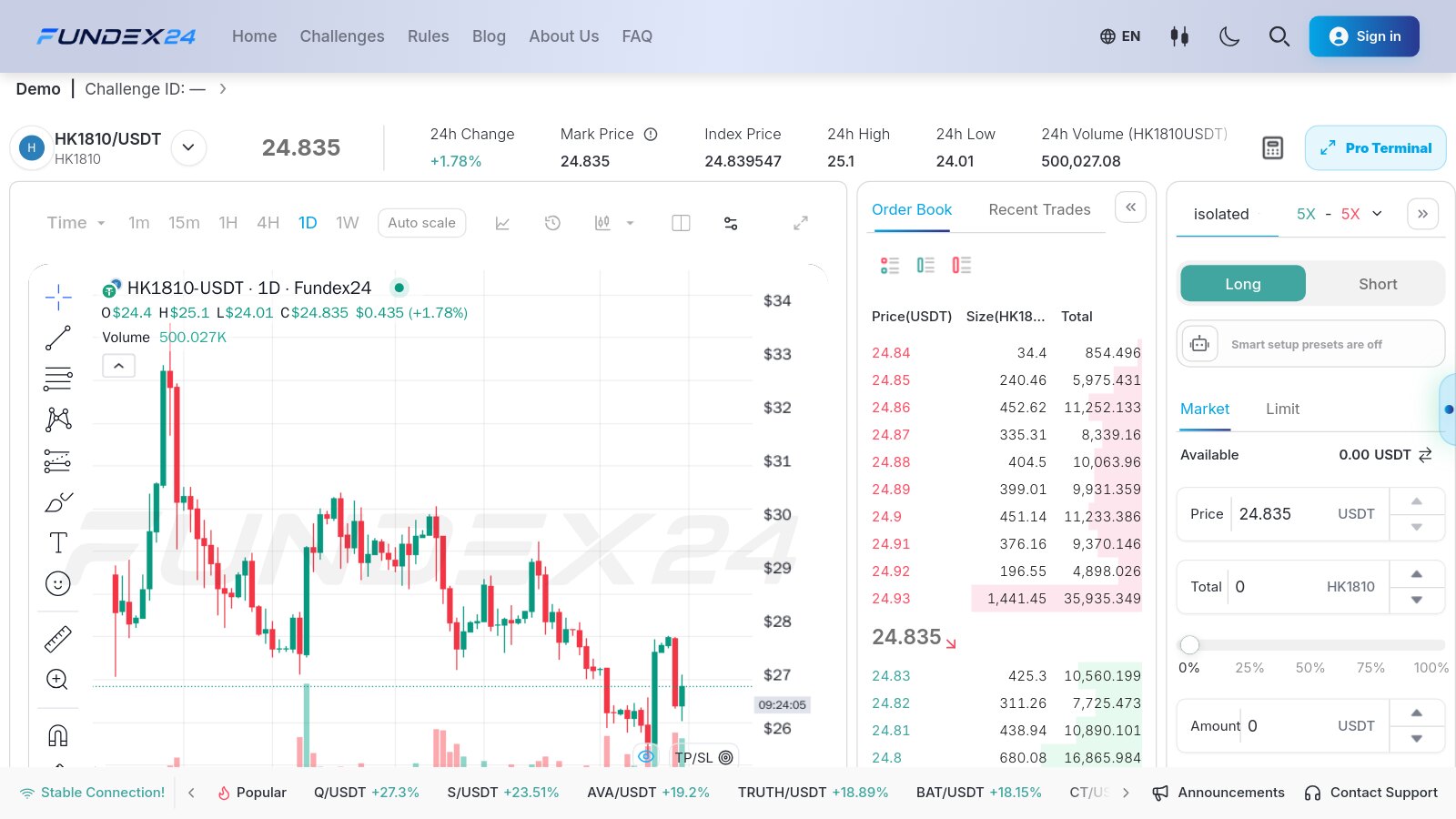
The slide was not a straight line. On August 19 the contract closed 9.7% higher, its best day, and on October 9 it bounced 9% off the low before losing 6.1% on October 12. Over 60 days the average low-to-high range was 3.4% and the widest day 10.3%; only 2 days topped 10%, but 13 topped 5%.
We will not guess why it fell or where it goes next. What the numbers give you is the size of an ordinary day, and that is what your position has to survive.
How big an HK1810 trade a $3,000 challenge can carry
The $3,000 challenge has a daily loss limit of $150 and a maximum loss of $300, both measured on equity, so an open loss counts the moment it appears. The Step 1 target is $300.
Start with the trap. The trade page opens with 5x leverage preselected. Put the whole $3,000 behind a 5x Xiaomi long and you hold a $15,000 position, on which a 1% move costs $150. An average opening hour in Hong Kong moves more than that, and your day is over.
Now a size built from Xiaomi’s real ranges. Risk $45, which is 1.5% of the account. Set the stop 4.5% from entry, just outside the 4.3% range of an average weekday. Divide the risk by the stop distance and you get a $1,000 position, about 40 units at 24.83, which needs $100 of margin at 1:10 or $200 at the default 5x.
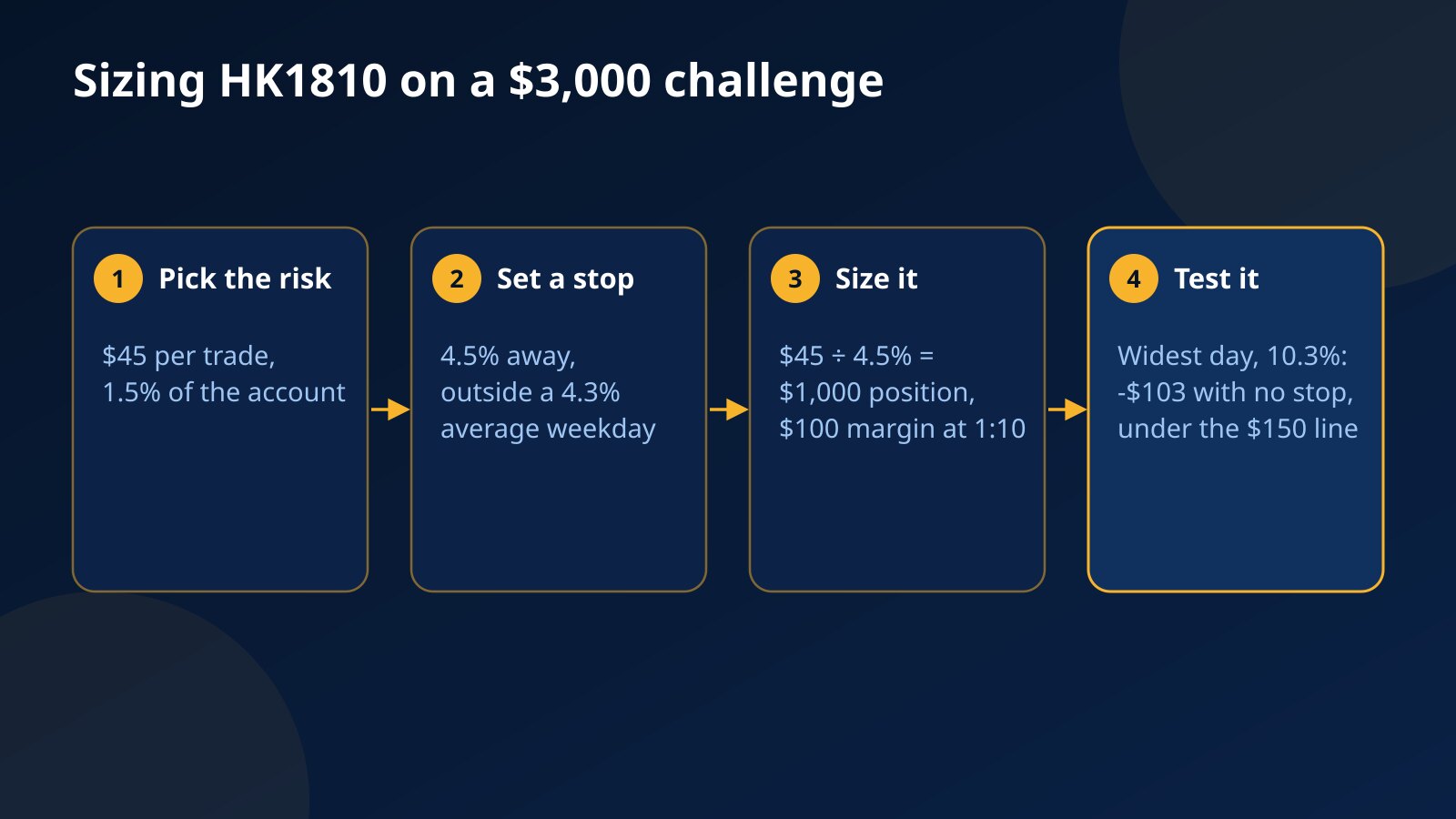
Run the bad days through it. The widest day of the last 60 (10.3%) would cost $103 with no stop at all, $47 short of the daily line. The 8.5% drop of July 31 would cost $85, and a Monday open 3.5% against you costs $35, inside the stop. Double the size and that 10.3% day costs $206, past the line. Our guide on how much to risk per trade explains why one such position at a time is plenty.
The upside is slow by design: a 5% move in your favor makes $50, so Step 1 takes several good trades. That suits the rules. A single trade that makes 60% or more of the stage target ($180 in Step 1) does not count toward it, and at $1,000 Xiaomi would need an 18% move to get there. Profit from trades held under 5 minutes is not counted either; it is not a violation, it just adds nothing.
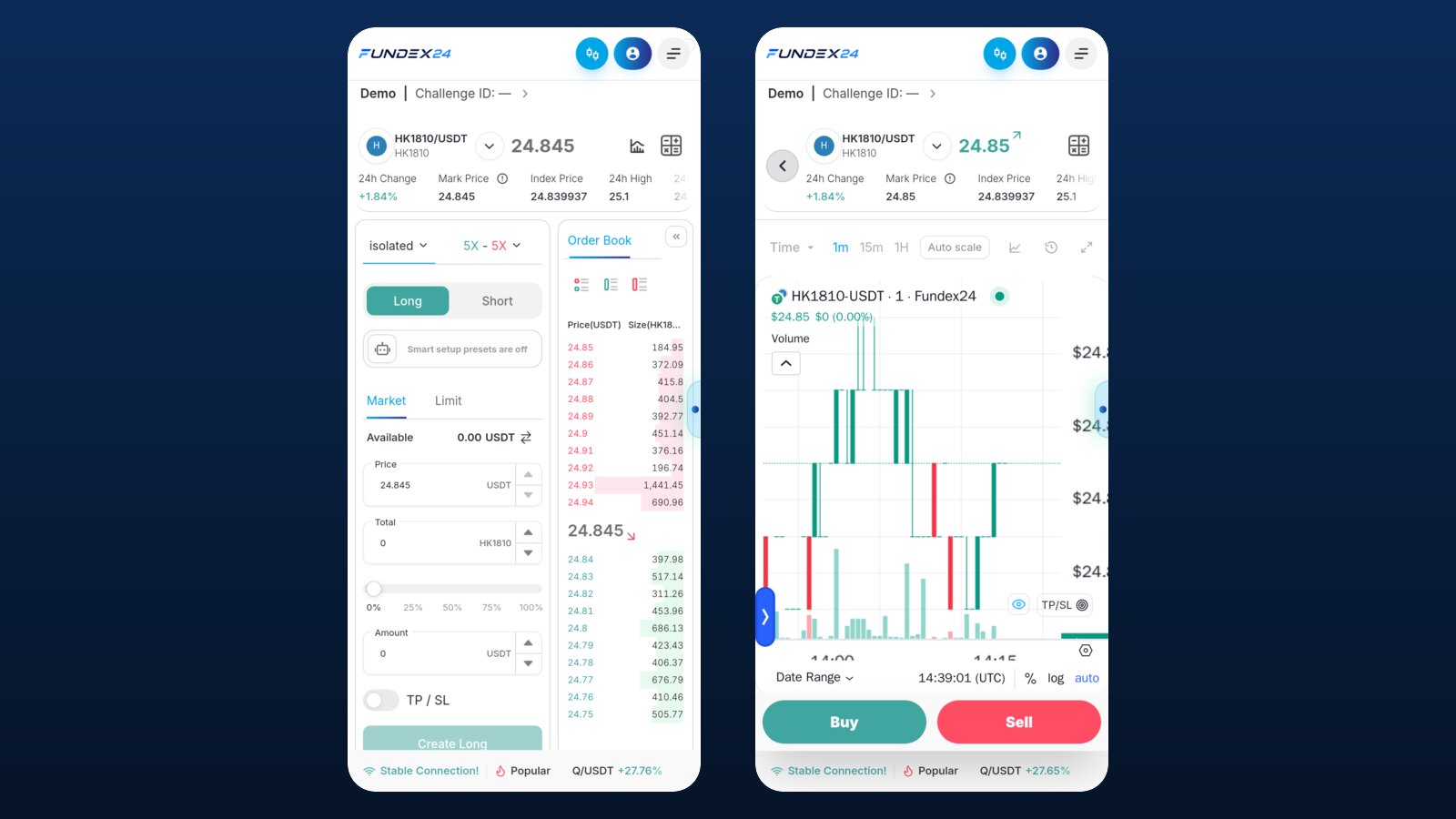
Watch the live HK1810/USDT chart through one Hong Kong morning first, and read daily drawdown vs max loss for how the two limits interact.
Pick a challenge and start trading
Two-step evaluation, transparent rules, profit split up to 80%.
Not sure which size fits? Read the rules · Common questions
Rehearse a Hong Kong morning before paying $29
Test all of this for free first. Create a Fundex24 account and open a practice account with $10,000 of virtual money and leverage up to 1:10 for 3 days. Sit through one Hong Kong open, size a position the way shown above, drag a stop onto the chart and watch how far 1810 travels before midnight Eastern.
When you want rules that count, the $3,000 challenge costs $29, or $26.10 with the blog code PROPOFF10. There are two steps, a 10% target and then an 8% target, with at least 5 valid trading days in each and no time limit. Sizes and fees are on the challenge plans page, and every limit is spelled out on the Fundex24 rules page.
Most people who buy a challenge do not pass it, and the fee is not refunded when you fail. Funded accounts are simulated accounts used for evaluation, with an 80% profit split for traders who reach them, and nothing here is a promise of income. Check the rules that apply where you live, and spend only what you can afford to lose.
Xiaomi stock: quick answers
Is Xiaomi stock listed in the US?
No. Xiaomi’s shares are listed on the Hong Kong Stock Exchange and trade during Hong Kong hours. The closest thing in the US is XIACY, an unsponsored ADR quoted over the counter.
Xiaomi ticker: is it 1810 or XIACY?
On HKEX the code is 1810, also shown as 01810 or 1810.HK; the over-the-counter ADR in the US uses XIACY; and the contract that follows the share price is HK1810/USDT.
Why does HK1810 show about 24.8 instead of about $3?
It is a quanto contract, so it takes Xiaomi’s price in Hong Kong dollars and reads the same number in USDT. A 1% move in the stock is still a 1% move on the contract, so the position math works as usual.
Does the HK1810 contract pay Xiaomi dividends?
No. It is a perpetual contract, not a share, so it carries no dividend, no voting right and no claim on the company. It only tracks the price.
When does HK1810 move the most?
The hour after the Hong Kong open, 9 to 10 a.m. local time, averaged a 1.5% move in our 30-day sample. Nights and weekends are far calmer, so Monday mornings can catch a stop off guard.
Questions about the Fundex24 challenges?
Open the support chat and ask — the team replies right there.
Chat with supportPrefer to read first? Browse the FAQ · Compare the challenges
Continue your learning path
Move from this article to the next useful action or topic.