


Buyer’s maths
A prop firm Black Friday discount is only a bargain if the challenge underneath is one you can realistically pass. Before you compare sale banners, work out three numbers: what you pay per $1,000 of account, what a failed attempt really costs, and which rules are most likely to end your run. One thing up front: Fundex24 has no Black Friday offer. Its blog code PROPOFF10 already takes 10% off the $3,000, $6,000 and $10,000 challenges, with no end date.
Black Friday 2026: the date, and what you’re really comparing
Black Friday falls on 27 November 2026, the day after US Thanksgiving, with Cyber Monday on 30 November. If you’re typing “prop firm Black Friday” into Google, you’re probably lining up several sale pages side by side, and every one of them leads with a percentage.
The percentage is the least useful number on the page. A challenge fee doesn’t buy you anything you keep. It’s the entry price for a test, and what you’re really paying for is a chance of passing that test. A discount changes the price of each attempt. It never changes the odds. Two challenges with the same sale price can end up costing you very different amounts once you count how many attempts each one tends to take.
Number one: what you pay per $1,000 of account
Put every offer on the same scale first: divide the fee you’d actually pay by the account size in thousands. At Fundex24’s list prices the $3,000 challenge costs $29, or $9.67 per $1,000. The $6,000 costs $59 ($9.83), the $10,000 costs $89 ($8.90) and the $20,000 costs $159 ($7.95). A $50,000 plan is listed at $259 but marked coming soon, so you can’t buy it yet.
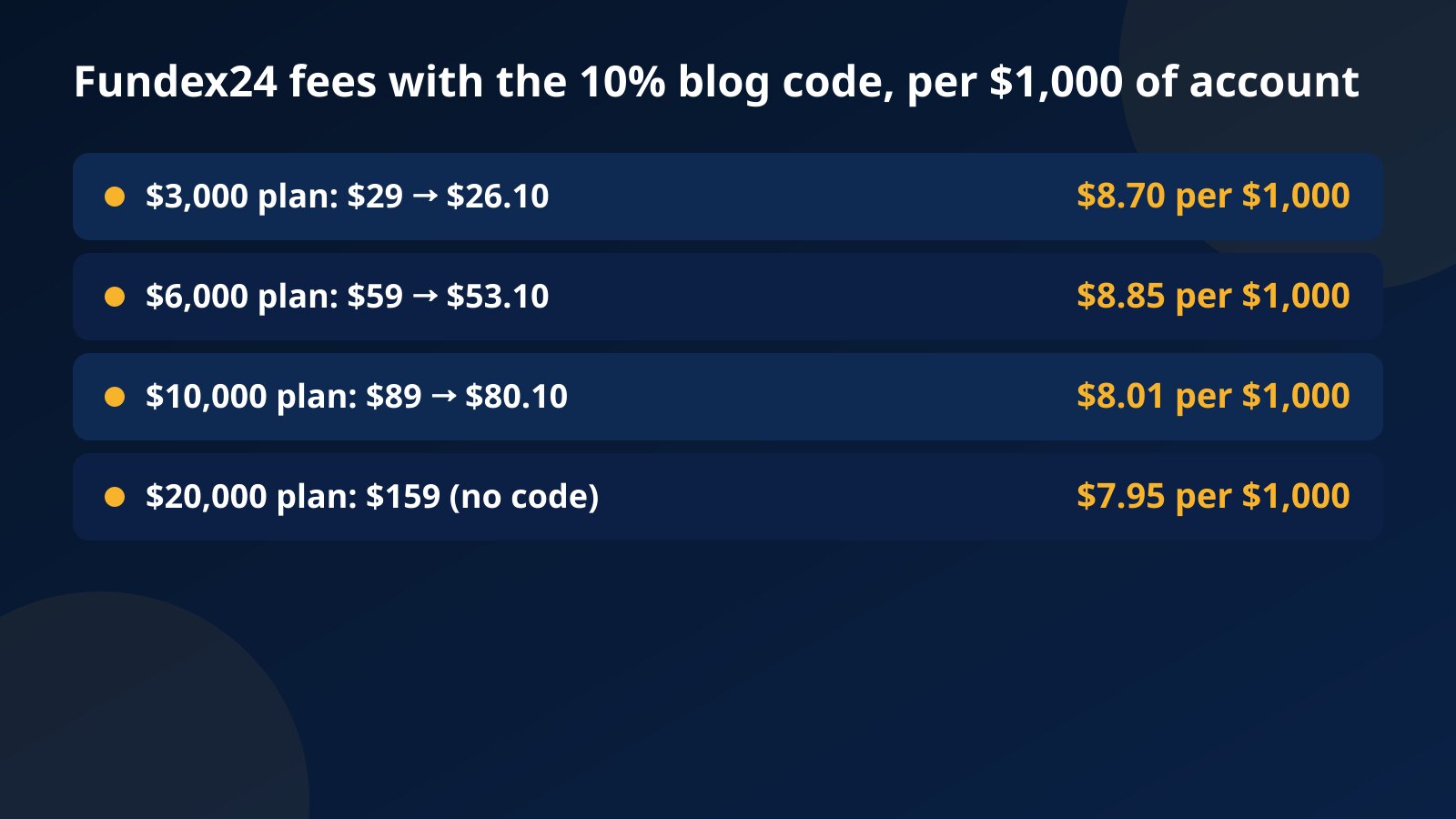
Bigger accounts are cheaper per $1,000, but that’s a poor reason to size up. A larger account has larger dollar limits, and you’ll have to trade it at a size that respects them. Choose the plan whose daily loss limit in dollars ($150 on $3,000, $500 on $10,000) fits the way you already trade, and only then look at the price. Our breakdown of what a prop challenge costs covers the sizes in more depth.
Number two: the cost of a fail, and how many retries a discount buys
Most challenge accounts fail. On Fundex24’s paid challenge accounts over the last 120 days, most of those failures came in Step 1, before the trader ever saw the second target. So the honest price of a challenge isn’t the fee. It’s the fee multiplied by the number of attempts you’re likely to need.
The arithmetic is short: expected spend = fee ÷ your chance of passing a single attempt. If you’d get through one attempt in three, a $26.10 challenge costs you about $78 on average before you pass. A discount shrinks that figure in proportion. Anything that changes your odds moves it far more.
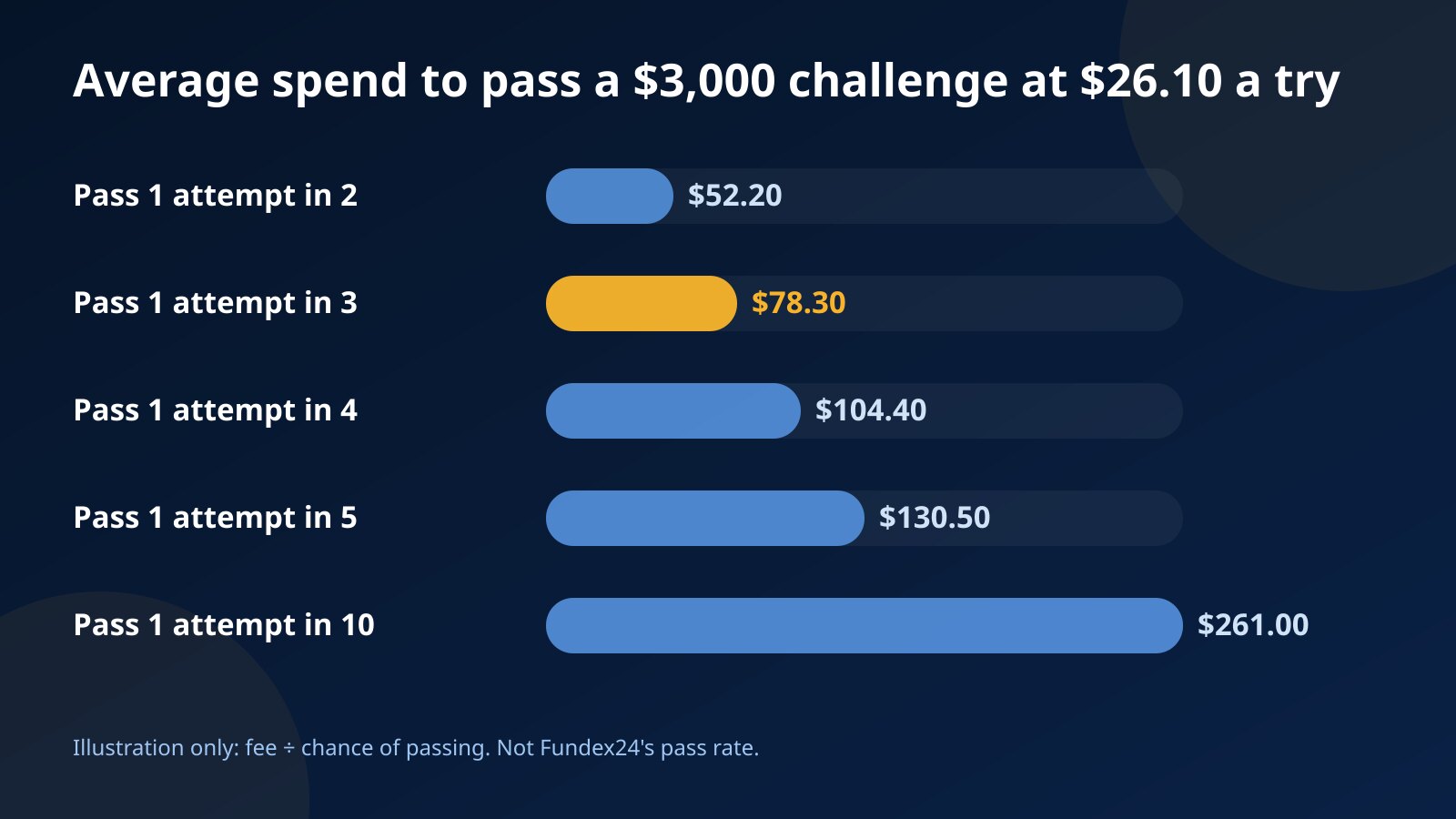
Seen this way, a 10% code on a $29 fee saves $2.90 an attempt. Ten attempts at $26.10 cost $261 instead of $290, so the code pays for roughly one extra try in ten. The same logic applies to any bigger percentage you see this November: it’s worth exactly what it saves on the attempts you’ll actually buy, and nothing at all if the rules underneath double the number of attempts.
Number three: the rules that make a cheap challenge expensive
The fee is printed in large type. The rules that set your odds sit further down the page, and they’re where a cheap challenge turns into an expensive one. Six questions cover most of it, and they fall into three pairs.
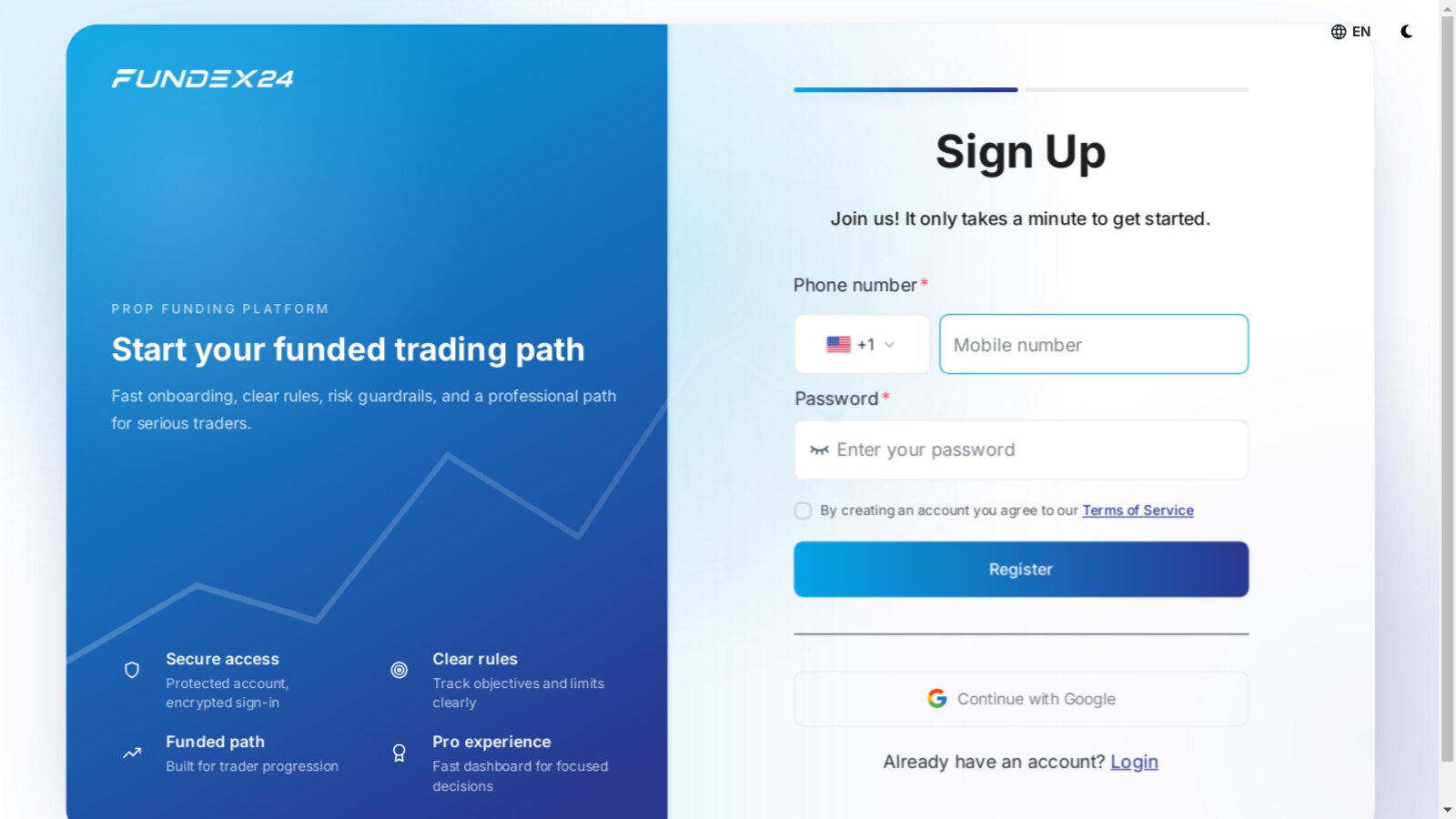
Create your Fundex24 account
Takes a few seconds. You can pick a challenge and add your phone number later.
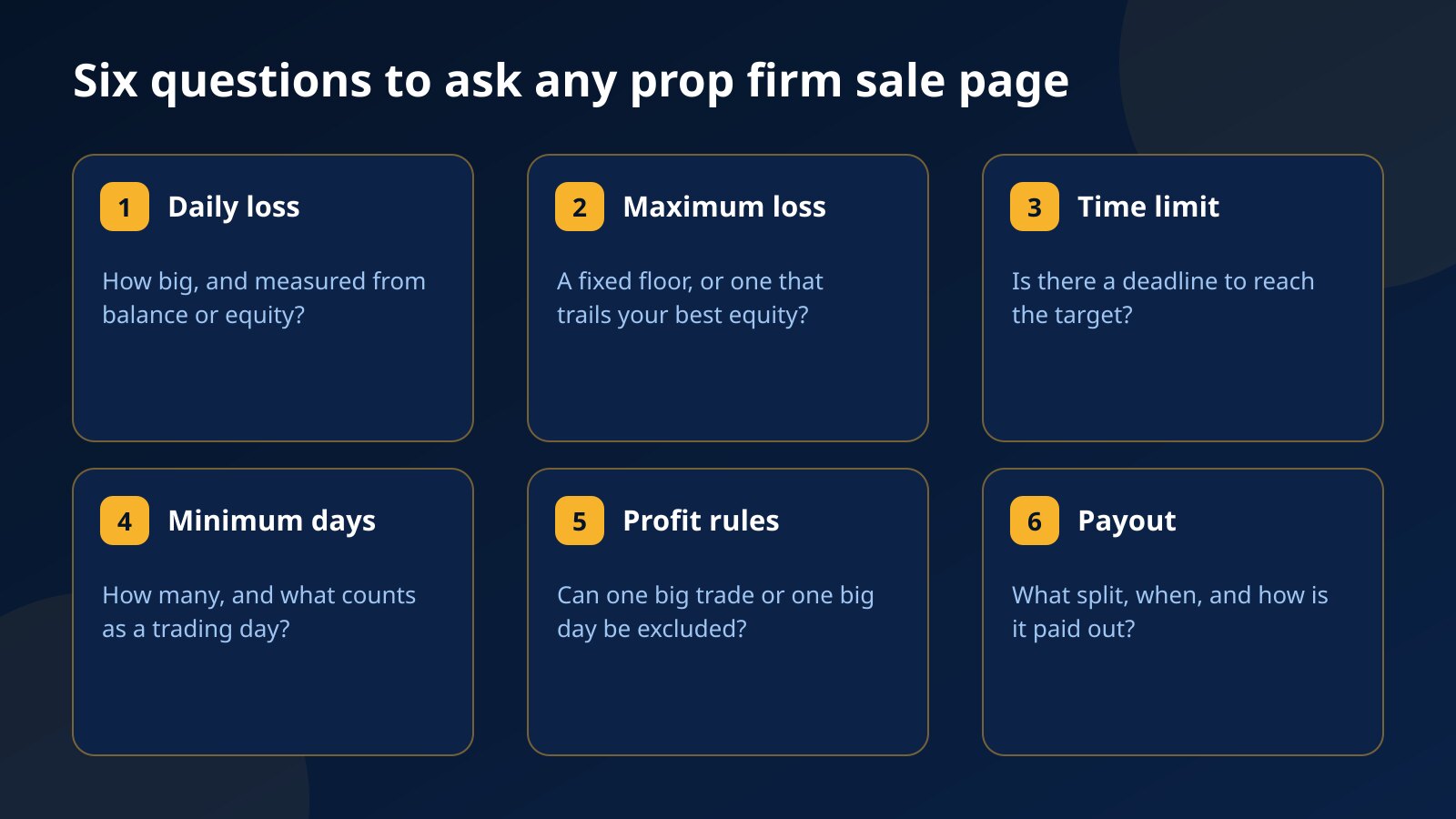
- Daily and maximum loss. Ask what the daily limit is measured from: the day’s starting equity counts open profit you give back as a loss, the closed balance doesn’t. Then ask whether the maximum loss is a fixed floor or trails your best equity upwards, which can leave you with less room after a good week.
- Time limit and minimum days. A 30-day target deadline turns a slow fortnight into a forced gamble in the last week. Check, too, what counts as a trading day.
- Profit rules and payout. Find out whether one big trade or one big day can be excluded, what the split is, and how the money actually reaches you.
For comparison, here is how Fundex24’s rulebook answers them. Daily loss is 5% and maximum loss 10% of the stage’s starting balance, and the maximum loss is a fixed floor: $2,700 on a $3,000 account. Since 16 October 2026 each day starts from the account’s closed balance at the daily reset, so profit that was still open at the reset and later fades no longer counts as a daily loss; a loss still open at the reset does count against the new day.
There’s no deadline for the 10% and 8% targets, just at least five valid trading days per step. A single trade that makes 60% or more of the stage’s target doesn’t count toward it, and neither does profit from a position held under five minutes. Funded accounts, which are simulated, pay an 80% split. Our pre-purchase checklist goes through each point.
A $26.10 challenge, traded on SOL: the numbers
Here is what the cheapest Fundex24 route looks like once you start trading. The $3,000 challenge with the code costs $26.10, which is also the most you can lose on it. The account has a $150 daily loss limit, a $2,700 floor and a $300 Step 1 target.
- Risk per trade: $30, or 1% of the account. Five full losers plus trading costs would take you through the daily line, so a sensible personal rule is to stop after three.
- Stop distance: SOL’s average daily range over the last 60 days was 5.4%. A stop 2.5% from entry sits inside an ordinary day without being hair-trigger.
- Position size: $30 ÷ 2.5% = $1,200 of SOL. At 1:10 that ties up $120 of margin; at the 5x the trade page preselects, $240.
- The bad day: SOL’s widest day in that period covered 16.9% from low to high (22 August). A $1,200 position caught on the wrong side of a move that size without a stop loses about $203, through the $150 daily line in a single trade. With the stop in place the loss is about $30, plus whatever the price slips past it.
Notice what the target rules do to the “one big trade” plan. On this account any single trade that makes $180 or more, 60% of the $300 target, doesn’t count toward it. Passing takes several ordinary wins over at least five valid trading days, and on $3,000 a valid day needs a closed trade with a net result of at least $7.50, profit or loss. You can check the sizing on the SOL/USDT trade page before you spend anything.
Fundex24’s prices today, and how the code works at checkout
There is no Fundex24 Black Friday price. The discount that does exist is the blog code PROPOFF10: 10% off the $3,000, $6,000 and $10,000 challenges, once per user, which brings them to $26.10, $53.10 and $80.10. It doesn’t apply to the $20,000 plan, and it has no end date. You can compare every plan’s rules on the challenges page.
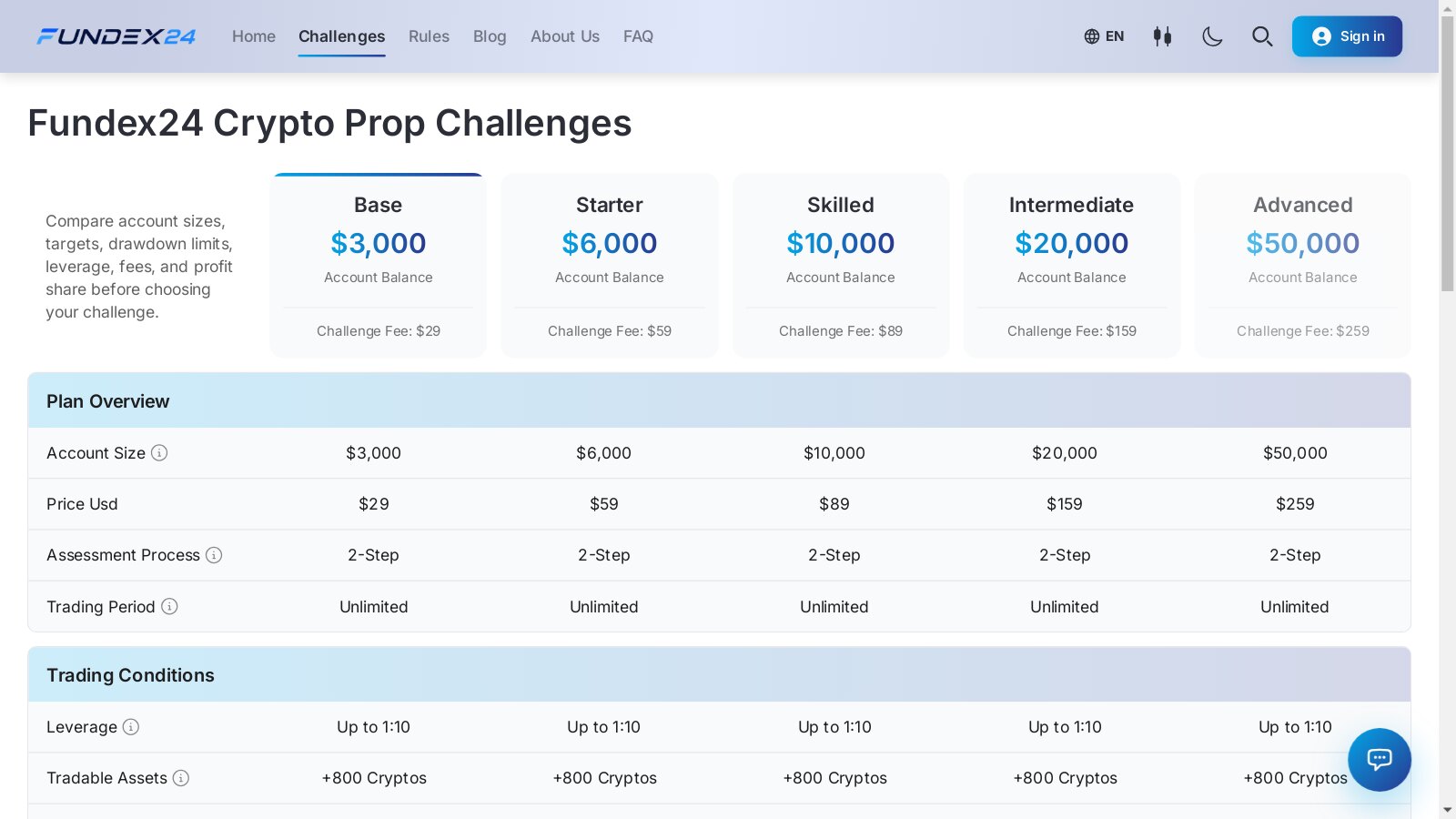
At checkout, type the code into “Have a promo code?” and press Apply before you pay. You pay in USDT on BEP20, TRC20 or ERC20, or from your Fundex24 wallet balance. The checkout asks for the exact plan price in USDT on the network you choose, and most of our buyers pay on BEP20. No identity check is needed to buy. Our guide to the 10% blog code walks through the steps.
One figure from our own checkout is worth knowing before any sale: people who enter a promo code finish paying about twice as often as people who don’t. A code is often what turns a comparison into a purchase. That’s why the decision should rest on the three numbers above, not on the size of the banner.
Before you buy anything: three free days
If you’ve never traded under prop rules, the cheapest attempt is the one you never need to make. Fundex24’s free practice account gives you $10,000 of virtual money for three days, with leverage up to 1:10 and three resets, on the same terminal and the same prices as a challenge. Use it to see how often your normal trading would brush a 5% daily line. It opens once you sign up for free.
If the practice run goes well, a $3,000 challenge at $26.10 caps your downside at the fee. If any rule is unclear, ask in support chat before you pay rather than after.
Risk note: crypto perpetuals are leveraged and can lose money quickly. Most challenge accounts fail, funded accounts on Fundex24 are simulated, and nothing in this article is a promise of income or investment advice.
Pick a challenge and start trading
Two-step evaluation, transparent rules, profit split up to 80%.
Not sure which size fits? Read the rules · Common questions
Prop firm Black Friday: quick answers
Does Fundex24 run a Black Friday sale?
No. The only discount is the blog code, which takes 10% off the $3,000, $6,000 and $10,000 challenges once per user and works today.
When is Black Friday 2026?
Friday, 27 November 2026, the day after US Thanksgiving. Cyber Monday follows on 30 November.
Is a bigger discount always the better deal?
Not necessarily. On average, reaching a funded account costs the fee divided by your chance of passing, so rules that halve your odds cancel out a 50% discount. Compare the daily loss basis, the type of maximum loss and any deadline before the price.
What is the most I can lose on a discounted challenge?
The fee you paid for it, which is $26.10 on the $3,000 plan with the code. Losing trades can fail the challenge account, but they can’t cost you more than that.
Can I use the blog code on the $20,000 plan?
No. It covers the $3,000, $6,000 and $10,000 plans only; the $20,000 plan costs $159.
Which is the cheapest prop firm challenge to start with?
At Fundex24 the $3,000 plan is the lowest fee: $29, or $26.10 with the code. Cheapest per attempt is usually the right start while you learn the rules, even though larger plans cost less per $1,000.
Questions about the Fundex24 challenges?
Open the support chat and ask — the team replies right there.
Chat with supportPrefer to read first? Browse the FAQ · Compare the challenges
Continue your learning path
Move from this article to the next useful action or topic.