


Price vs value
The cheapest meme coins by unit price, such as PEPE, SHIB, BONK and Simon’s Cat (CAT), cost a tiny fraction of a cent, but that does not make them cheap. What a coin is worth is its price multiplied by its supply, and these coins have supplies in the trillions. Below is the arithmetic that shows why “it only has to reach one cent” is the most expensive idea in crypto, and why on a challenge account the price per token stops mattering at all.
Why a coin at $0.000004 is not one of the cheapest meme coins
A coin’s market capitalization is its price times the number of tokens in circulation. That number, not the price on the screen, tells you how much money the market has already put into it, and how much more it would need to go higher.
Take PEPE. All 420.69 trillion tokens were created at launch and all are in circulation. At the time of writing (early October 2026), one PEPE traded around $0.0000043, which puts the whole coin at roughly $1.8 billion. To double, PEPE does not need “just a few more zeros”; it needs about another $1.8 billion of buying. A coin priced at $90 with the same market cap would need exactly the same.
So low unit prices are mostly a choice made at launch. Creators pick enormous supplies because a buyer who holds 20 million tokens feels richer than one who holds 0.02 of something. The feeling is free; the market cap is the bill.
What “one cent” would really take for six low-priced memes
The most common dream in meme coin chats is a coin reaching one cent. Here is what one cent per token means for six popular low-priced coins, using their supplies (rounded):
- Shiba Inu (SHIB): about 589 trillion in circulation, so one cent means a market cap of roughly $5.9 trillion.
- Pepe (PEPE): 420.69 trillion, so about $4.2 trillion.
- Bonk (BONK): close to 100 trillion minted at launch, so a figure on the order of $1 trillion.
- Simon’s Cat (CAT): about 8.1 trillion, so roughly $81 billion.
- Pump.fun (PUMP): 1 trillion in total, so $10 billion if every token is counted.
- Book of Meme (BOME): 69 billion, so about $690 million.
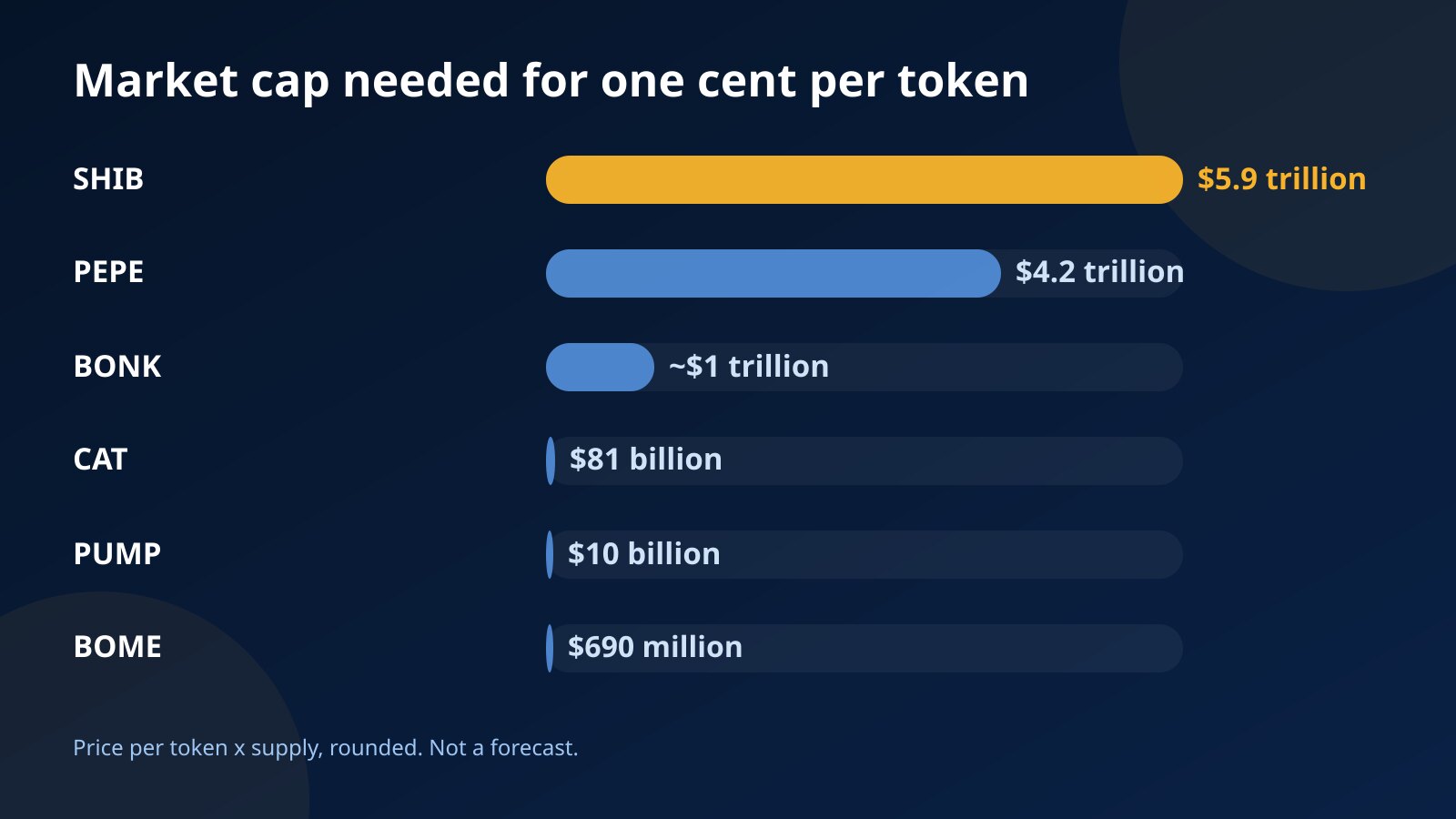
Look at the last two lines together. BOME traded around $0.001 at the time of writing, PUMP around $0.0063. By unit price BOME looks six times cheaper, yet one cent for BOME is a far smaller valuation than one cent for PUMP. The price tag alone told you nothing about which is “cheap”.
None of this predicts where any coin goes. It only shows that “low price, so room to grow” is not an argument. A coin with a small market cap can still lose nearly everything, and a big one can still double.
1000PEPE, 1000SHIB, 1000BONK, 1000CAT: contracts that hide the zeros
On futures markets, prices with eight zeros after the decimal point are hard to read and hard to quote. So the contracts for the smallest coins are listed per thousand tokens. On Fundex24, as on Binance futures, you trade 1000PEPE, 1000SHIB, 1000BONK and 1000CAT.
Create your Fundex24 account
Takes a few seconds. You can pick a challenge and add your phone number later.
The rule is simple: the price you see is the price of 1,000 tokens. At the time of writing 1000PEPE/USDT showed about $0.0043, which is $0.0000043 per PEPE times 1,000. Nothing about the coin changes; only the unit does.
This matters in two places. When you compare the chart with a spot price quoted elsewhere, divide by 1,000 before you panic. And when you read a “target” someone posted, check which unit they meant. A percentage move, on the other hand, is identical in both units: if PEPE rises 12%, 1000PEPE rises 12%. Coins like BOME and PUMP have no prefix because their prices are already large enough to read; you trade them as BOME/USDT and PUMP/USDT.
On a challenge account, only percent move times size counts
Once you trade a contract instead of buying tokens, the unit price disappears from your results completely. Your profit or loss is the percentage move multiplied by the dollar size of your position. Nothing else.
A $500 position in 1000PEPE and a $500 position in Bitcoin both make $50 on a 10% move up and both lose $50 on a 10% move down. The PEPE position holds millions of tokens and the Bitcoin one a sliver of a coin; the account does not care. What differs is how often each coin makes that 10% move, and meme coins make it much more often, in both directions.
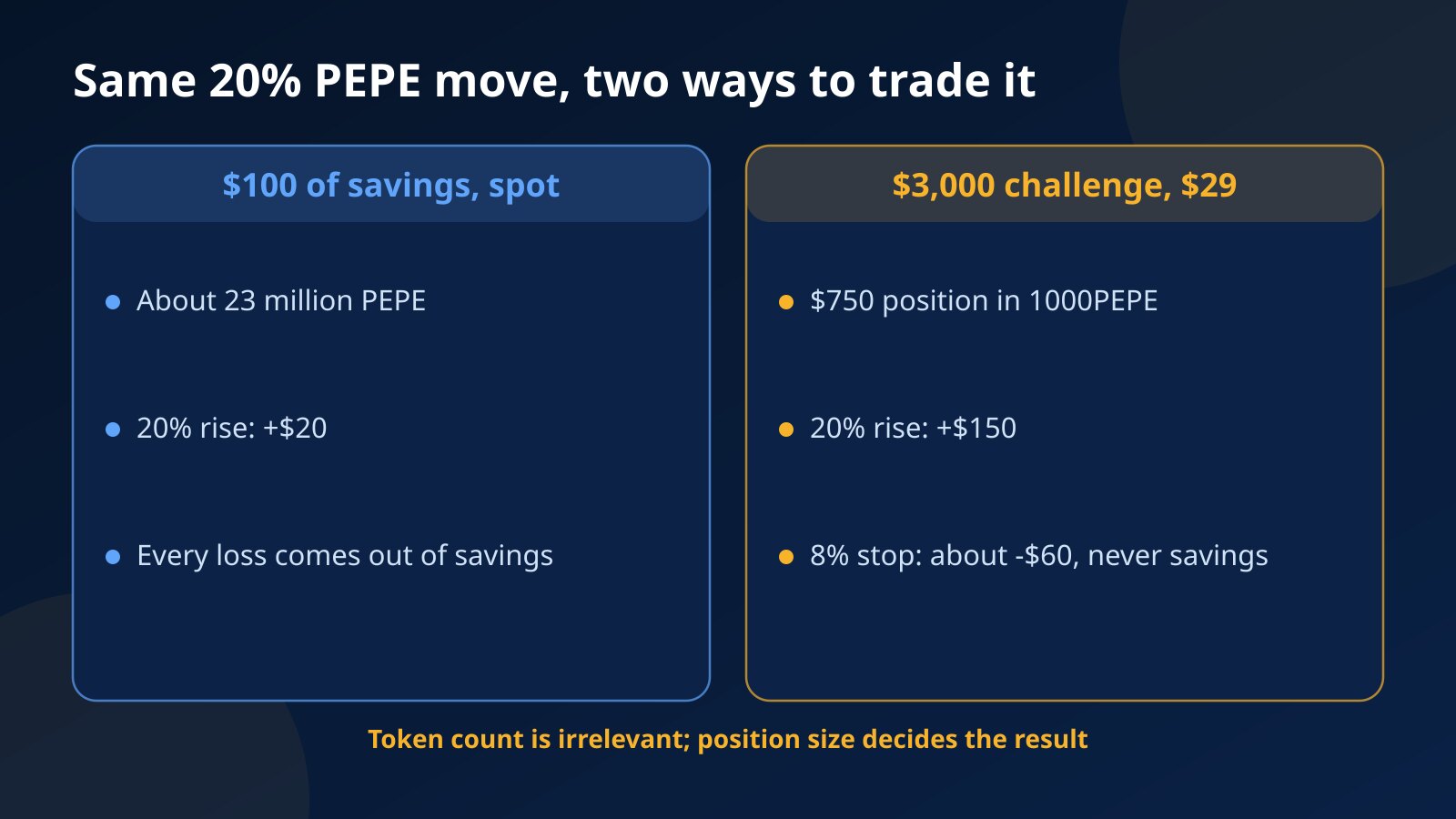
Here is the comparison in numbers. With $100 of your own money you can buy about 23 million PEPE. A 20% rise gives you $20; a 50% fall costs you $50 of savings. On a $3,000 challenge account bought for $29, a $750 position in 1000PEPE makes $150 on the same 20% rise, which is half the $300 Step 1 target. The other side is just as real: a 20% drop against that position costs $150, the whole daily loss limit, so a position this size only makes sense with a stop loss, for example 8% away for a $60 loss.
Notice also why $750, not $1,500. A single trade that makes 60% or more of the stage target, $180 on a $3,000 Step 1, does not count toward the target. A bigger position would have turned that 20% move into a trade that earns nothing for your progress. Profit from trades held under five minutes is also not counted.
If not the price, then what? Choosing a meme coin and where to start
Drop the unit price from your checklist and look at things that actually change your trade:
- Daily range: how far the coin usually moves in a day. It sets your stop distance and therefore your size.
- Liquidity: thin coins jump through stops. The older, larger memes usually fill closer to your price.
- Triggers: listings, token unlocks and posts from big accounts move small memes more than any chart pattern.
- Your own record: which coin you have already traded on practice without breaking your rules.
On Fundex24, PUMP is the 4th most-traded meme coin by number of positions over the last 45 days and PEPE the 9th; we compared PEPE with DOGE and SHIB in our small-budget meme coin guide.
The cheapest real way to start costs nothing. Sign up for free and open the practice account: $10,000 of virtual balance, leverage up to 1:10, for 3 days, on the same contracts. When you trust your sizing, a $3,000 challenge costs $29 (the code PROPOFF10 brings it to $26.10), and the challenge plans page lists the larger sizes. Most people fail their first challenge, so treat the fee as the price of a test, not an investment.
Risk note: meme coins are highly volatile and can lose most of their value. Funded accounts are simulated, and nothing here is a forecast or a promise of income.
Pick a challenge and start trading
Two-step evaluation, transparent rules, profit split up to 80%.
Not sure which size fits? Read the rules · Common questions
Cheap meme coin questions, answered
Which meme coin has the lowest price?
Coins like PEPE, SHIB, BONK and CAT trade at a few millionths of a dollar per token. That ranking changes daily and says nothing about value; market cap is the number to compare.
Can SHIB or PEPE reach one cent?
At one cent, SHIB would be worth about $5.9 trillion and PEPE about $4.2 trillion, using their current supplies. Judge for yourself how realistic that is; nobody can promise either way.
What does the 1000 in 1000PEPE mean?
The contract price is quoted for 1,000 tokens. Percentage moves are the same as for a single token, so your profit and loss work exactly as on any other pair.
Is it better to trade a low-priced coin with a small account?
No. A position of a given dollar size makes or loses the same amount on the same percentage move, whatever the token costs.
Do I need to buy the coins to trade them on Fundex24?
No. You trade USDT perpetual contracts that follow Binance futures prices, long or short, without holding the tokens or a wallet for them.
Questions about the Fundex24 challenges?
Open the support chat and ask — the team replies right there.
Chat with supportPrefer to read first? Browse the FAQ · Compare the challenges
Continue your learning path
Move from this article to the next useful action or topic.