




From demo to challenge
The demo trading mistakes that cost nothing on a practice account are exactly the ones that cost a prop challenge fee later. Below are six habits virtual money quietly teaches, the challenge rule each one runs into, a drill to fix it, and a checklist for deciding when you are ready to move on.
Why do demo habits follow you into a challenge?
Because you trade the way you practised. On a demo account a loss is just a number and a reset puts it back; in a challenge the same loss can close the account, and the only way to start over is to pay again.
A quick recap if the model is new: a prop challenge is a paid evaluation on a simulated account. On Fundex24 you pay a one-time fee from $29, pass two stages with a 10% and then an 8% profit target while staying inside drawdown limits, and then trade a funded account with an 80% profit split. How crypto prop trading works explains it in full.
Six demo trading mistakes and the rule each one breaks
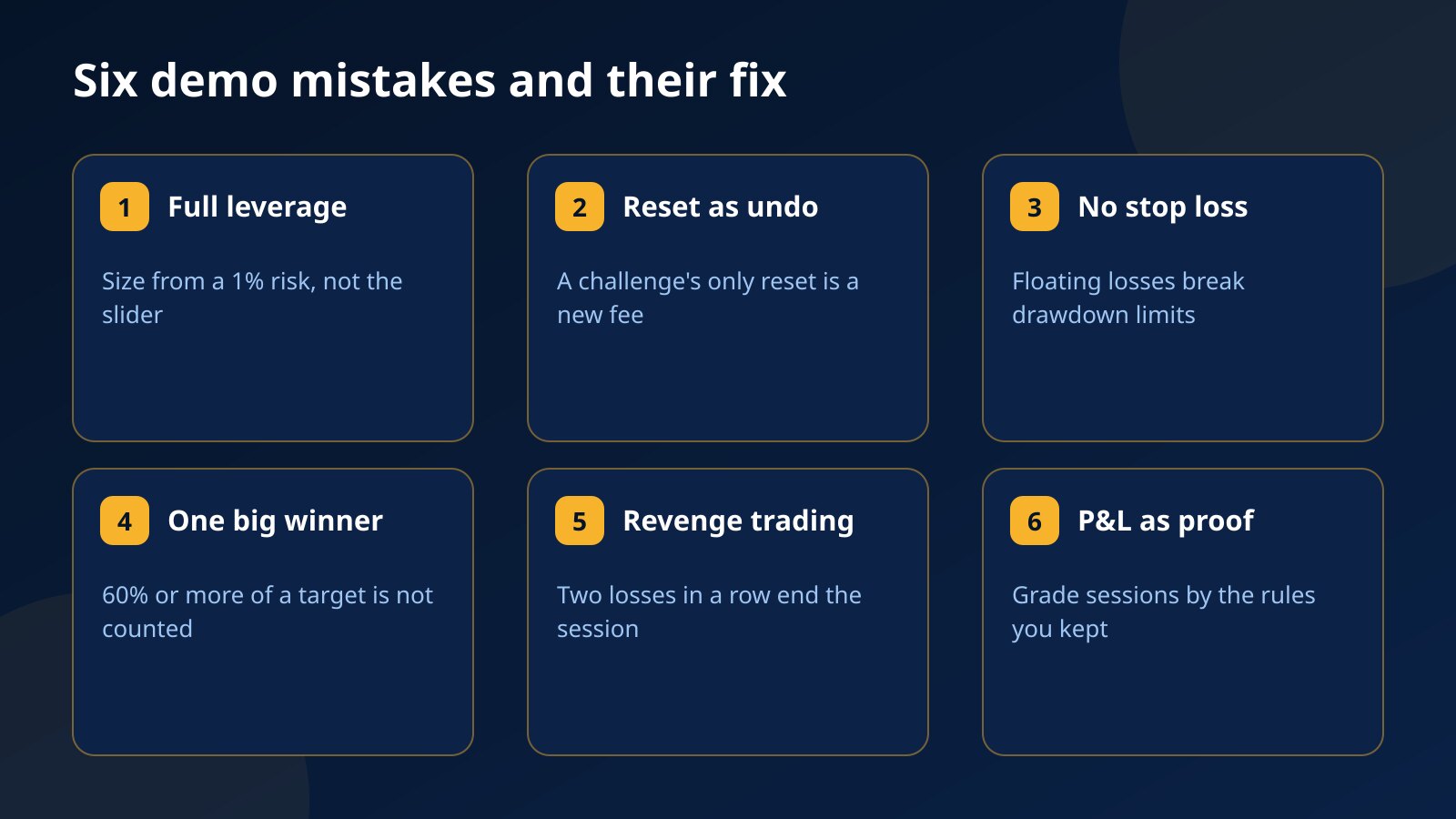
Each mistake below is harmless on the Fundex24 practice account and expensive on a challenge account. The drill is how to unlearn it while mistakes still cost nothing.
1. Using full leverage because the money is virtual
Leverage goes up to 1:10 on both the practice account and a challenge, so the setting itself is not the issue. The issue is sizing from leverage instead of risk: a full-size position with a loose stop can eat the 5% daily limit in one move. Drill: decide the loss first, 1% or less, and size from the stop distance, as the guide on how much to risk per trade shows.
2. Treating a reset as an undo button
Practice gives you 3 resets for the whole run, and it is tempting to spend one whenever a day goes badly. A challenge has no reset button; the only fresh start is buying another challenge. Drill: after a bad day, trade the reduced balance at your next session and keep resets for planned moments, never mid-session.
3. No stop loss, and holding the loser
Holding a losing position until it comes back works often enough on a demo to feel like a strategy. In a challenge, a floating loss that touches the 5% daily or 10% maximum drawdown closes the account at that moment, even if price recovers an hour later. Drill: no practice position without a stop loss, and never move a stop further away once the trade is open.
Create your Fundex24 account
Takes a few seconds. You can pick a challenge and add your phone number later.
4. Chasing one big winner
One oversized trade feels like the fastest route to a target. In the challenge stages, a single position making 60% or more of the stage target does not count toward progress, which is $600 on stage 1 of a $10,000 account. Drill: plan the target as several ordinary winners, and log any practice trade that would have crossed that line.
5. Revenge trading after a loss
Jumping straight back in with a bigger size after a stop-out costs nothing on a demo. In a challenge, it is how an ordinary losing day turns into a broken daily limit. Drill: after two losses in a row, end the session, write down what happened and return the next day at the same size.
6. Judging readiness by P&L, or reading virtual profit as income
A good week of virtual profit says little about whether you are ready and nothing about what you would earn. Practice profit cannot be withdrawn, and a challenge promises no earnings either. Drill: grade each session by whether you kept your rules, not by where the balance finished.
How do you know you are ready to leave the demo?
You are ready when your process repeats itself, not when the balance looks good. Before paying for anything, check yourself against this list:
- All six practice milestones are done.
- Several sessions in a row without breaking your own daily and maximum limits.
- A written plan with a fixed risk per trade, and position sizes that actually match it.
- A stop loss on every position in your journal, with no stop moved further away.
- No practice trade that would have fallen under the 60% rule.
- You can explain every losing trade in one sentence.
If two or more items are missing, the challenge rule drills for demo are a better use of your remaining practice days than a purchase.
Which challenge should you choose first?
Start with the plan whose fee you could lose calmly. The fee is one-time and not refunded if you fail, and it is the most you can lose on a single challenge, so the right size is the one where losing it would not tip you into revenge trading.
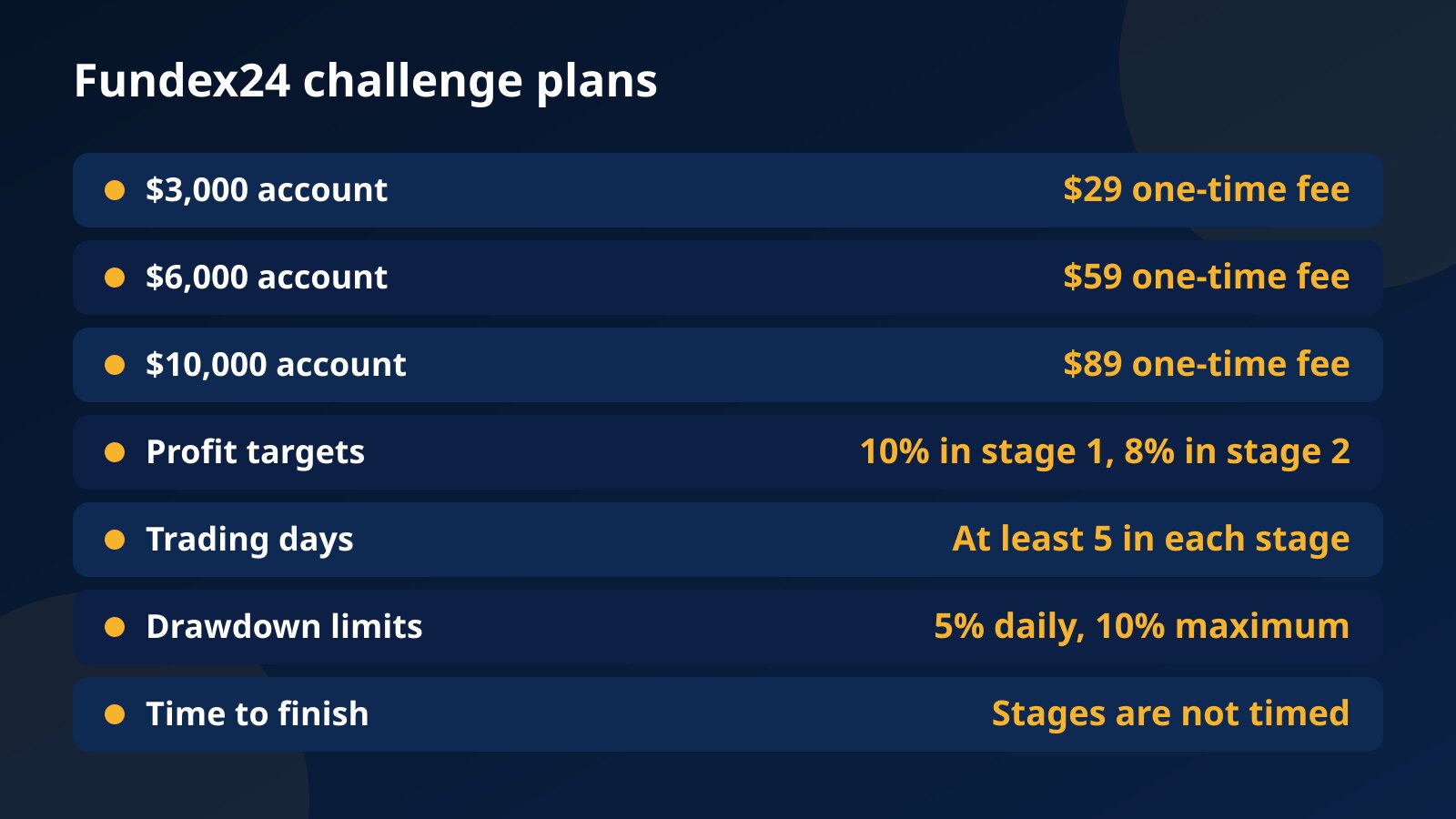
All three plans have two stages, at least 5 trading days in each and no deadline to finish a stage; the only clock is that the first trade must be opened within 30 days of purchase. Fees are paid in USDT on BEP20, TRC20 or ERC20, and no KYC is needed to start. The Fundex24 challenge plans page lists them side by side.
This article checks the trader. To check the firm as well, from rules to payouts and support, read what to check before buying a challenge. And finish practising first, because the practice account closes as soon as a challenge account is activated.
What should you do next?
If you have not used your practice run yet, start there: sign up for a free practice account, verify your phone, open Accounts from the sidebar, press Start practising and place your first trade on BTC/USDT with the six drills in mind.
Pick a challenge and start trading
Two-step evaluation, transparent rules, profit split up to 80%.
Not sure which size fits? Read the rules · Common questions
Crypto trading with leverage carries a high risk of loss. Results on a practice account do not predict results in a challenge or on a funded account.
Demo to challenge FAQ
How long should I trade on a demo before a prop challenge?
It depends on consistency, not the calendar. The Fundex24 practice run is currently 3 days, so use it to build habits and judge readiness by the checklist rather than a number of weeks.
Can I keep my practice account after buying a challenge?
No. The practice account closes when a challenge account is activated, and it cannot be opened again by anyone who has bought a challenge.
What happens if I fail my first challenge?
The challenge account closes and the fee is not refunded. You can buy another one, so each attempt costs its own fee and nothing more.
Is demo trading the same as trading a challenge account?
The terminal and the prices are the same, but the rules are not. A challenge enforces drawdown limits, trading days and the 60% rule, while the practice account evaluates nothing.
Questions about the Fundex24 challenges?
Open the support chat and ask — the team replies right there.
Chat with supportPrefer to read first? Browse the FAQ · Compare the challenges
Continue your learning path
Move from this article to the next useful action or topic.