




Challenge costs
The prop firm challenge cost is the first number most traders check, and it is usually read the wrong way. The sticker price matters less than what the fee buys, how it scales with account size and how many attempts your plan is likely to need. This guide breaks the cost down with real prices, a cost-per-$1,000 comparison and the expenses people forget to count.
What a prop firm challenge fee actually pays for
A challenge fee buys an evaluation, not a deposit. You pay once, receive a simulated account with a stated size and rules, and the fee is the most you can lose. If you break a rule the attempt ends; if you pass, you move on toward a funded account and a share of any profit you make.
Because the fee is not a balance, you never get it back as cash, and at Fundex24 it is not refunded after a failed attempt. That is why the useful question is not whether a challenge is cheap, but what one attempt costs you and how many attempts your plan needs. Offers differ across the industry, so when you compare prices, compare what each fee includes rather than the number alone. The refund question is also answered in the Fundex24 FAQ.
If the evaluation itself is new to you, start with what a prop firm challenge is.
Prop firm challenge cost by account size
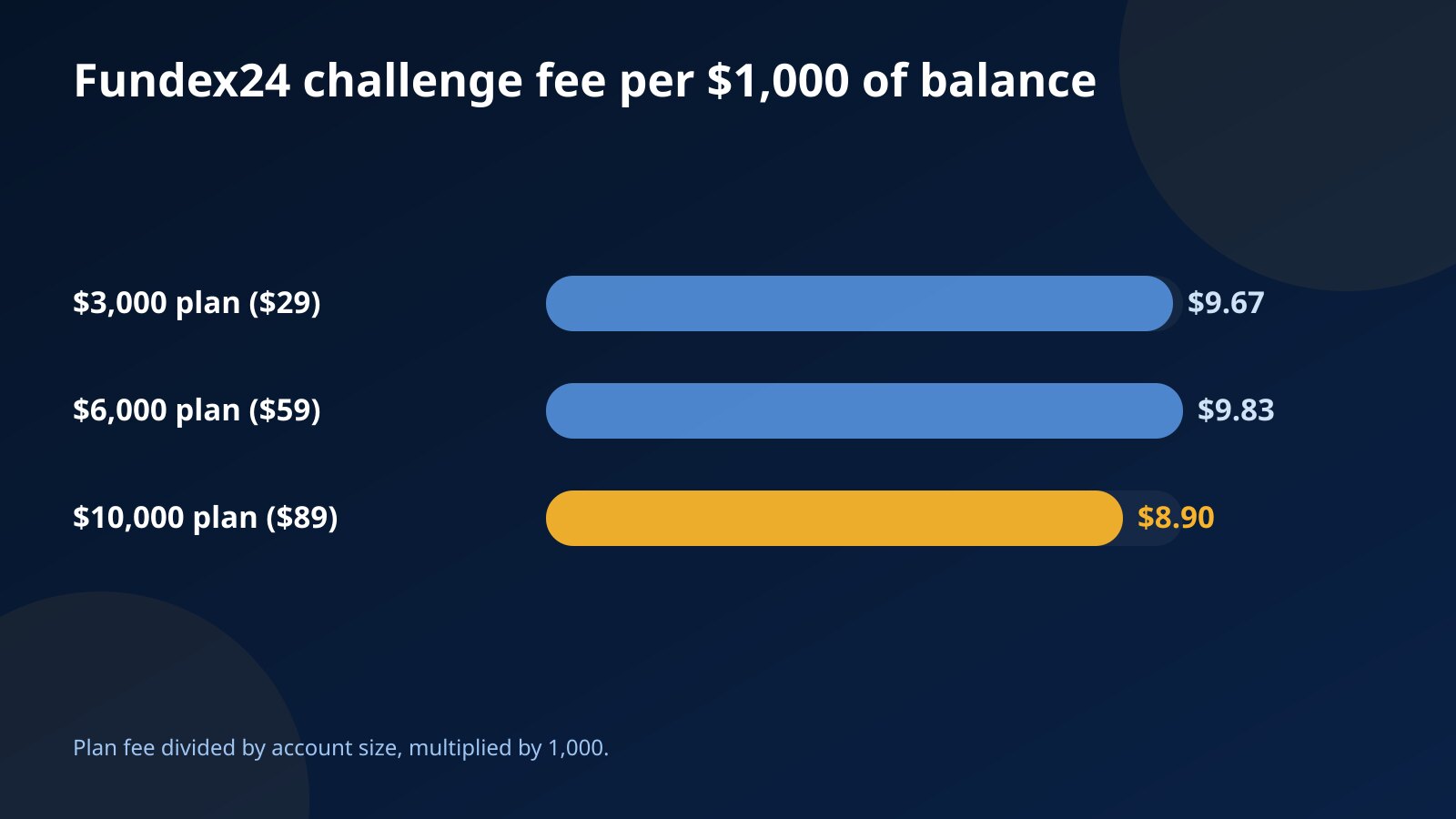
Across the industry, fees generally rise with account size. At Fundex24 there are three plans, each paid once in USDT: $3,000 for $29, $6,000 for $59 and $10,000 for $89. The rules are identical on all three, so what changes is the dollar size of every limit and target.
A simple way to compare plans is the fee per $1,000 of balance. It comes to about $9.67 on the $3,000 plan, $9.83 on $6,000 and $8.90 on $10,000. The largest plan is the cheapest per dollar of balance, but that only matters if you can trade its bigger dollar swings calmly. Put differently, all three plans cost a little under 1% of the balance they give you access to.
Create your Fundex24 account
Takes a few seconds. You can pick a challenge and add your phone number later.
How to weigh those swings against the price is covered in which funded account size to choose.
The real cost is the fee times your attempts
A cheaper plan you pass on the first try costs less than a bigger plan that takes three attempts. Three attempts at $89 cost $267; one attempt at $29 costs $29. The sticker price only tells half the story.
You cannot know your number of attempts in advance, but you can work on it. Rehearsing on the free practice account first, with a $10,000 virtual balance for a short run (currently 3 days), leverage up to 1:10 and no fee, and arriving with a fixed risk per trade is the cheapest way to reduce the attempts you need. Budget for the attempts your plan realistically requires, and never for more than you can afford to lose. A practical rule is to decide before you buy how many attempts you are willing to fund in total, and to review what ended each failed attempt before buying the next one.
Costs people forget to count
The fee is the visible cost. A few others sit around it, and they add up if you ignore them.
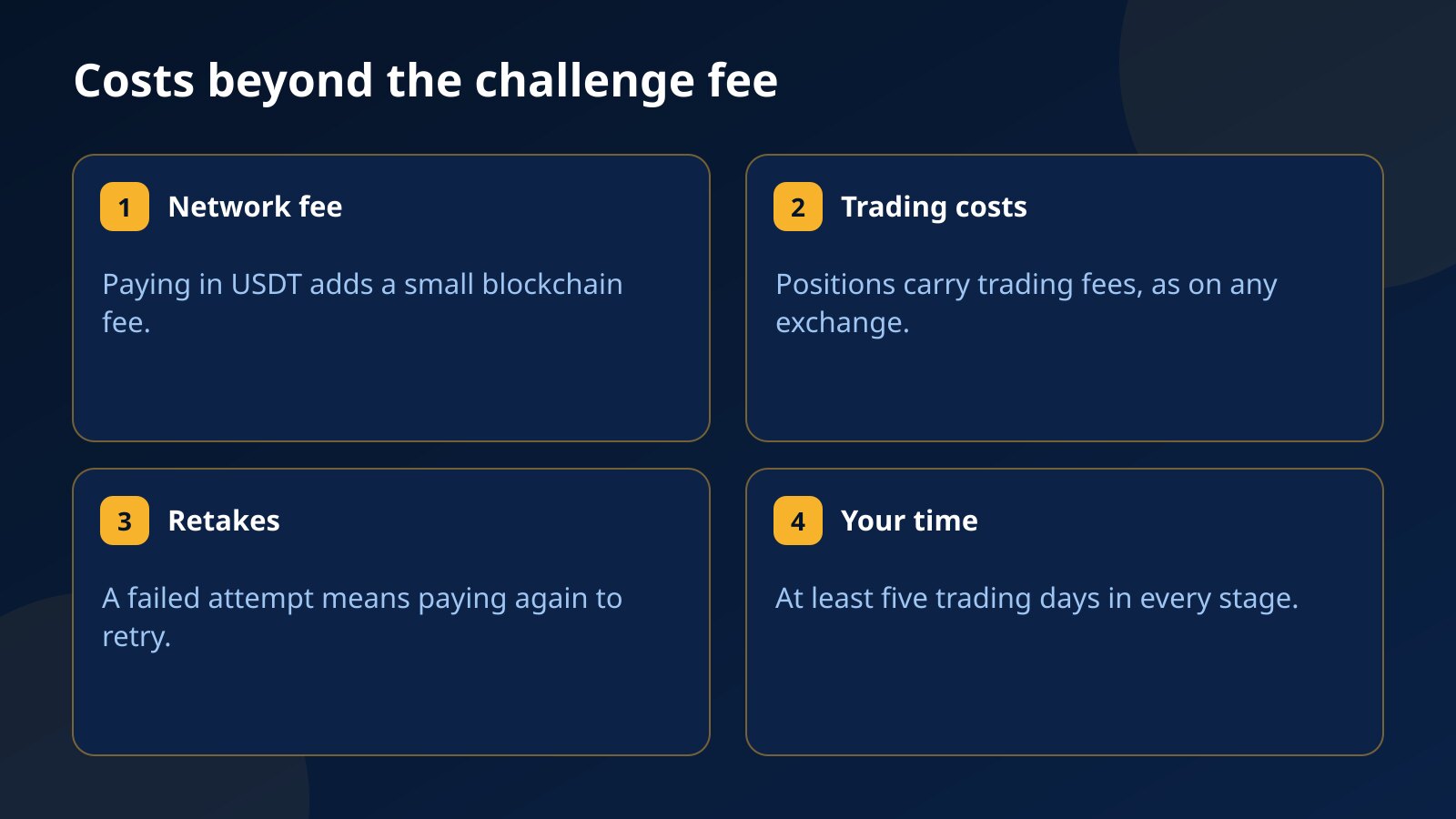
Paying in USDT means a blockchain network fee on top of the price, and sending on the wrong network can lose the payment entirely, so read USDT deposits and withdrawals before you pay. Trading costs apply to positions during the challenge, just as they would on an exchange, so check the current schedule in the platform rather than assuming zero. Time is a cost too: each stage needs at least 5 trading days.
What the Fundex24 fee includes
At Fundex24 the one-time fee covers both evaluation stages, 10% and then 8%, each with at least 5 trading days and no deadline for the targets. If you pass, it also covers the funded account itself: there is no extra fee to activate it, and the profit split starts at 80%.
If you fail, you can buy a new challenge whenever you are ready, and several challenges can run at the same time as long as trades are not copied between them. Current prices are on the challenge plans page, and payment questions go to the billing team.
Funded accounts at Fundex24 are simulated accounts for evaluation purposes, and no earnings are promised. Treat the fee as the price of a test, not as an investment.
Pick a challenge and start trading
Two-step evaluation, transparent rules, profit split up to 80%.
Not sure which size fits? Read the rules · Common questions
Frequently asked questions
Is the prop firm challenge fee refundable?
At Fundex24, no. The fee pays for the evaluation and is not refunded if the challenge fails.
Do I pay again when I get the funded account?
No. After you pass both stages and complete KYC, the funded account is activated without an extra fee.
Is a cheaper plan worse?
No. The rules and percentages are identical on all three Fundex24 plans; a cheaper plan only means smaller dollar amounts for every limit, target and payout.
How can I pay for a Fundex24 challenge?
In USDT on BEP20, TRC20 or ERC20. No KYC is needed to buy a challenge; it is only required when you request the funded account.
Questions about the Fundex24 challenges?
Open the support chat and ask — the team replies right there.
Chat with supportPrefer to read first? Browse the FAQ · Compare the challenges
Continue your learning path
Move from this article to the next useful action or topic.