




Rules before fees
Good prop challenge practice starts with an awkward fact: the Fundex24 practice account enforces none of the challenge rules, so a demo only rehearses them if you bring the rules yourself. Below, each rule becomes a drill on the $10,000 virtual balance, with a three-day log showing how to track it and an honest note on what a demo rehearsal cannot cover.
What is a prop challenge?
A prop challenge is a paid evaluation: you trade a simulated account under fixed rules, and if you pass, you move to a funded account and a share of the profit. On Fundex24 a one-time fee from $29 buys a challenge account, stage 1 sets a 10% profit target and stage 2 an 8% target, and passing both leads to a funded account with an 80% profit split. All of these accounts are simulated, and no earnings are promised.
If the model is new to you, what crypto prop trading is covers it end to end. This article assumes you know the basics and want to practise the rules before paying for the real test.
Why won’t the practice account enforce the rules for you?
Because it was built to teach the terminal, not to evaluate you. The Fundex24 practice account has no drawdown rules, counts nothing toward a payout and flags no broken limit; you could lose half the balance in a morning and nothing on screen would stop you.
That freedom helps a beginner and misleads anyone rehearsing a challenge, because on a challenge account the same morning ends the account. For this kind of practice you act as your own risk desk: write the limits down before each session, check them while you trade and record every breach honestly, even when the platform does not.
The mechanics already match. Practice runs on the same charts, order panel and execution model as the paid terminal, with leverage up to 1:10 and isolated margin, which is also the only margin mode on challenge accounts. What you add is the rulebook, and the Fundex24 challenge rules page has all of it.
Drill 1: how do you practise the 5% daily drawdown?
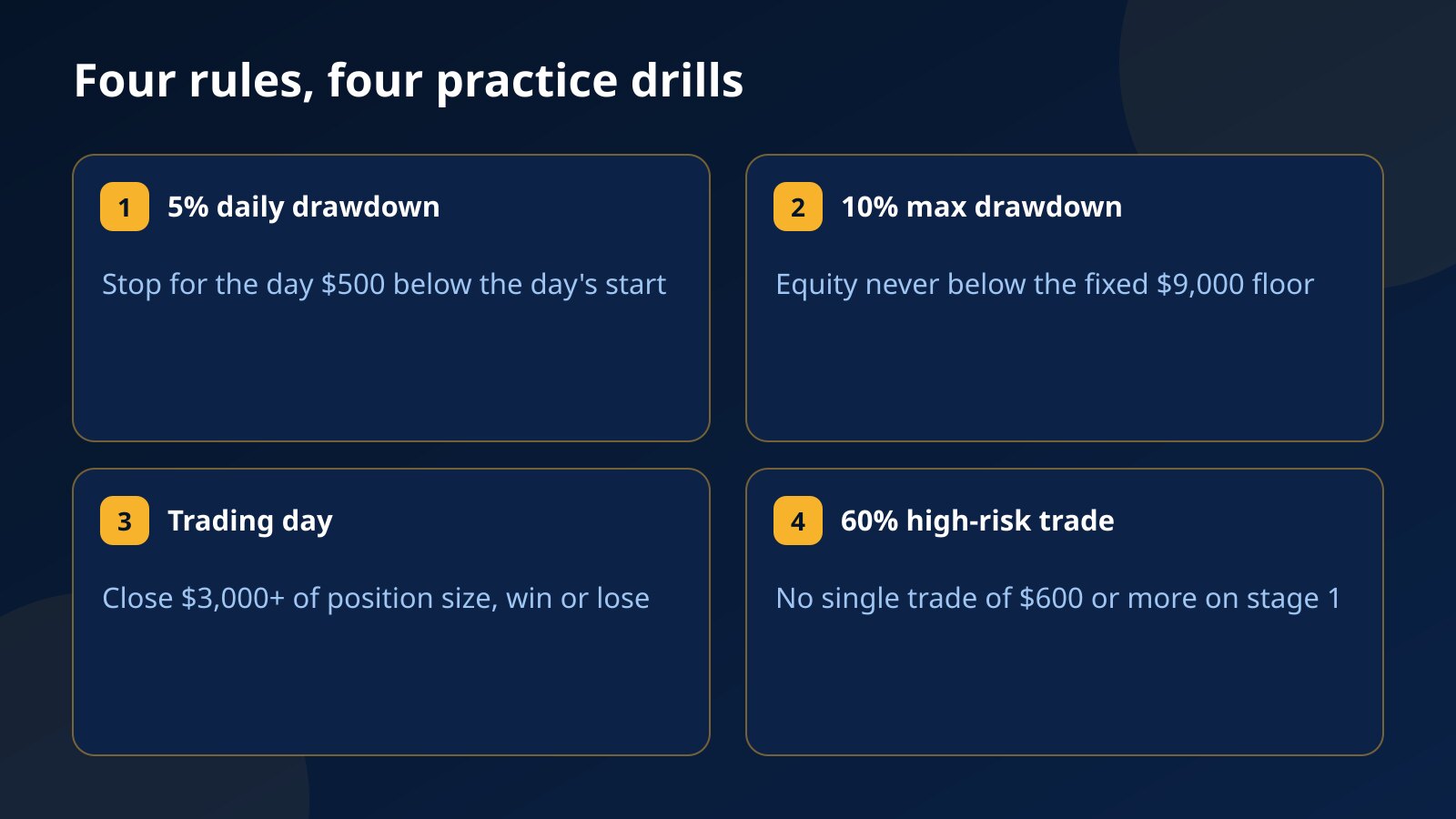
Write down the balance you start the day with, work out 5% of it and stop trading if equity falls that far. On a fresh $10,000 practice balance the line sits $500 down, at $9,500.
The limit is 5% of that day’s starting balance, so it moves with your account. Start a later day at $10,200 and your allowance is $510, with the floor at $9,690. A challenge dashboard tracks the day’s starting balance for you; on practice, note your balance at the first session of the day and use that figure.
The drill
- Before the first trade, write the start balance and the daily floor where you can see them.
- Size trades so that several stop-outs in a row cannot reach the floor; risking 1% per trade leaves room for about five.
- If equity touches the floor, close everything and stop for the day, even if a position might still come back.
The last point is the hard one. Walking away while a trade “only needs a little more time” feels wasteful on virtual money, which is exactly why it is worth drilling there first.
Drill 2: the fixed 10% maximum drawdown
The maximum drawdown is 10% of the initial balance and it never moves: on a $10,000 account the floor is $9,000, whether you are up $800 or down $300. On the practice account, treat $9,000 as a wall.
Because the floor is fixed, profit gives you breathing room and losses use it up. After a good week at $10,600 you have $1,600 before the wall; after a poor one at $9,400 you have just $400, which is less than a single day’s allowance.
Equity counts, not only balance
A challenge watches both balance and equity. A floating loss that touches either limit breaks it, even for a moment and even if price comes straight back, so a position held without a stop can end the account overnight while you sleep.
Create your Fundex24 account
Takes a few seconds. You can pick a challenge and add your phone number later.
The drill: every practice position gets a stop loss, and after each session you record the lowest equity you saw, not just where the balance finished. The guide to daily drawdown vs max loss goes deeper into how the two limits interact.
Drill 3: what counts as a trading day?
A day counts as a trading day when the positions you closed that day add up to a position size of at least 30% of the stage’s starting balance, which is $3,000 on a $10,000 account. Position size here means the full notional value (entry price times quantity), not the margin, and whether those trades won or lost does not matter. Each stage needs at least 5 trading days.
The drill: close at least $3,000 of position size on each practice day you want to count, and write the total in your journal. A single $5,000 position, like the one in the 1% risk example, clears the bar on its own; two $1,000 trades do not. Mark every qualifying day so spreading your trading across days becomes normal, rather than something you only think about once a stage is under way.
Stages are not timed on Fundex24, so there is never a reason to force a trade just to log a day. The drill is to take a qualifying trade only when a real setup appears, and to be comfortable leaving a day blank.
Drill 4: how does the 60% high-risk trade rule work?
In the challenge stages, a single position that makes 60% or more of the stage’s profit target does not count toward progress. On stage 1 of a $10,000 account the target is $1,000, so any one trade making $600 or more is left out of your progress, although the profit itself stays in the account.
On stage 2 the target is 8%, or $800, so the line drops to $480. The rule rewards repeatable trading over one lucky shot, and the practice drill is to plan the target as a series of trades.
At 1% risk with a target twice the stop distance, a winner makes about $200. Reaching $1,000 then takes several winners, and none of them comes near $600. If a practice trade ever makes $600 or more, log it as a breach and ask why the position was that large.
Worked example: three days of prop challenge practice
This is what a rule log looks like on the $10,000 practice balance. The figures are an example; the columns are the ones worth keeping.
Day 1 started at $10,000, so the daily floor was $9,500, and the lowest equity of the day was $9,780. Day 2 opened at $10,140, which moved the floor to $9,633, and equity never dipped below $9,890. Day 3 opened at $10,060 with a floor of $9,557.
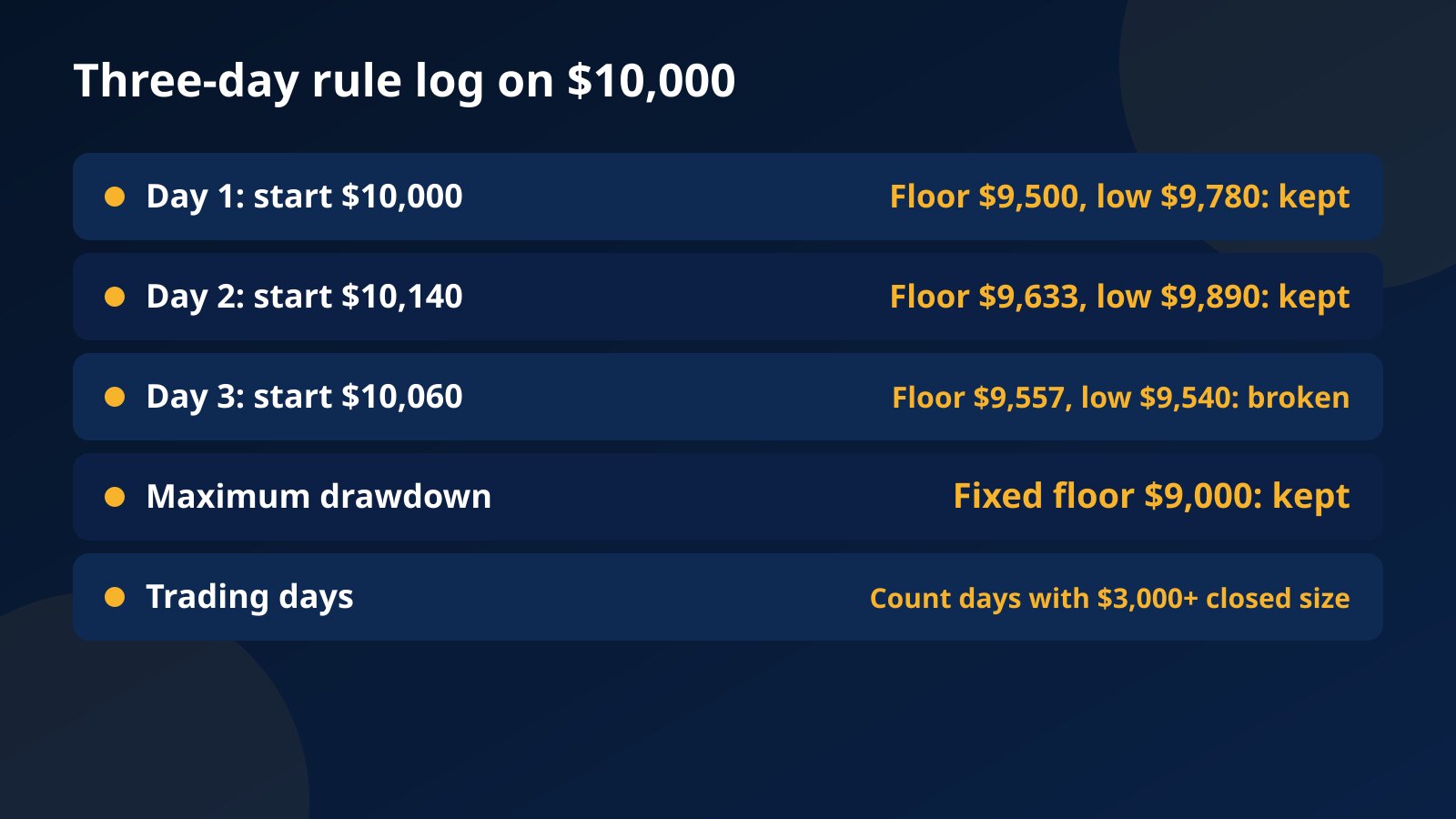
Day 3 is the lesson. A dip pushed equity to $9,540, $17 under the daily floor, before the trade recovered and closed at a small loss. The practice account carried on as if nothing had happened, while a challenge account would have closed at that moment. Writing “broken” in the log is the whole point of the exercise.
How do the drills scale to a $3,000 or $6,000 plan?
The percentages stay the same and only the dollar amounts shrink. If you plan to buy a smaller account, drill with its numbers from the start so the sizes feel normal on day one of the challenge.
- $3,000 account ($29): daily limit $150 on a $3,000 day, fixed floor $2,700, a trading day needs $900 of closed position size, and with a $300 stage 1 target a single trade of $180 or more does not count.
- $6,000 account ($59): daily limit $300 on a $6,000 day, fixed floor $5,400, trading day $1,800 of closed position size, stage 1 target $600 and a high-risk line of $360.
- $10,000 account ($89): daily limit $500 on a $10,000 day, fixed floor $9,000, trading day $3,000 of closed position size, stage 1 target $1,000 and a high-risk line of $600.
The practice balance is always $10,000, so scale your risk instead. For a $3,000 plan, risk $30 per trade rather than $100 and measure your results against the $3,000 limits in the list above.
What can a demo rehearsal not do?
It cannot rehearse a whole stage. Each stage needs at least 5 trading days and the practice run is currently 3 days, so a demo rehearses the habits (the daily floor, a stop on every position, profit spread across trades) rather than a full stage.
It cannot recreate the pressure either. Knowing that a fee rides on the next trade changes how people behave, which is why the demo mistakes that cost a challenge fee are worth reading before you decide. Timing matters too: practice closes as soon as a challenge account is activated and cannot be opened once a challenge has been bought, so run your drills first.
Pick a challenge and start trading
Two-step evaluation, transparent rules, profit split up to 80%.
Not sure which size fits? Read the rules · Common questions
To begin, open a free practice account, verify your phone, open Accounts from the sidebar, press Start practising and write your daily floor down before the first trade on BTC/USDT. When the drills feel routine, the challenge plans and prices are there to compare.
Leveraged crypto trading is risky. Keeping your rules on a practice account does not mean you will pass a challenge or earn anything from one.
Prop challenge practice FAQ
Does the Fundex24 practice account have drawdown limits?
No. It has no drawdown rules and evaluates nothing, so you need to track the limits yourself.
Can I pass a prop challenge on the practice account?
No. Practice is separate from every challenge, and nothing done there counts toward stage progress or a payout.
Is the daily drawdown checked on balance or equity?
Both. The limit is 5% of the day’s starting balance, and a floating loss that touches it breaks the rule even if price recovers afterwards.
Do the drawdown rules change on the funded account?
The 5% daily and 10% maximum limits stay the same. The funded account adds one more: if the total risk of all open positions goes above 3% of the day’s starting balance, that day’s profit is not counted.
Are hedging and news trading allowed in a Fundex24 challenge?
Yes, both are allowed. Prohibited practices include abusive scalping, exploiting system errors and copying identical trades across challenges.
Questions about the Fundex24 challenges?
Open the support chat and ask — the team replies right there.
Chat with supportPrefer to read first? Browse the FAQ · Compare the challenges
Continue your learning path
Move from this article to the next useful action or topic.