




Evaluation basics
A prop firm challenge is a paid trading evaluation: you trade a simulated account under fixed rules, and if you reach the profit target without breaking the loss limits, you qualify for a funded account and a share of the profit it makes. This guide explains what the fee buys, which rules decide the result, how the path to funding works step by step, and who should not start one yet.
What a prop firm challenge is
A proprietary trading firm, or prop firm, wants to know one thing before it gives you a funded account: can you make money without taking reckless risk? The challenge is how it finds out. You pay a one-time fee, receive an evaluation account of a stated size, such as $10,000, and trade it under a published rulebook.
The account is simulated, so the losses you make during the evaluation are not debts. The fee is the most you can lose. If you reach the profit target while respecting every limit, you move on to a funded account; if you break a rule, the attempt ends and you can buy a new one.
Firms describe the same model with different words: evaluation, assessment, audition, challenge. The mechanics barely change. What changes from firm to firm is the fine print, and that is where most attempts are won or lost.
Why prop firms test traders first
A firm that paid out to anyone who got lucky for a week would not last long. The evaluation filters for behaviour that repeats: controlled losses, sensible position sizes, and profit spread over several days rather than one oversized bet.
That is why the rulebook says far more about losses than about gains. A profit target proves you can make money; the drawdown limits prove you can survive a bad day. For the wider picture of how the business model works, start with our crypto prop trading guide.
The four core rules of a prop firm challenge
Every challenge is assembled from the same four parts. The numbers below are Fundex24’s, shown on a $10,000 account, because concrete figures make the rules easier to picture.
1. Profit target
This is the gain you must reach before a stage counts as passed. Fundex24 uses two stages: 10% in stage 1 ($1,000) and 8% in stage 2 ($800). Why the structure has two stages is covered in the two-step challenge explained.
2. Daily drawdown
This caps how much you may lose in one day, measured from that day’s starting balance. At Fundex24 it is 5%, so a day that starts at $10,000 must never go below $9,500.
3. Maximum drawdown
This is the overall floor. At Fundex24 it is 10% of the initial balance and it never moves: on a $10,000 account the floor stays at $9,000 however much profit you make first. Some firms use a trailing floor that follows your equity peak instead, so check which kind you are paying for.
Create your Fundex24 account
Takes a few seconds. You can pick a challenge and add your phone number later.
4. Minimum trading days
You must actually trade on a minimum number of days before a stage can be passed. Fundex24 asks for at least 5 trading days per stage, and a day only counts if you open and close at least one position with a profit or loss of 0.25% of the initial balance or more ($25 on $10,000).
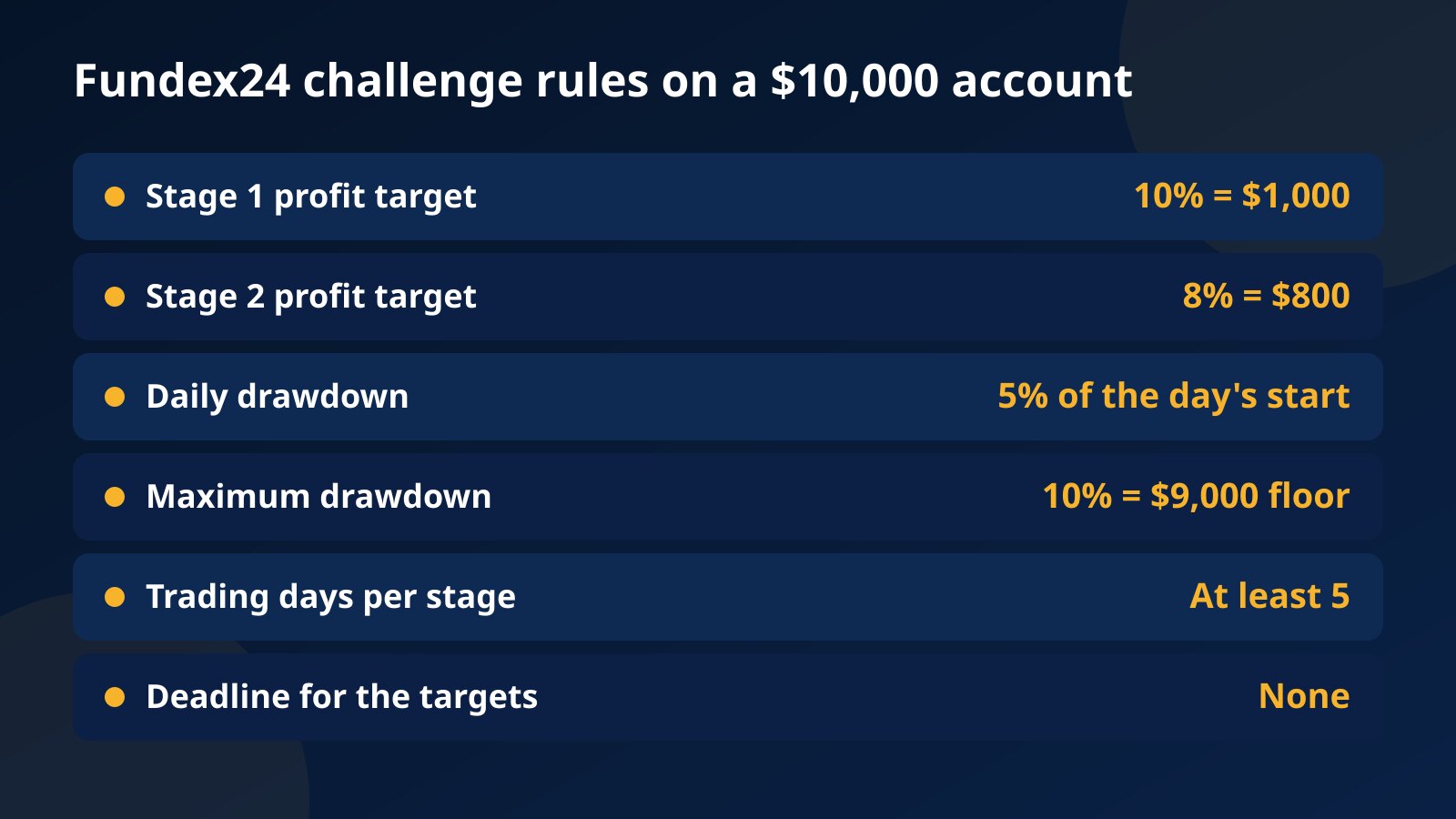
Around these four rules sit the details. Fundex24 has no deadline for reaching the targets, although the first trade must be opened within 30 days of purchase. Only isolated margin is allowed, and a short list of behaviours is prohibited. The complete wording is on the Fundex24 rules page, and it is worth one careful read before you pay.
How you qualify for a funded account, step by step
At Fundex24 the path from purchase to payout has five steps. Each has a condition you control and, in a few places, a date worth writing down.
- Choose a plan: $3,000 for $29, $6,000 for $59 or $10,000 for $89, paid once in USDT on BEP20, TRC20 or ERC20. No KYC is needed to start.
- Pass stage 1 by reaching 10% with at least 5 trading days and no rule broken.
- Pass stage 2 by reaching 8% under the same limits. After entering stage 2 you have 30 calendar days to open its first trade.
- Request the funded account with a ticket in the user panel within 10 calendar days of passing, then complete KYC with a passport, national ID card or birth certificate plus a face photo. There is no extra fee, and the account is active within 24 hours.
- Trade the funded account and withdraw: you keep 80% of the profit, paid in USDT on BEP20 on the 12th or the 28th of the month once the payout conditions are met.
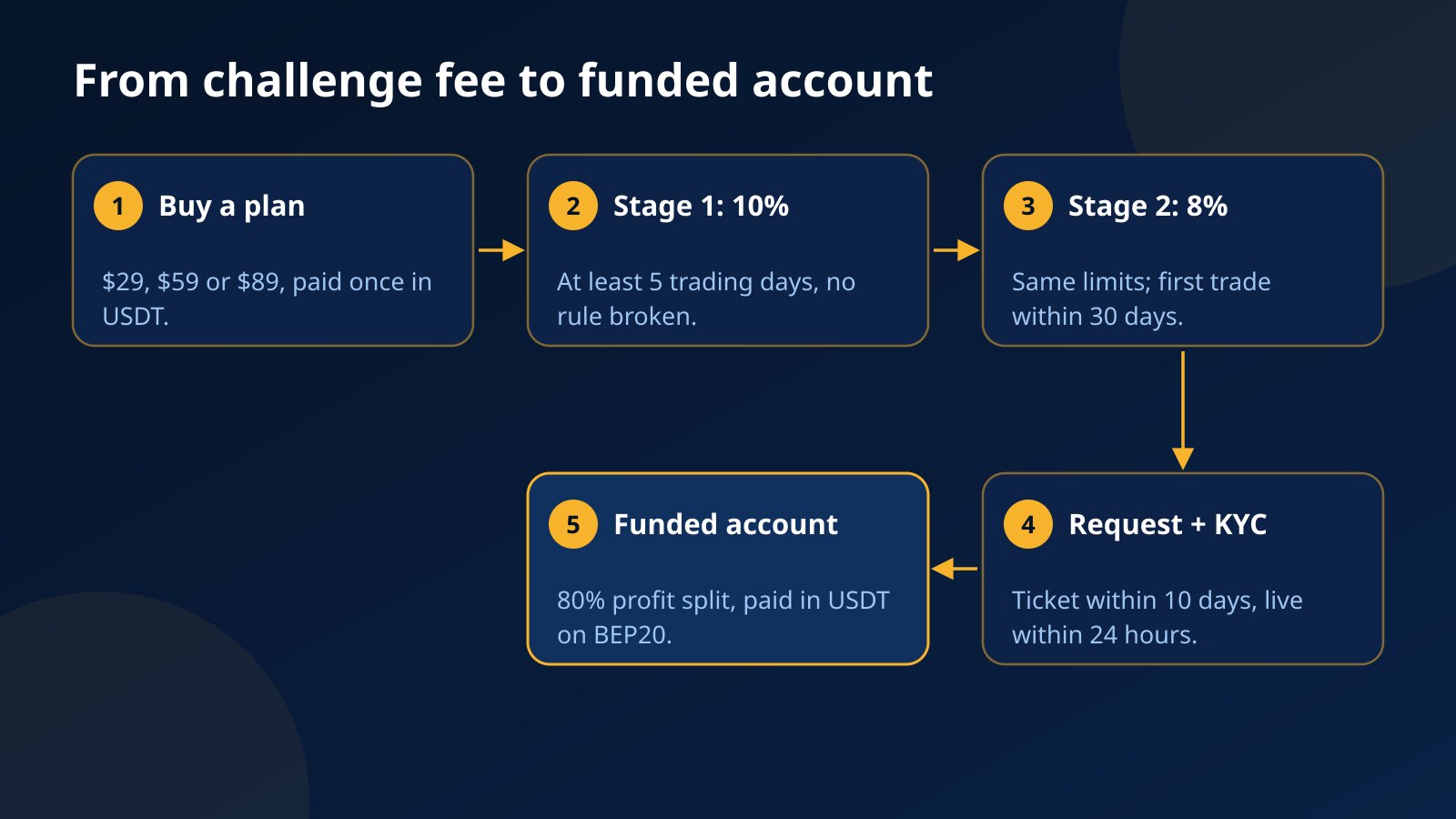
Because there is no time limit on the targets, you never have to force trades in a final week. If you want a practical plan for getting through both stages, read how to pass a crypto challenge.
What the challenge really measures
Traders often see the profit target as the main obstacle. In practice the limits end far more attempts than the target does, and two details explain why.
First, the limits are checked against both balance and equity. If an open position’s floating loss touches the daily or maximum limit even for a moment, the rule is broken, even when the price recovers a minute later. Your stop-loss has to sit well inside the limit, not next to it.
Second, profit has to be spread out. During the challenge stages, a single position that makes more than 60% of the stage’s target is treated as a high-risk trade, and its profit is not counted. On a $10,000 stage 1, that means one trade cannot carry more than $600 of the $1,000 target.
Put the two together and the intent becomes clear. A trader who risks 1% per trade can take four losses in a row and still have room under the 5% daily limit. A trader who risks 2.5% has hit the limit after the second loss. The rules reward the first style on purpose. For how the two limits interact, read daily drawdown vs max loss.
What happens when you pass, and when you fail
If you break a rule, the challenge account is closed. You get no refund, but you owe nothing either, and you can buy a new challenge whenever you are ready. Treat a failed attempt as data: which rule ended it, and at what position size?
If you pass, the rules stay with you. The funded account keeps the same 5% daily and 10% maximum drawdown and adds one more limit: the combined risk of all open positions must not exceed 3% of the day’s starting balance, or that day’s profit is not counted. An account with no trade for more than 30 calendar days is deactivated.
The profit split starts at 80% and rises to 95% after five successful withdrawals and a total profit of 60% of the initial plan balance. The first withdrawal requires at least 30 days since the first funded trade and at least 5 trading days on the funded account.
Is a prop firm challenge right for you?
A challenge suits a trader who already has a routine: a fixed risk per trade, a stop on every position, and a record of sticking to both on losing days. For that trader, a small fee in exchange for a funded account with clear loss limits is a reasonable trade-off.
Pick a challenge and start trading
Two-step evaluation, transparent rules, profit split up to 80%.
Not sure which size fits? Read the rules · Common questions
It does not suit someone who is still searching for a strategy. In that case the free practice account is the better first step: a $10,000 virtual balance for a short run (currently 3 days), leverage up to 1:10 and 3 resets in total, with no fee. When you are ready, compare the challenge plans and prices, or ask the support team about any rule before you buy.
Funded accounts at Fundex24 are simulated accounts used for evaluation, and no earnings are promised. Only pay a challenge fee you can afford to lose.
Frequently asked questions
Can I lose more than the challenge fee?
No. The evaluation account is simulated, so trading losses during the challenge are never charged to you. The one-time fee is the full cost of the attempt.
Is there a deadline to pass a Fundex24 challenge?
There is no time limit for reaching the targets. The only dates to watch are opening your first trade within 30 days of purchase and your first stage-2 trade within 30 calendar days of entering stage 2.
Can I trade during news releases?
Yes. Opening, closing and editing trades during news is allowed at Fundex24. The drawdown limits still apply, so a volatile release deserves a smaller position.
Can I run more than one challenge at a time?
Yes, several challenges can run at once. Copying identical trades across them is prohibited and fails every challenge involved.
Questions about the Fundex24 challenges?
Open the support chat and ask — the team replies right there.
Chat with supportPrefer to read first? Browse the FAQ · Compare the challenges
Continue your learning path
Move from this article to the next useful action or topic.