




Trading gold
Choosing a funded account for gold is less about the headline account size and more about the details around the instrument: whether gold is on the symbol list at all, what form it trades in, how the drawdown limits fit its daily moves and what the rules say about news. This guide walks through what to check, how to size an XAUUSD position so that a normal gold day does not threaten your limits, and how gold works inside a Fundex24 challenge.
What to check in a funded account for gold
Start with the symbol list. Many prop firms are built around one market, and gold may simply not be offered, or it may come as a different instrument from the one you are used to: a spot contract, a future, or a USDT-quoted contract that follows the gold price. Each form has its own trading hours, costs and behaviour when the underlying market is closed, so confirm what you would actually be trading before you pay for an evaluation.
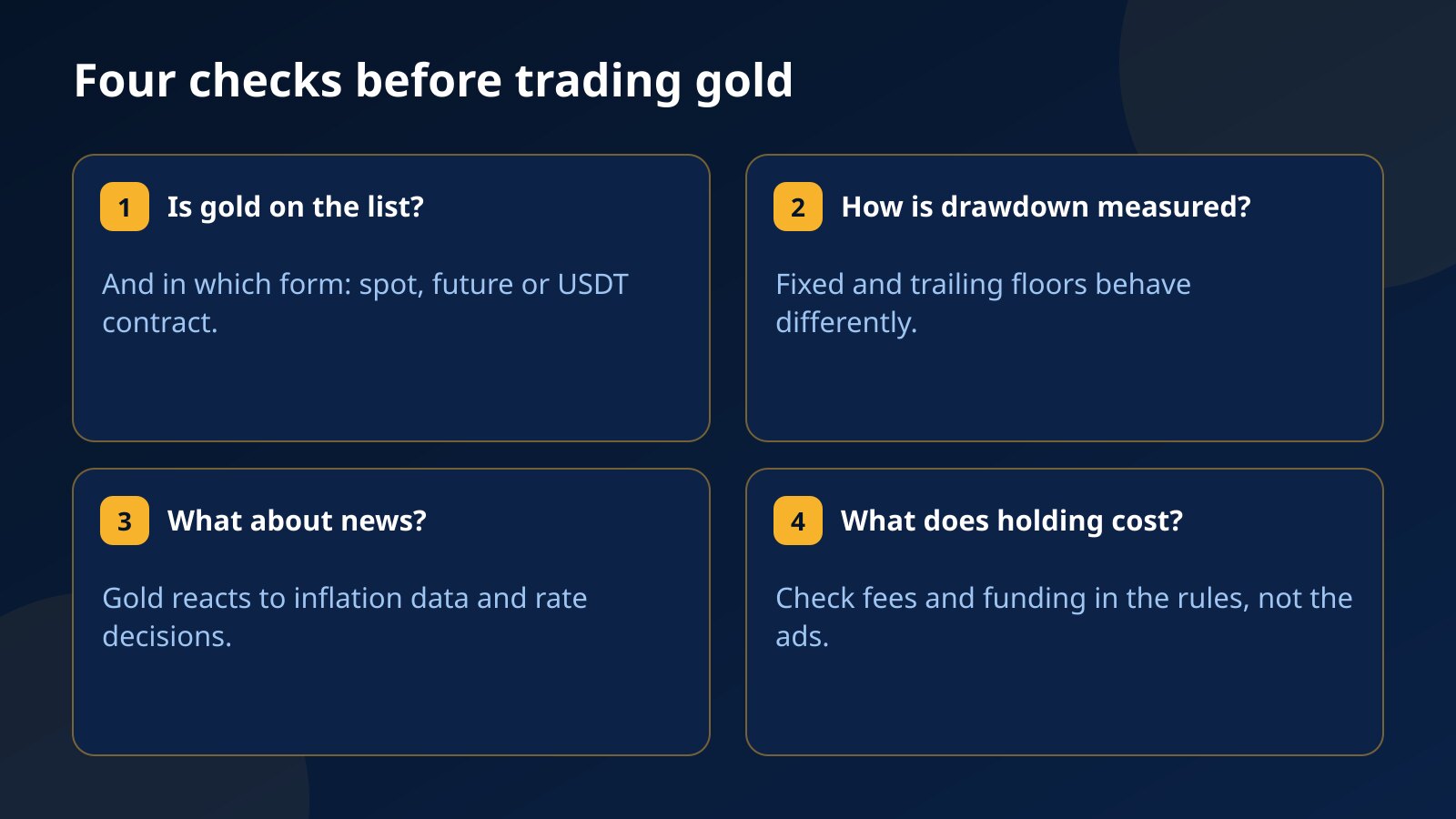
Then read the rules through a gold trader’s eyes. Four questions cover most of it:
- Is gold tradable in the evaluation and the funded stage? Some firms list it on one account type only.
- How is drawdown measured? A fixed floor and a trailing floor behave very differently on a trending metal.
- What happens around news? Gold reacts to inflation data and central bank decisions, so check whether trading is allowed and how limits are measured during those moves.
- What does a position cost to hold? Look for fees and funding or overnight charges on the rule and fee pages, not in the marketing.
If the challenge itself is new to you, what a prop firm challenge is covers the basic structure first.
Gold versus crypto: size by stop distance, not by habit
Gold usually moves less in a day than most crypto pairs, and that single difference changes position sizing more than anything else. The formula stays the same in both markets: position value equals the amount you are willing to lose divided by the distance to your stop, as a percentage.
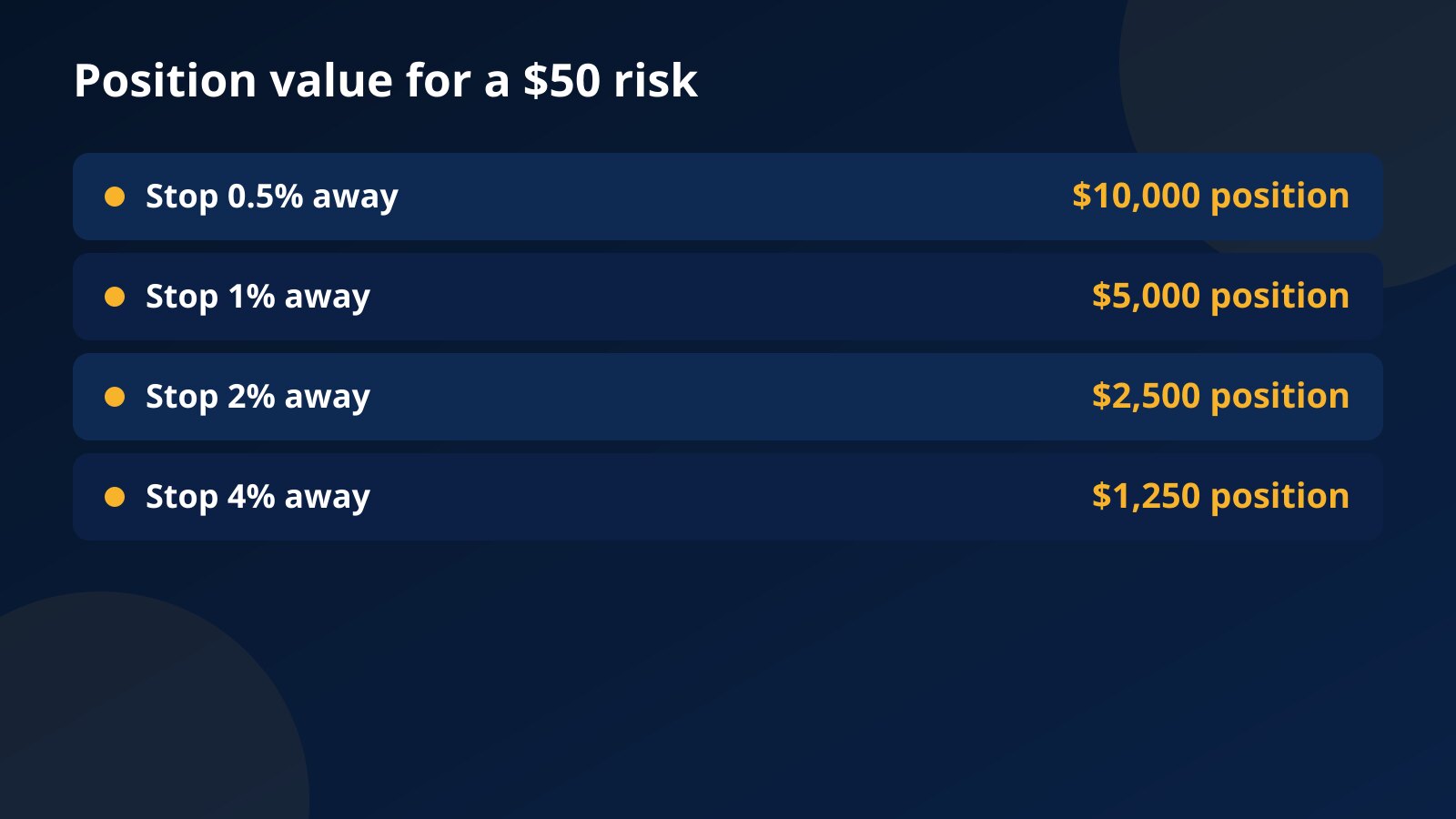
On a $10,000 account, risking 0.5% means $50 per trade. With a stop 0.5% away, the position value is $10,000; with a stop 2% away, it is $2,500. A trader who brings a crypto-sized position to gold, or a gold-sized position to crypto, quietly changes their risk by a factor of four while “the usual” still feels normal. The wider habits behind this are covered in crypto prop trading risk management, and how account size turns into buying power is explained in what a large funded account really means.
Write the stop distance down before you write the size. If the stop that makes sense on the chart forces a position larger than you are comfortable with, the trade is the problem, not the formula.
Create your Fundex24 account
Takes a few seconds. You can pick a challenge and add your phone number later.
Drawdown and target maths for gold
At Fundex24 the limits are the same whatever you trade: a daily drawdown of 5% of the day’s starting balance and a maximum drawdown of 10% of the initial balance, fixed. On a $10,000 account that is about $500 of room on a day that starts at $10,000, and a floor at $9,000. Both balance and equity are monitored, so an open gold position that swings against you counts before you close it. The two measurements are compared in daily drawdown vs max loss.
The profit target interacts with gold’s calmer days in a way worth planning for. Stage 1 asks for 10%, which is $1,000 on $10,000, and stage 2 for 8%, each over at least 5 trading days and with no deadline. A slower market tempts traders to size up to get it done. Do not let one trade do the whole job: at Fundex24, if a single position makes more than 60% of the stage target, its profit is not counted toward that target. On a $10,000 stage 1, that means no single trade should be expected to carry more than $600 of the $1,000.
Small, quick gold trades have one more catch. A trading day only counts when you open and close a position with a profit or loss of at least 0.25% of the initial balance, which is $25 on a $10,000 account. A session of tiny scalps that nets less than that may not add a trading day at all, so plan at least one trade per session with a meaningful target.
News, sessions and the funded-stage risk cap
Gold’s biggest moves tend to cluster around scheduled events: inflation and employment data, and central bank decisions. News trading is allowed at Fundex24, but the drawdown limits apply exactly the same during a spike, and equity is monitored as the price moves. A practical habit is to stand aside or cut size before a major release rather than widen a stop after the fact.
Once you are funded, one more rule matters for traders who like to stack positions: the combined open risk of all positions must stay within 3% of the day’s starting balance, or that day’s profit is not counted. Two or three gold positions in the same direction add up quickly under this cap. Hedging is allowed only with at least 15 minutes between the opposing positions, and all positions use isolated margin.
Trading gold on Fundex24
Fundex24 started with crypto, and stocks, ETFs and commodities can now be traded from the same challenge account in the Fundex24 terminal. Gold appears as XAU/USDT under Commodities in the token selector: a USDT-quoted contract that follows the gold price, traded with the same account, the same limits and the same profit split as every other symbol. Check the contract details shown in the terminal before your first trade.
The free practice account is the cheapest place to learn how gold feels next to your usual pairs: $10,000 in virtual funds for a short run, currently 3 days, with leverage up to 1:10 and up to three resets. If you are still choosing a plan, choosing a funded account size compares the options. Plans are on the challenges page, every condition is on the rules page, and the challenge support team can answer questions about specific symbols.
Frequently asked questions
Can I trade gold in a Fundex24 challenge?
Yes. Gold is listed as XAU/USDT under Commodities in the terminal and can be traded from the same challenge account as crypto, stocks and ETFs.
Pick a challenge and start trading
Two-step evaluation, transparent rules, profit split up to 80%.
Not sure which size fits? Read the rules · Common questions
Do the challenge rules change for gold?
No. The 10% and 8% targets, the 5% daily and fixed 10% maximum drawdown, the trading-day definition and the single-position rule are the same for every symbol.
Is news trading on gold allowed?
Yes. The drawdown limits and, on a funded account, the 3% combined open-risk cap still apply during the move.
How big should a gold position be?
Size it from the stop: the amount you are willing to lose divided by the stop distance in percent. $50 of risk with a 1% stop is a $5,000 position.
Does one big gold trade count toward the target?
Only up to a point. If a single position makes more than 60% of the stage target, its profit is not counted toward that target.
Questions about the Fundex24 challenges?
Open the support chat and ask — the team replies right there.
Chat with supportPrefer to read first? Browse the FAQ · Compare the challenges
Continue your learning path
Move from this article to the next useful action or topic.