


Updated 16 November 2026
Prop firms deny or shrink payouts when a request misses a written condition; at Fundex24 the conditions are a 30-day wait, five trading days, no open positions and no violations. That covers outright refusals. The other half of “why do prop firms deny payouts” is the payout that arrives smaller than expected because a rule left some profit out of the count. This guide goes through every reason a Fundex24 payout can be refused or reduced as of November 2026, with the dollar lines on each plan and how to stay clear of them.
Why do prop firms deny payouts? Start with the four conditions
Because the account isn’t eligible yet, which is the most avoidable refusal of all. Fundex24’s FAQ sets four requirements before any withdrawal, plus a calendar:
| Condition | Requirement | If it isn’t met |
|---|---|---|
| Time since your first funded trade | At least 30 days | Not eligible yet |
| Trading days on the funded account | At least 5 | Not eligible yet |
| Open positions and pending orders | 0 of each | Close everything first |
| Rule violations | None | Payout can be denied |
| Request date | The 14th or 28th, one request per period | Wait for the next date |
The 30 days run from your first trade on the funded account, not from the day it was activated. Say that trade happens on 3 December 2026: 30 days later is 2 January 2027, so the earliest payout date is 14 January 2027, provided five trading days are done by then. A trading day here means the same as in the challenge: a UTC day on which one closed position’s net result, profit or loss, is at least 0.25% of the starting balance, which is $25 on a $10,000 account.
None of this is a race. Profit can stay on the account for up to 365 days from your first trade, so missing the 14th only moves the request to the 28th. Our guide to what happens after you pass covers the funded request that comes before all of this.
Why a payout comes out smaller than 80% of your profit
Three rules can leave profit out without refusing the payout. None of them is a violation, and losses on the same trades always count in full.
The best-day rule
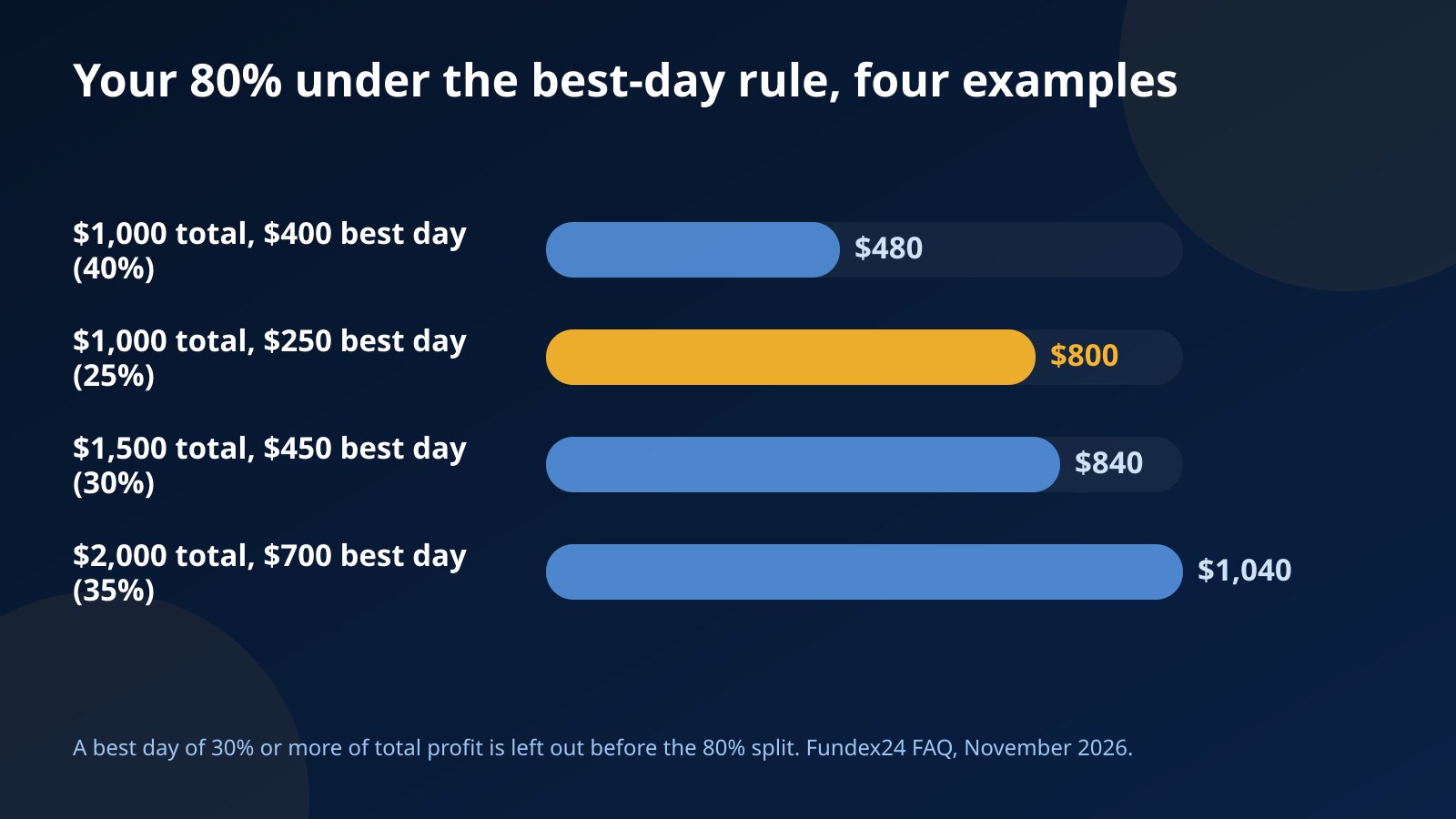
If your best day is 30% or more of total profit, that day’s profit is left out and your 80% is worked out on the rest. The share is best day ÷ total profit; when it reaches 30%, the counted profit is total minus best day, and the payout is 80% of that:
| Total profit | Best day | Best-day share | Profit that counts | Your 80% |
|---|---|---|---|---|
| $1,000 | $400 | 40% | $600 | $480 |
| $1,000 | $250 | 25% | $1,000 | $800 |
| $1,500 | $450 | 30% | $1,050 | $840 |
| $2,000 | $700 | 35% | $1,300 | $1,040 |
Note the third row: exactly 30% is already enough for the day to drop out. Losing days stay in the total, while trades set aside by other rules don’t, so a big win followed by a few small losses can push the best day’s share up rather than down.
The 3% floating-loss rule
Since 11 November 2026, every funded account is checked at every moment: if the floating loss of all open positions together goes past 3% of the day’s starting balance, recorded at 00:00 UTC, no profit from that UTC day is paid out. That covers trades closed earlier that day, trades closed later, and any position open at that moment even if it closes on a later day. The account stays active and losses count in full.
Create your Fundex24 account
Takes a few seconds. You can pick a challenge and add your phone number later.
The line is $90 on $3,000, $180 on $6,000, $300 on $10,000 and $600 on $20,000, and an ordinary day can reach it. Over the 30 days to the 15 November 2026 close, Bitcoin (BTC) had an average day range of 3.16% on Binance USDT-M perpetuals. A $10,000 BTC position on a $10,000 funded account, caught on the wrong side of a range that size, would be down $316, past the $300 line. A $5,000 position would be down $158.
The five-minute rule
A position held under five minutes, counted from the last time you added to it, keeps no profit, at every stage. Our article on the 80% profit split mindset looks at trading a funded account with the payout in mind.
When the profit is gone for good
Some outcomes don’t just trim a payout; they end the account or the cooperation:
- A loss-limit breach: the funded account has the same 5% daily and 10% maximum loss as the challenge. Touching either ends it, and earlier profit is no longer withdrawable.
- Prohibited behaviour: abusive scalping, repetitive algorithmic patterns, exploiting system errors and market manipulation. The FAQ says a first case brings a formal warning, and if it is found at withdrawal, the profit payment or even the cooperation can be refused.
- Someone else trading: only the person who completed KYC may trade the account, and use by a third party gets it blocked. Logging in from several of your own devices is fine.
- Inactivity: more than 30 calendar days without a trade deactivates a funded account.
KYC sits one step earlier. Without it there is no funded account to pay from at all: after Step 2 you press “Request funded account” on the Accounts page within 10 calendar days and upload a passport, national ID card or birth certificate with a face photo.
How do prop firms pay out at Fundex24?
In USDT, to your own wallet, twice a month. You close all positions, open “Withdraw Profit” in your user panel on the 14th or the 28th, and enter a wallet address on BEP20, the BNB Smart Chain. It is the only network used for payouts, and the transfer is completed within 24 hours. You receive 80% of the counted profit; the other 20% is Fundex24’s.
The wallet address is the one detail that is entirely yours. The FAQ asks you to make sure the wallet supports BEP20 before entering it, and to type it carefully. Our piece on USDT deposits and withdrawals explains the networks, and the wider guide to how prop firm payouts work follows a request from start to finish.
Before you press Withdraw Profit
Run through the same order the rules do. It takes a minute and covers every eligibility condition above:
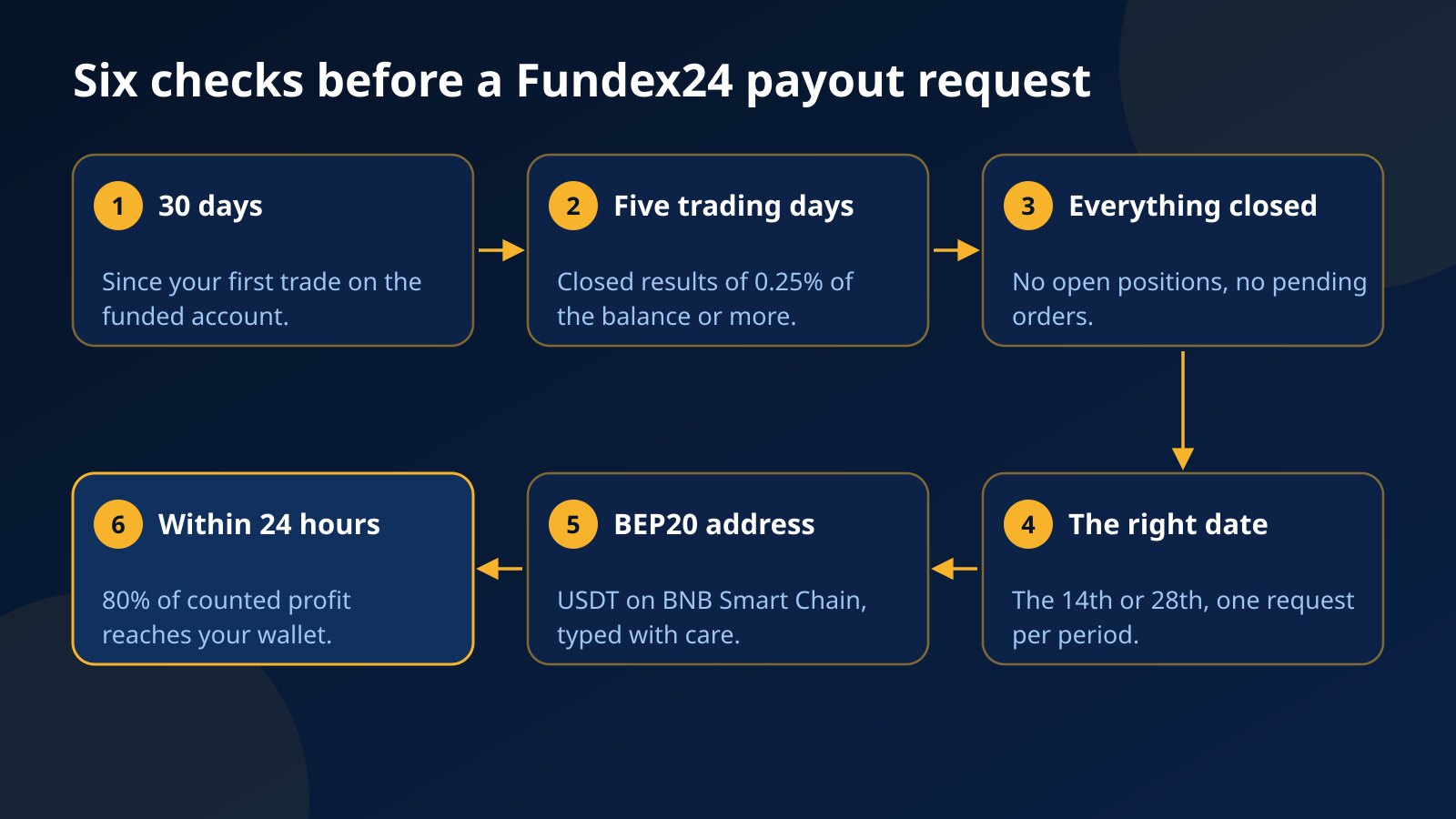
Then look back over the period for the three profit rules: a best day near 30% of the total, any moment when open losses passed 3% of the day’s starting balance, and positions closed inside five minutes. If something is unclear, ask before you request; the support chat has a payout category for exactly this.
On the figures used here: every rule number comes from Fundex24’s FAQ and rules page as of November 2026, including the floating-loss rule in force since 11 November 2026. The BTC range is from Binance USDT-M perpetual daily candles, UTC days, through the 15 November 2026 close, with range = (high − low) ÷ open, and the payout examples are arithmetic, not results. The full rule text sits on the Fundex24 FAQ page.
Payout questions in one place
Do prop firms really pay out?
Fundex24 publishes its payout terms in full: 80% of counted profit, on the 14th and 28th, in USDT on BEP20 within 24 hours. It publishes no payout totals, so the written terms are what you can check.
Pick a challenge and start trading
Two-step evaluation, transparent rules, profit split up to 80%.
Not sure which size fits? Read the rules · Common questions
What is a prop firm payout?
It is your share of the qualifying profit on a funded account. At Fundex24 that share is a flat 80%, sent as USDT to your own wallet.
How long does a prop firm payout take?
At Fundex24 the transfer is completed within 24 hours of a request made on the 14th or the 28th of the month.
Can a prop firm refuse a payout after a violation?
Yes. If prohibited behaviour is found at withdrawal, Fundex24 can refuse the profit payment and even end the cooperation; a loss-limit breach ends the account and earlier profit with it.
Can I leave profit in the account and withdraw later?
Yes. Profit can stay for up to 365 days from your first trade, and you can make one request in each period.
Do losing days count in the best-day rule?
They do. Losing days are part of the total profit the 30% share is measured against, while trades set aside under other rules are not.
Questions about the Fundex24 challenges?
Open the support chat and ask — the team replies right there.
Chat with supportPrefer to read first? Browse the FAQ · Compare the challenges
Continue your learning path
Move from this article to the next useful action or topic.