


Updated 16 November 2026
Bitcoin (BTC) can only reach $1 million if its total value grows about 15-fold, to roughly $20.1 trillion for the 20.11 million coins in circulation on 16 November 2026. That is 15.3 times its $1.31 trillion market cap on CoinGecko that evening, and about 71% of the value of all the gold above ground at the 15 November gold price. So can Bitcoin reach 1 million dollars? Nothing in its code stops it and nothing in its history promises it. What we can lay out is the arithmetic, the yearly pace it would take, and the falls Bitcoin has taken along the way. It is market math, not a forecast.
What would Bitcoin’s market cap be at $1 million?
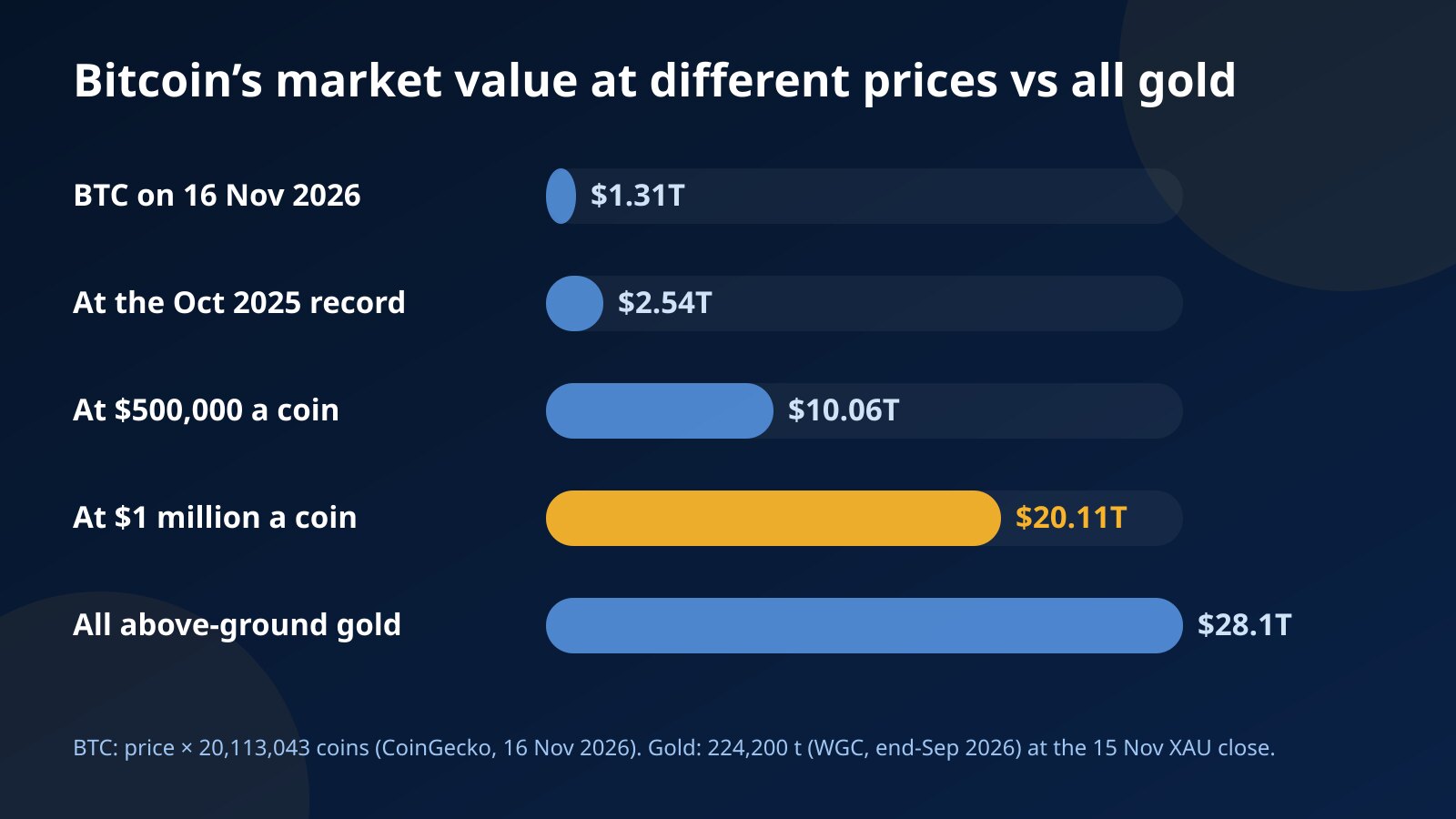
About $20.1 trillion. Market cap is price × coins in circulation, and CoinGecko counted 20,113,043 BTC at 22:56 UTC on 16 November 2026, when one bitcoin cost $65,348. The table runs the same multiplication at other prices people ask about.
| Price per BTC | Market value | Times the 16 Nov value |
|---|---|---|
| $65,348 (16 Nov 2026) | $1.31 trillion | 1.0× |
| $126,080 (record, 6 Oct 2025) | $2.54 trillion | 1.9× |
| $250,000 | $5.03 trillion | 3.8× |
| $500,000 | $10.06 trillion | 7.7× |
| $1,000,000 | $20.11 trillion | 15.3× |
| $1,000,000 × all 21 million BTC | $21.00 trillion | 16.0× |
The record row uses the November 2026 supply, so it slightly overstates Bitcoin’s value on 6 October 2025, when fewer coins existed. Even at that peak, the whole network was worth about an eighth of what $1 million a coin implies.
Gold is the usual yardstick. The World Gold Council estimates 224,200 tonnes of gold above ground at the end of September 2026. That is about 7.21 billion troy ounces, and at the 15 November close of the XAU gold contract, $3,904.03 an ounce, it comes to roughly $28.1 trillion. A $1 million bitcoin would be worth about 71% of that; on 16 November 2026 Bitcoin was worth about 4.7% of it.
How many bitcoin are there, and how many are left?
There were 20,113,043 BTC in circulation on 16 November 2026, against a hard cap of 21 million, so 95.78% of all the bitcoin that will ever exist had already been issued and 886,957 remained.
New coins arrive slowly. Since the April 2024 halving, each block pays miners 3.125 BTC, and with a block about every ten minutes that is roughly 450 BTC a day, or 164,250 a year: about 0.82% of the coins in circulation. The reward halves every 210,000 blocks, roughly every four years, until the last fractions of a coin are paid out around 2140.
For the $1 million question, supply barely matters any more. Whatever the year, a $1 million price would mean a market value somewhere between $20.1 and $21 trillion; the growth would have to come almost entirely from the price.
Can Bitcoin reach 1 million in 10 years? The pace it takes
Only at an average gain of about 31.4% a year from the 15 November 2026 close of $65,351.05 on Binance spot, and 72.6% a year to get there in five. The table sets those required rates beside what Bitcoin actually did over three past stretches.
| Period | Price multiple | Average per year |
|---|---|---|
| Needed: $1 million by November 2031 (5 years) | 15.3× | +72.6% |
| Needed: by November 2036 (10 years) | 15.3× | +31.4% |
| Needed: by November 2046 (20 years) | 15.3× | +14.6% |
| Actual: 17 Aug 2017 to 15 Nov 2026 (9.2 years) | 15.3× | +34.4% |
| Actual: 1 Jan 2018 to 15 Nov 2026 (8.9 years) | 4.8× | +19.2% |
| Actual: 1 Jan 2021 to 15 Nov 2026 (5.9 years) | 2.3× | +14.9% |
The formula is (end ÷ start)^(1 ÷ years) − 1. The coincidence in the fourth row is real: from $4,261.48 on 17 August 2017, the first day of Binance’s BTC/USDT price history, Bitcoin rose 15.3-fold by 15 November 2026, almost exactly the multiple $1 million now needs. That took 9.2 years and included falls of 84% and 78% on the way.
Create your Fundex24 account
Takes a few seconds. You can pick a challenge and add your phone number later.
The next two rows show how much the starting point decides the answer. Begin on 1 January 2018, two weeks after the 2017 peak, and the average drops to 19.2% a year; begin in 2021 and it is 14.9%. Calendar years swung from −73.0% in 2018 to +302.0% in 2020, and 2026 stood at −25.4% by 15 November. These rows describe what a target implies; they are not a view on whether Bitcoin will hit it.
Can Bitcoin go to zero? Its deepest falls so far
Nothing in the data rules it out, but in more than nine years of Binance prices its deepest fall was 84.1%, from $19,798.68 on 17 December 2017 to $3,156.26 on 15 December 2018. The table lists every fall of 30% or more from a record high since that 2017 peak.
| Record high | Low that followed | Fall | Days to a new record |
|---|---|---|---|
| $19,798.68 (17 Dec 2017) | $3,156.26 (15 Dec 2018) | −84.1% | 1,079 |
| $41,950 (8 Jan 2021) | $28,850 (22 Jan 2021) | −31.2% | 31 |
| $64,854 (14 Apr 2021) | $28,805 (22 Jun 2021) | −55.6% | 189 |
| $69,000 (10 Nov 2021) | $15,476 (21 Nov 2022) | −77.6% | 849 |
| $73,777 (14 Mar 2024) | $49,000 (5 Aug 2024) | −33.6% | 237 |
| $109,588 (20 Jan 2025) | $74,508 (7 Apr 2025) | −32.0% | 121 |
| $126,199.63 (6 Oct 2025) | $57,800.19 (1 Jul 2026) | −54.2% | Not yet (405 days to 15 Nov 2026) |
Every fall but the last was followed by a new record, after anything from 31 to 1,079 days. The latest one is still open: on 15 November 2026 BTC closed 48.2% below its October 2025 peak and 13.1% above the July low. The days column counts from the record to the first day the price traded above it again.
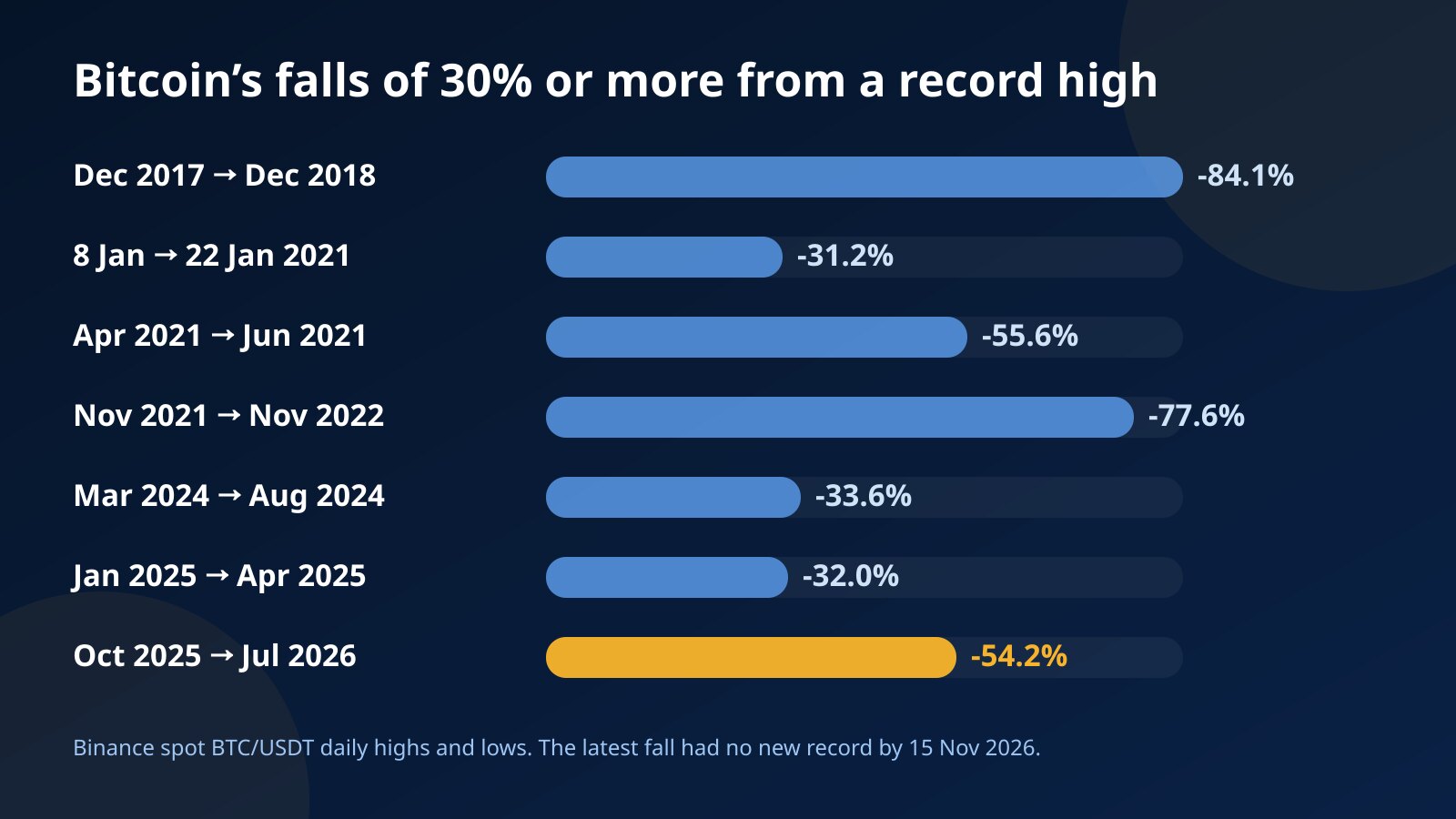
So the history holds two falls of more than 75%, each followed by new highs. It doesn’t show that the next fall must end the same way, which is why “can Bitcoin go to zero” has no answer in the data, only a track record.
Trading Bitcoin both ways on a prop challenge
You don’t need a view on $1 million to trade Bitcoin; you need to know how far it moves in a day. BTC/USDT, the perpetual contract Fundex24 shows, closed at $65,309.80 on 15 November 2026. Over the 365 days before that, its median day covered 2.95% from low to high, 3 days had a range of 10% or more, and the widest, 19.0%, came on Friday 6 February 2026. It closed higher on 176 days and lower on 189.
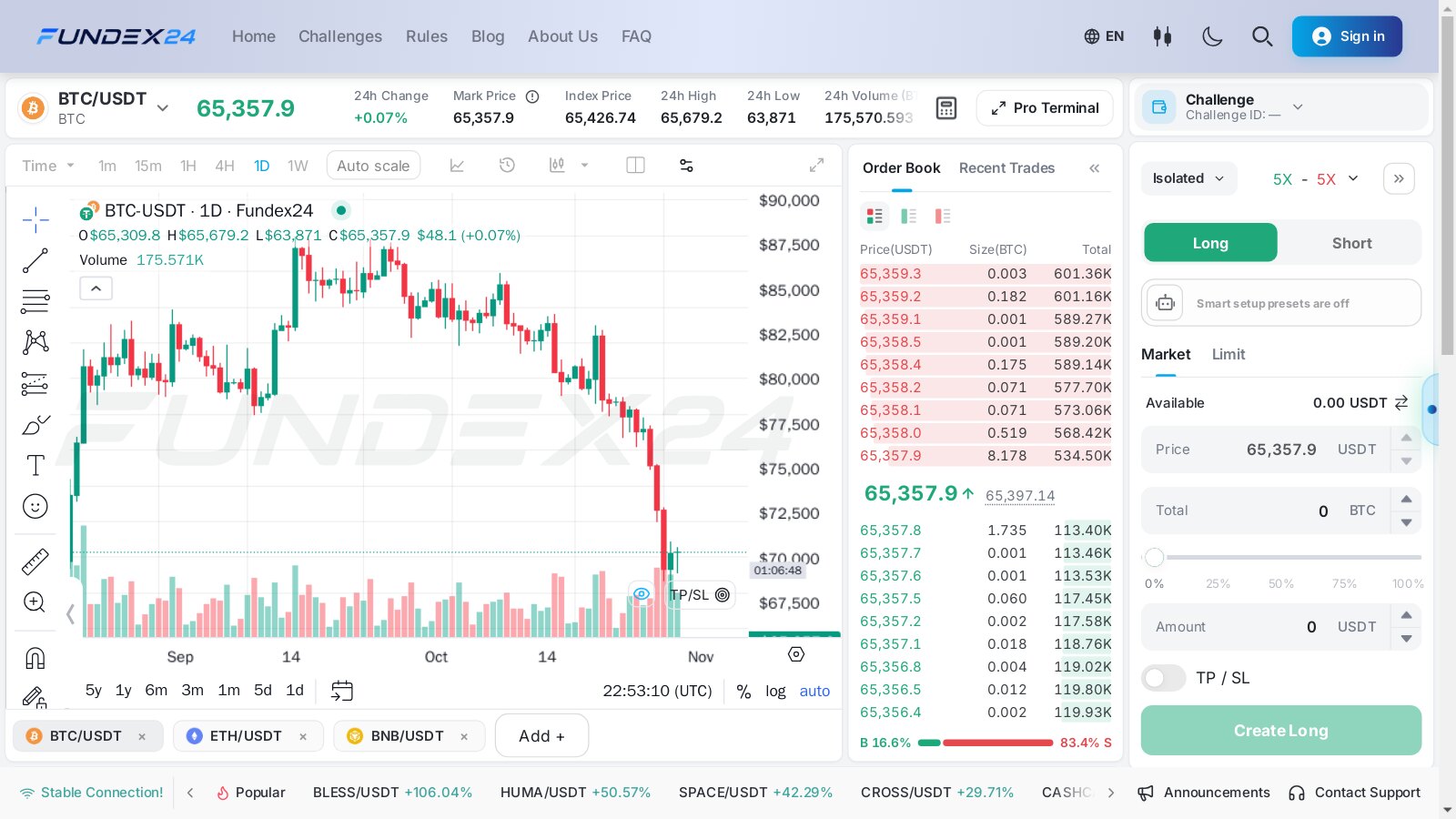
On Fundex24 that contract trades long or short at up to 1:10, isolated margin only, on a simulated account with prices that follow Binance futures. On the $10,000 challenge the daily loss limit is $500 below the balance recorded at 00:00 UTC, the account fails if equity touches $9,000, and the targets are $1,000 for Step 1 and $800 for Step 2. Profit from a single position that earns $600 or more, 60% of the Step 1 target, doesn’t count toward it.
Put those limits next to the data. A $5,000 BTC position, $1,000 of margin at 5x, swung $147.50 from high to low on a median day. On 6 February 2026 the same position would have swung $950, nearly twice the daily limit. Twice in the past year Bitcoin fell 9.5% or more from the day’s open, and once it rose that far, moves that would have liquidated a 1:10 position on the wrong side. Our guide to building a Bitcoin trading plan turns numbers like these into rules, and crypto prop risk management covers sizing across pairs.
The $10,000 challenge costs $89, or $80.10 with the PROPOFF10 code, which takes 10% off the $3,000, $6,000 and $10,000 plans once per user. The fee is the most you can lose on a challenge, and it isn’t refunded if the challenge fails. The challenge plans page lists all four sizes on sale, and the BTC/USDT trade page opens without an account.
If you are weighing other routes, trading crypto without capital compares the options and what each costs, and the best pairs for prop trading puts BTC next to the alternatives. Answers on payouts and KYC are in the Fundex24 FAQ.
Where the numbers come from
Market cap, circulating supply and the $126,080 record are CoinGecko’s at 22:56 UTC on 16 November 2026. Yearly changes, record highs, falls, recovery days and the pace table use Binance spot BTC/USDT daily candles from 17 August 2017 through the 15 November 2026 close. Daily ranges and the 9.5% counts come from the BTC/USDT perpetual on Binance, UTC days, over the 365 days to 15 November 2026, and the gold price from the XAU perpetual’s close that day. The gold tonnage is the World Gold Council’s end-September 2026 estimate; the block reward and halving schedule are Bitcoin’s protocol rules. Challenge numbers are from Fundex24’s rules and FAQ as of November 2026.
Nothing here is a price prediction or investment advice. Funded accounts are simulated, and leveraged trading can lose the whole margin of a position.
Pick a challenge and start trading
Two-step evaluation, transparent rules, profit split up to 80%.
See the challengesNot sure which size fits? Read the rules · Common questions
Bitcoin price questions, answered with data
Can Bitcoin hit 1 million by 2031?
It would need to average about 72.6% a year from the 15 November 2026 close, roughly twice its 34.4% yearly average since August 2017. That is a statement about pace, not about the odds.
How many bitcoin are left to mine?
About 886,957 BTC, or 4.22% of the 21 million cap, going by CoinGecko’s circulating figure on 16 November 2026. At 3.125 BTC per block and further halvings, the last of them will take until around 2140.
How low can Bitcoin go?
The code sets no floor. As of 15 November 2026, the lowest point of the fall that began in October 2025 was $57,800.19 on 1 July 2026, 54.2% under the record, and the fall that ended in December 2018 went as far as 84.1%.
Can Bitcoin crash?
It has, repeatedly: seven falls of 30% or more from a record since December 2017. On a single day, 6 February 2026, the BTC/USDT perpetual moved 19.0% between its high and its low.
What Bitcoin price would match the value of all gold?
About $1.40 million a coin. The World Gold Council’s 224,200 tonnes, priced at the 15 November XAU close, come to roughly $28.1 trillion, and dividing by 20,113,043 BTC gives that figure.
Do you need to own bitcoin to trade it on a prop account?
No. On Fundex24 you trade the BTC/USDT perpetual on a simulated account, long or short, and the only money you pay is the challenge fee, from $29 for a $3,000 account.
Questions about the Fundex24 challenges?
Open the support chat and ask — the team replies right there.
Chat with supportPrefer to read first? Browse the FAQ · Compare the challenges
Continue your learning path
Move from this article to the next useful action or topic.