


Challenge rules
They exist, and Fundex24 runs one: there is no deadline for reaching the 10% Step 1 target or the 8% Step 2 target. What a prop firm with no time limit still asks of you is activity: a first trade within 30 days of the stage starting, never 30 days in a row without a trade, and at least five valid trading days in each step. The rest is up to your pace, and that should change how much you risk per trade.
What “no time limit” means on a Fundex24 challenge
On the rules page the Trading Period row reads Unlimited for every plan: the challenge has no expiry date as long as you keep to the activity rules. In practice that means:
- Targets: 10% in Step 1 (the Challenge) and 8% in Step 2 (Verification), with no date by which you must reach them.
- First trade: within 30 calendar days of the stage starting.
- Inactivity: 30 calendar days without a trade fails the challenge.
- Minimum days: at least five valid trading days in each step.
- Closing out: a stage can’t pass while you still have positions open.
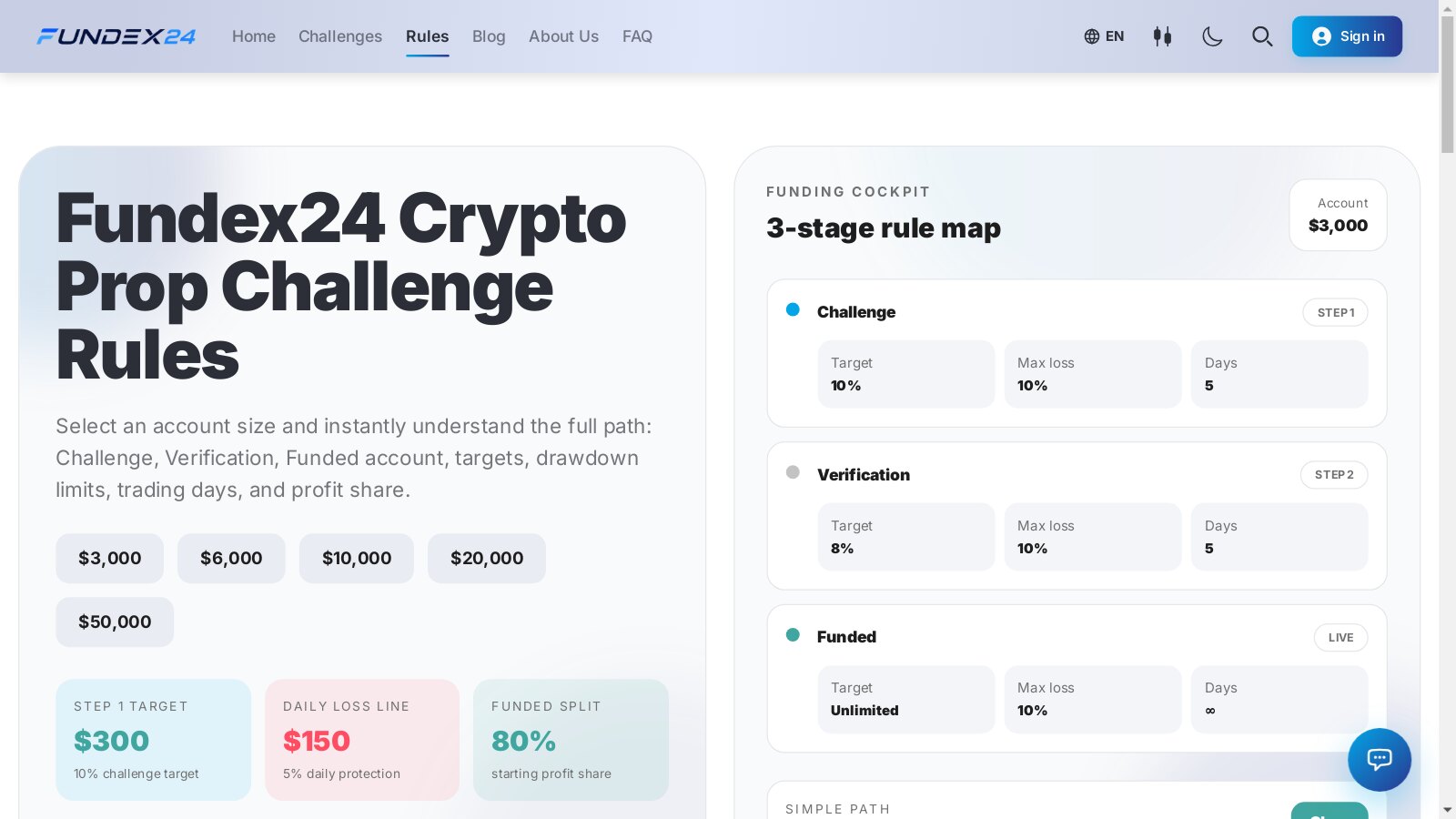
The loss limits don’t change with the clock. Daily loss is 5% and maximum loss 10% of the stage’s starting balance, and touching either one fails the account even if the price comes back an hour later.
Five valid trading days: what counts and what doesn’t
A valid trading day isn’t any day you happen to click Buy. It’s a day with at least one closed trade whose net result, profit or loss, comes to at least 0.25% of the stage’s starting balance. On a $10,000 account that’s $25.
Three things follow from that wording. A string of scalps that each net $8 won’t make a valid day on $10,000, however many of them you take. A $30 loss will, because the rule counts losses as well as wins. And a position you open but don’t close that day doesn’t count at all, because only closed trades do. So the earliest you can pass a step is on your fifth valid day, provided the target is already reached and nothing is left open.
The clocks that still run
Put on a timeline, a Fundex24 challenge has short deadlines at the two ends and a long open stretch in the middle. That middle is where the benefit of unlimited time lives, and it’s also where the 30-day inactivity rule can catch someone who walks away for a month after a bad week.
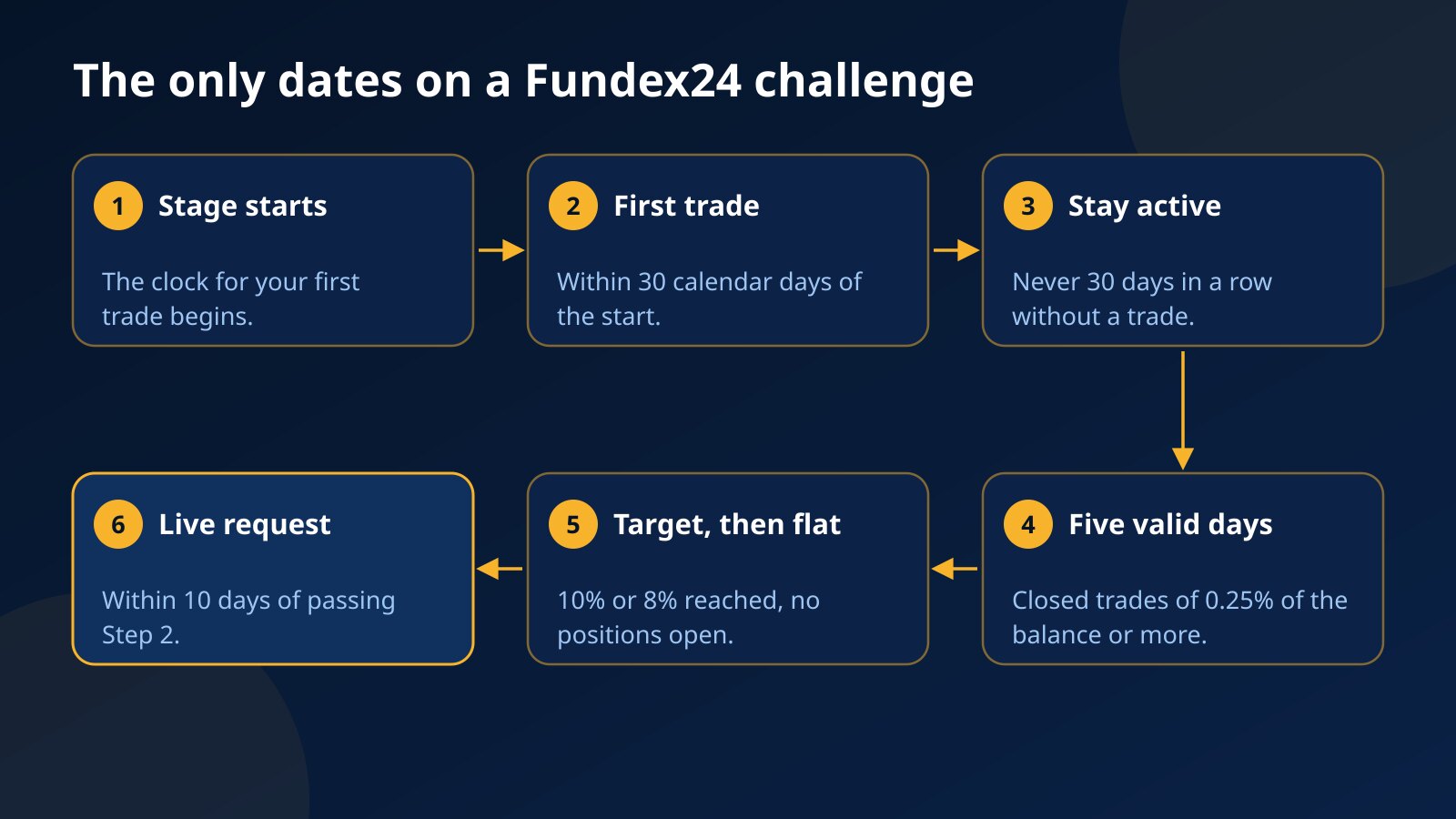
The last date comes after Step 2. Once you pass Verification you have 10 days to ask for the funded account with a “Live account request” support ticket; the team reviews it and activates the account. Our explainer of the two-step challenge covers what changes between the steps.
Deadlines aren’t what fail accounts. The daily loss is.
If time pressure were the main problem, removing it would fix most failures. Our own numbers say otherwise. On Fundex24’s paid challenge accounts over the last 120 days, 59.2% of failed accounts were closed by the daily loss limit and 34.2% by the maximum loss. Only 6.5% failed for something that wasn’t a loss limit at all.
The timing points the same way. Of those failed accounts, 14.1% went within a day of purchase and 28.3% within three days, but 57.6%, more than half, failed after their first week. These traders weren’t racing a deadline. Early or late, the most common ending was a single day that went too far, and most failures happen in Step 1.
There’s an hour-of-day pattern as well: 37.6% of daily-loss failures came in the same four hours, 12:00 to 16:00 UTC, the window around the US open. With no deadline, sitting that window out on days you aren’t ready for it costs you nothing.
Create your Fundex24 account
Takes a few seconds. You can pick a challenge and add your phone number later.
Four habits that unlimited time makes possible
Size from the daily line, not the calendar
Traders on a deadline work backwards from the date: $1,000 in 30 days means $33 a day, so the size has to produce $33 a day. Without a deadline, start from the other end. Take your daily loss limit and size down until a full bad day is something you can shrug off.
Skip the days that don’t suit you
A central-bank day, a market you haven’t been following, a morning when you’re tired. You need five valid days per step, not twenty, and nobody is counting the ones you leave out.
Never take the last-week gamble
The classic deadline failure is doubling up in the final days. Here it isn’t even useful: on a $10,000 Step 1, a single trade that makes $600 or more (60% of the $1,000 target) doesn’t count toward it.
Keep a minimum rhythm
The inactivity rule is the only way unlimited time can bite. If you step away, make sure a trade goes in before 30 days pass. Our guide to passing without overtrading shows how few trades a calm week really needs.
Worked example: a $10,000 Step 1 on BTC, at no-deadline pace
The account: $10,000, a $1,000 Step 1 target, a $500 daily loss limit and a maximum-loss floor at $9,000.
- Risk per trade: $50, half a percent. Ten full losers would be needed to reach the daily line, so a bad day costs you a day, not the account.
- Stop distance: BTC’s average daily range over the last 60 days was 3.1%. A stop 1.25% from entry lets an ordinary day breathe.
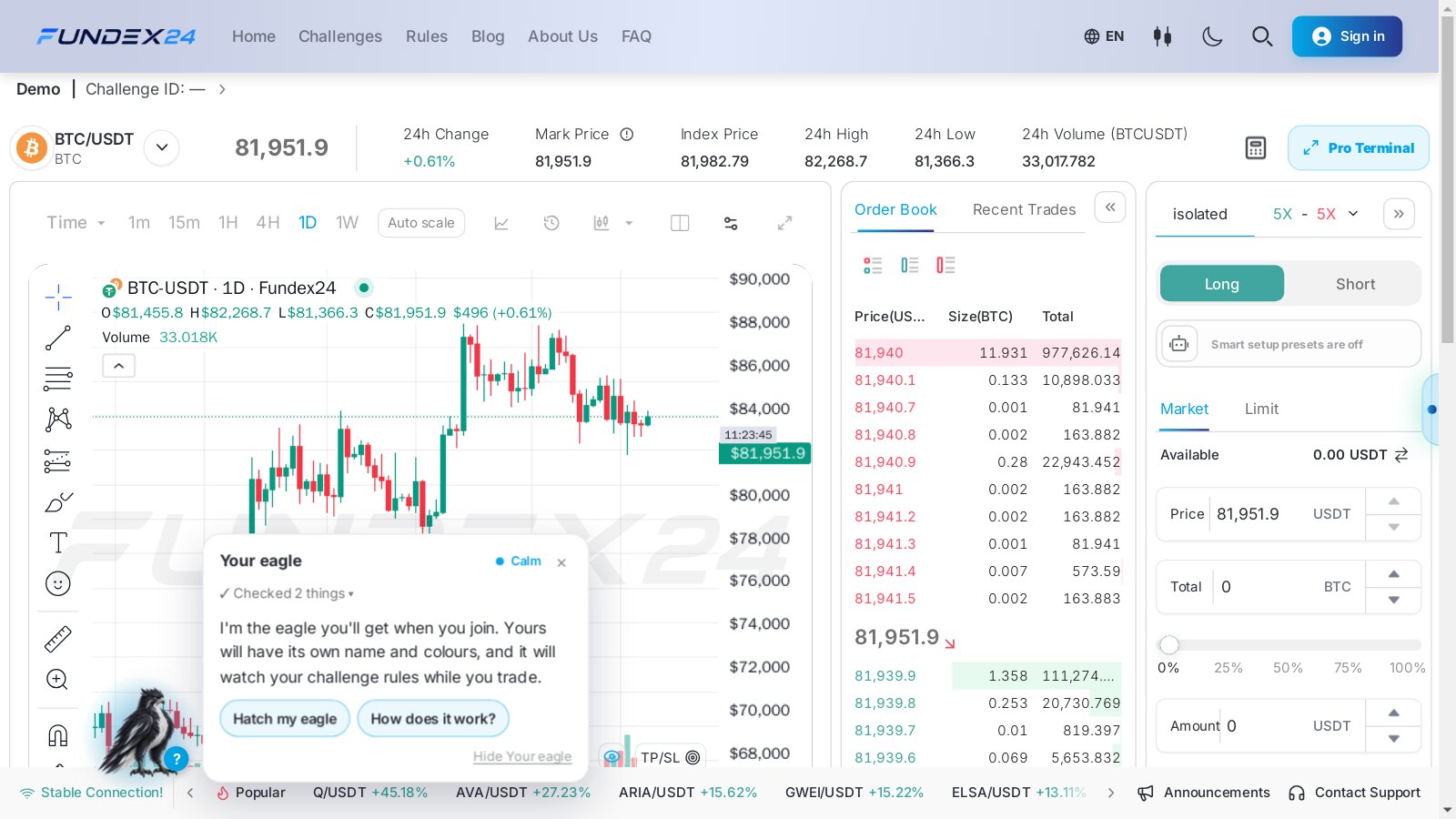
- Position size: $50 ÷ 1.25% = $4,000 of BTC, about 0.05 BTC with the price near $81,000 at the time of writing (mid-October 2026). At 1:10 that’s $400 of margin; at the 5x the trade page preselects, $800.
- The widest day: BTC covered 9.8% from low to high on 19 August. Caught on the wrong side without a stop, a $4,000 position would lose about $392, nearly four-fifths of the day’s limit in one trade. With the stop, the loss is about $50 plus any slippage past it.
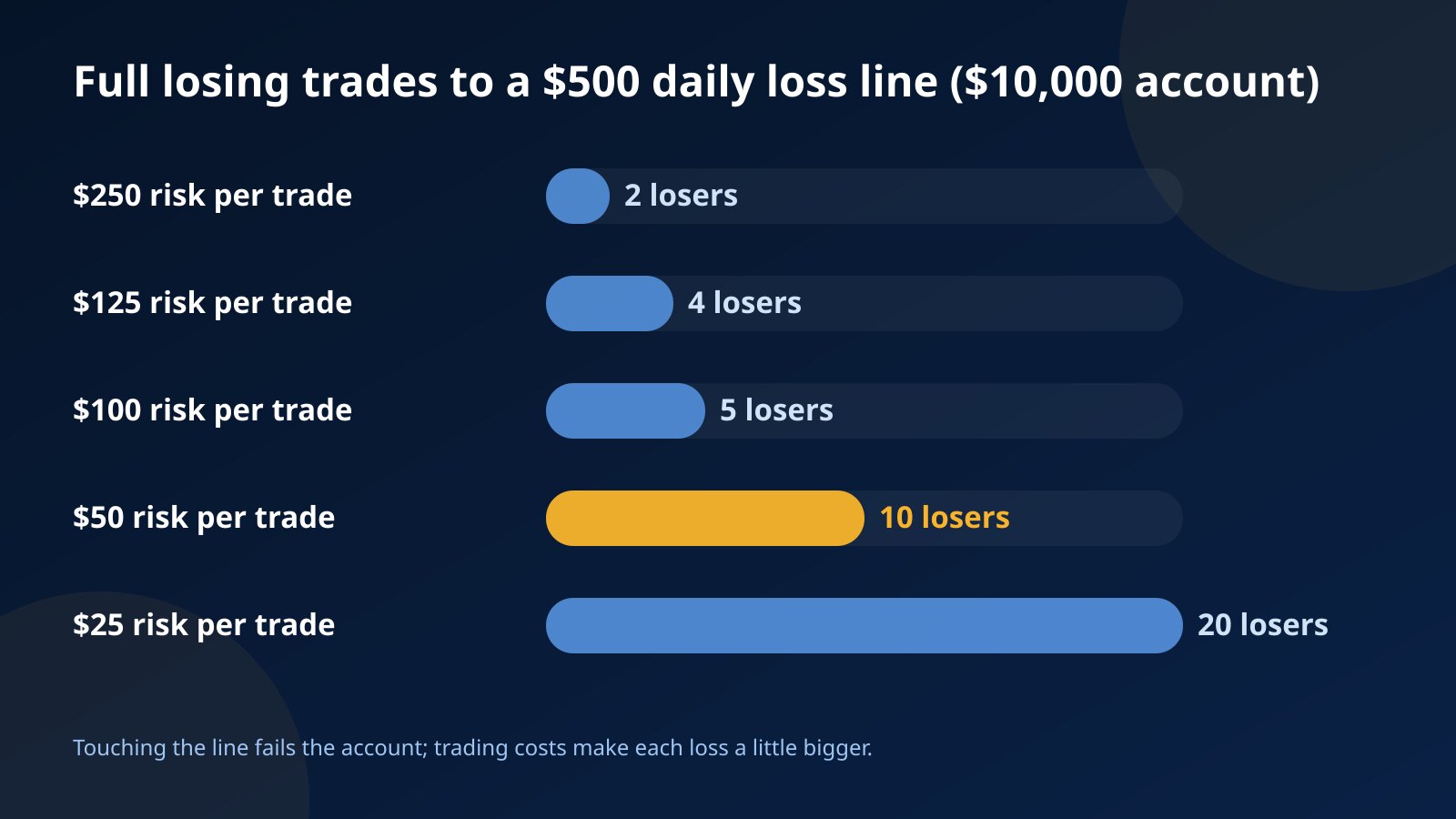
At $50 a trade, the $1,000 target is twenty times your risk. Reaching it in five days takes luck, and on a challenge without a deadline you don’t need to. If it takes six weeks, the rules don’t mind. You can test the numbers on the BTC/USDT trade page.
Trading slowly usually means holding positions overnight, so know how the daily loss has worked since 16 October 2026. Each day now starts from the account’s closed balance at the daily reset, not from its equity. Profit still open at the reset that you give back later is no longer a daily loss. An open loss is different: if your BTC long is $150 under water at the reset, your room for the new day is $350, not $500. Our piece on daily drawdown vs max loss sets out both limits side by side.
Watching the room you have left
The trade page has a rule-based helper for this. Every account has its own eagle, and on the trade page it shows today’s room to the daily loss and the distance to the maximum-loss floor. It warns you when a position has no stop, tells you what a new stop would risk against today’s room, and after a close explains why the trade ended and whether the five-minute or 60% rule kept its profit out of the target. It doesn’t predict prices and it doesn’t trade for you, and you can hide it and bring it back from the account menu.
Moving to a prop firm with no time limit: where to start
There’s one Fundex24 account that does run on a clock: the free practice account. It lasts three days, comes with $10,000 of virtual money, three resets and leverage up to 1:10, and it’s a good place to find out what a half-percent risk feels like before it matters. It opens once you create a free account.
After that, the $3,000 challenge costs $29, or $26.10 with the blog code PROPOFF10, and the fee is the most you can lose. You can compare the challenge sizes first; the Trading Period reads Unlimited on every plan. Be realistic about the odds, though: most challenge accounts fail, and the funded account at the end is simulated, with an 80% profit split.
One warning before you start: at 1:10, a 1% move against you costs 10% of the position’s margin, and losses build quickly. Nothing here is investment advice or a promise of income.
Pick a challenge and start trading
Two-step evaluation, transparent rules, profit split up to 80%.
Not sure which size fits? Read the rules · Common questions
No-time-limit challenges: common questions
Is there really no time limit on a Fundex24 challenge?
There’s no deadline for reaching the 10% and 8% targets. The only time rules are about activity: trade within 30 days of a stage starting and never go 30 days without a trade.
What happens if I don’t trade for 30 days?
The challenge fails. Thirty calendar days without a trade, counted from your last one, is the inactivity limit.
Can I pass a step in five days?
Yes, if you reach the target, have five valid trading days and have no positions open. Five is the minimum, not a goal.
Does a losing day count as a valid trading day?
It does, as long as a closed trade’s net loss is at least 0.25% of the stage’s starting balance. The rule looks at the size of the result, not its sign.
Does the free practice account have a time limit?
Yes. It runs for three days with three resets, because it’s meant for learning the terminal, not for being evaluated.
Is there any deadline after I pass Step 2?
One: ask for your funded account with a Live account request ticket within 10 days of passing.
Questions about the Fundex24 challenges?
Open the support chat and ask — the team replies right there.
Chat with supportPrefer to read first? Browse the FAQ · Compare the challenges
Continue your learning path
Move from this article to the next useful action or topic.