




Step-by-step guide
Most guides to a crypto prop firm stop at “pass the challenge, get funded”. This one follows a single $10,000 Fundex24 account from the moment you pay to the first withdrawal, with the dollar figure behind every rule along the way. At the end you get a short list of questions that work for judging any crypto prop offer, not only this one.
Step 1: pick a plan at the crypto prop firm and pay
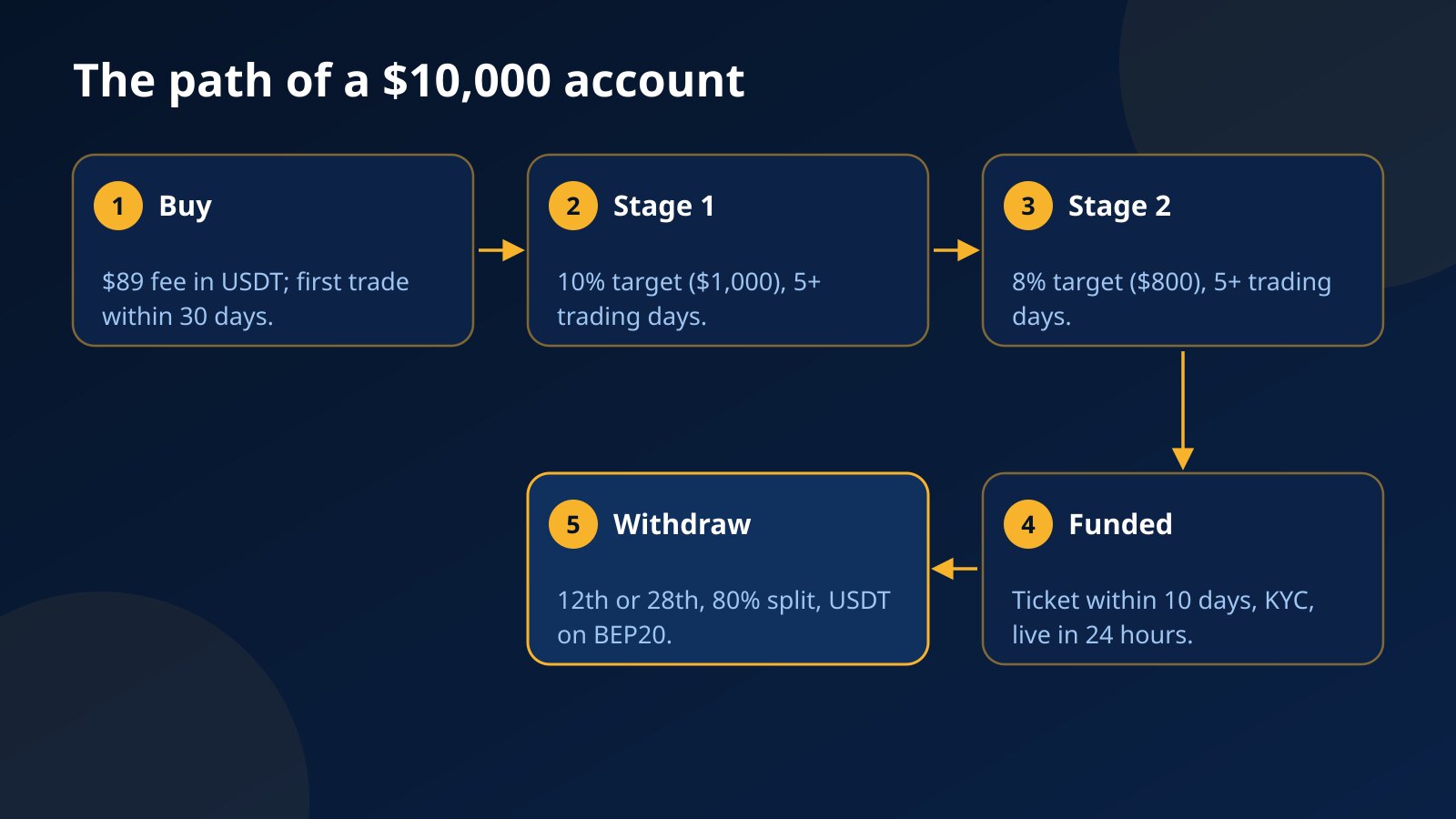
Fundex24 has three plans: a $3,000 account for $29, a $6,000 account for $59 and a $10,000 account for $89. The fee is paid once, in USDT on BEP20 (BSC), TRC20 or ERC20, and there is no KYC at this point. If you fail, the fee is not refunded, but it is also the most you can lose, and you can buy a new challenge whenever you like.
Our example uses the $10,000 plan. Before paying, it is worth checking the PROPOFF10 discount code, which brings that fee down to $80.10 for one purchase per account.
The clock starts at purchase in one way only: your first trade has to be opened within 30 days, or the challenge is void. There is no time limit for finishing the stages themselves.
Step 2: stage 1 on a $10,000 account
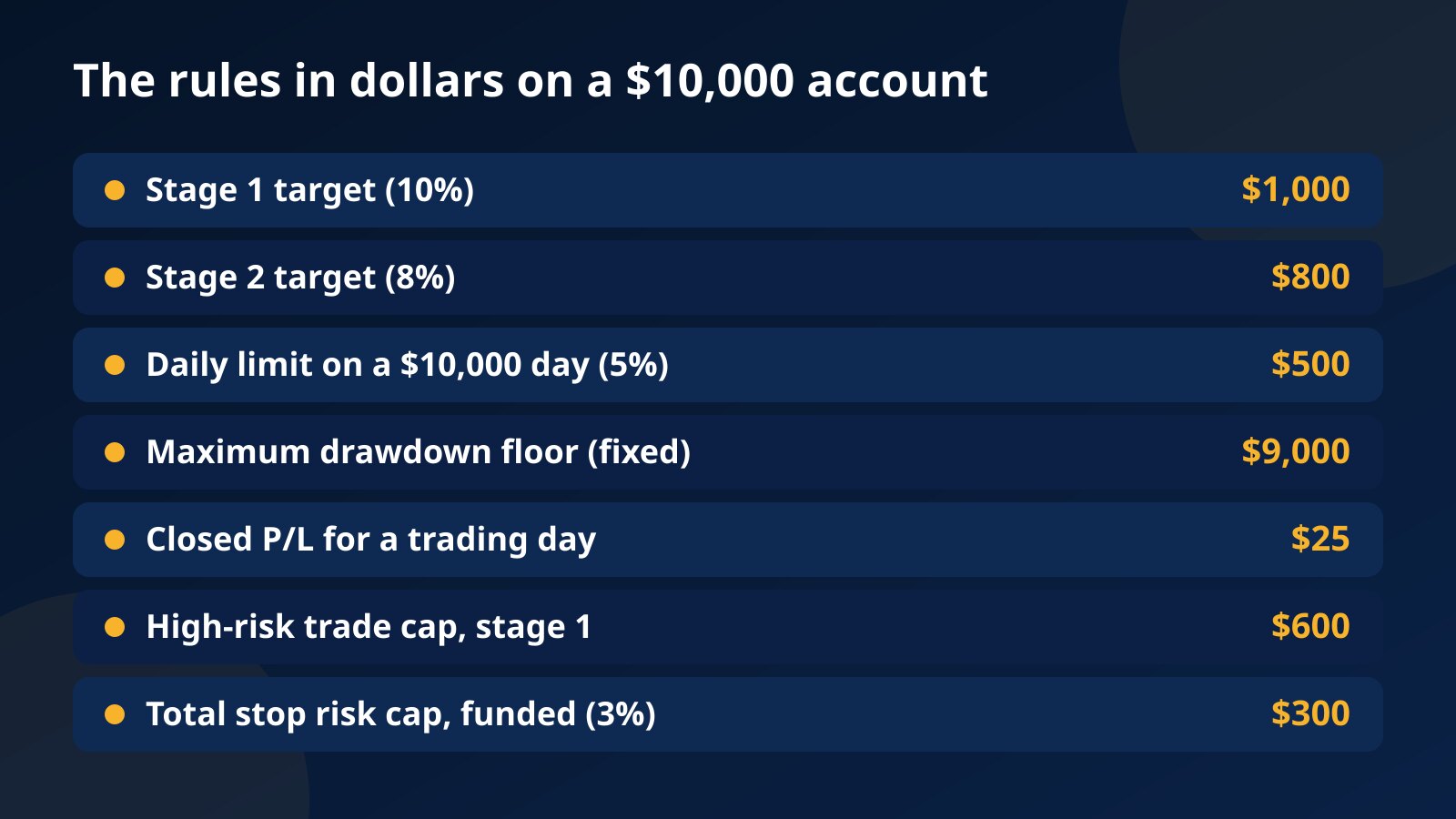
Stage 1 asks for a 10% profit, which is $1,000, so the goal is a balance of $11,000. You also need at least 5 trading days in the stage. A trading day is a day on which you open at least one position and close it with a profit or loss of at least 0.25% of the initial balance: $25 here. Opening a trade and closing it for $6 does not count.
The two loss limits in dollars
The daily drawdown is 5% of the day’s starting balance. If a day starts at $10,400, you may lose up to $520 that day, so your equity must stay above $9,880. The maximum drawdown is 10% of the initial balance and it does not move: the floor is $9,000 on day one and still $9,000 after you are up $900.
Both limits look at balance and at equity. A floating loss that touches the limit for a moment breaks the rule, even if price turns around a minute later and the trade ends green. The difference between the two limits is covered in more depth in daily drawdown vs max loss.
The $600 high-risk trade cap
In the challenge stages, a single position that makes more than 60% of the stage’s profit target is treated as high risk, and its profit does not count toward the target. In stage 1 that line sits at $600. If one lucky BTC short makes $700, you still need to earn the target with other trades. The rule pushes you toward several moderate wins, which also keeps each trade small next to the drawdown limits.
Leverage goes up to 1:10 on every market, and only isolated margin is allowed. You can go long or short, and you can open the BTC-USDT trade page or any other market with prices that follow Binance Futures. You never buy or hold the coin itself.
Step 3: stage 2 and its 30-day start
Stage 2 has a lower target, 8%, or $800 on this account, and again needs at least 5 trading days. The daily and maximum drawdown work exactly as in stage 1. Because the target is smaller, the high-risk cap is smaller too: 60% of $800 is $480, so a single $500 winner would not count.
Create your Fundex24 account
Takes a few seconds. You can pick a challenge and add your phone number later.
There is one deadline to keep in mind. After you enter stage 2, you have 30 calendar days to open your first stage-2 trade. Beyond that first trade, there is again no time limit to reach the target.
A common trap here is speed. After passing stage 1 it is tempting to size up and finish quickly, but a bigger size is exactly what turns a normal losing day into a breach. Going after the $800 at the pace that got you through stage 1 is the safer choice.
Step 4: request the funded account and complete KYC
The funded account is not switched on by itself. After passing stage 2 you send a ticket from the user panel within 10 calendar days. This is the point where KYC comes in: a passport, national ID card or birth certificate, uploaded clearly together with a face photo. There is no extra fee, and the account is active within 24 hours.
The 3% cap on total stop risk
The funded account keeps the 5% daily and 10% maximum drawdown, and adds one rule. The platform adds up the risk of all your open positions, measured as what each one would lose if its stop-loss is hit, and caps that total at 3% of the account: $300 on a $10,000 account.
In practice: three positions that would each lose $100 at their stops sit right at the $300 cap. Try to add a fourth one of the same size and the platform will not open it, because the total risk to your stops would go above 3%. Planning the stop before the entry tells you in advance how much room is left.
Also keep the account alive. If you place no trade for more than 30 calendar days, the funded account is deactivated.
Step 5: the first withdrawal on the 12th or 28th
Withdrawals open twice a month, on the 12th and the 28th, with one request per period. The first one has four conditions: at least 30 days since your first funded trade, at least 5 trading days on the funded account, all positions closed and no rule violations.
The split is 80% to you. If the funded account shows $600 of profit when you request, your share is $480. It is paid in USDT on BEP20 (BNB Smart Chain) only, within 24 hours, so make sure your wallet address is on that network. USDT deposits and withdrawals covers the wallet side.
What can end the run early
Breaking the daily or maximum drawdown closes the account at any stage. Beyond the limits, a short list of behavior is prohibited:
- Abusive scalping, and repetitive algorithmic patterns that only exploit short-term behavior.
- Exploiting system errors such as wrong prices or data delays.
- Market manipulation.
- Letting someone else trade your account.
- Copying identical trades across several challenges you run at the same time; this fails all of the related challenges.
A first detection brings a formal warning. If it is found at withdrawal, the payout or the cooperation can be refused. What is allowed is just as useful to know: news trading, long and short on every market, and hedging a long and a short on the same market. The complete list is on the Fundex24 rules page.
How to judge any crypto prop firm offer
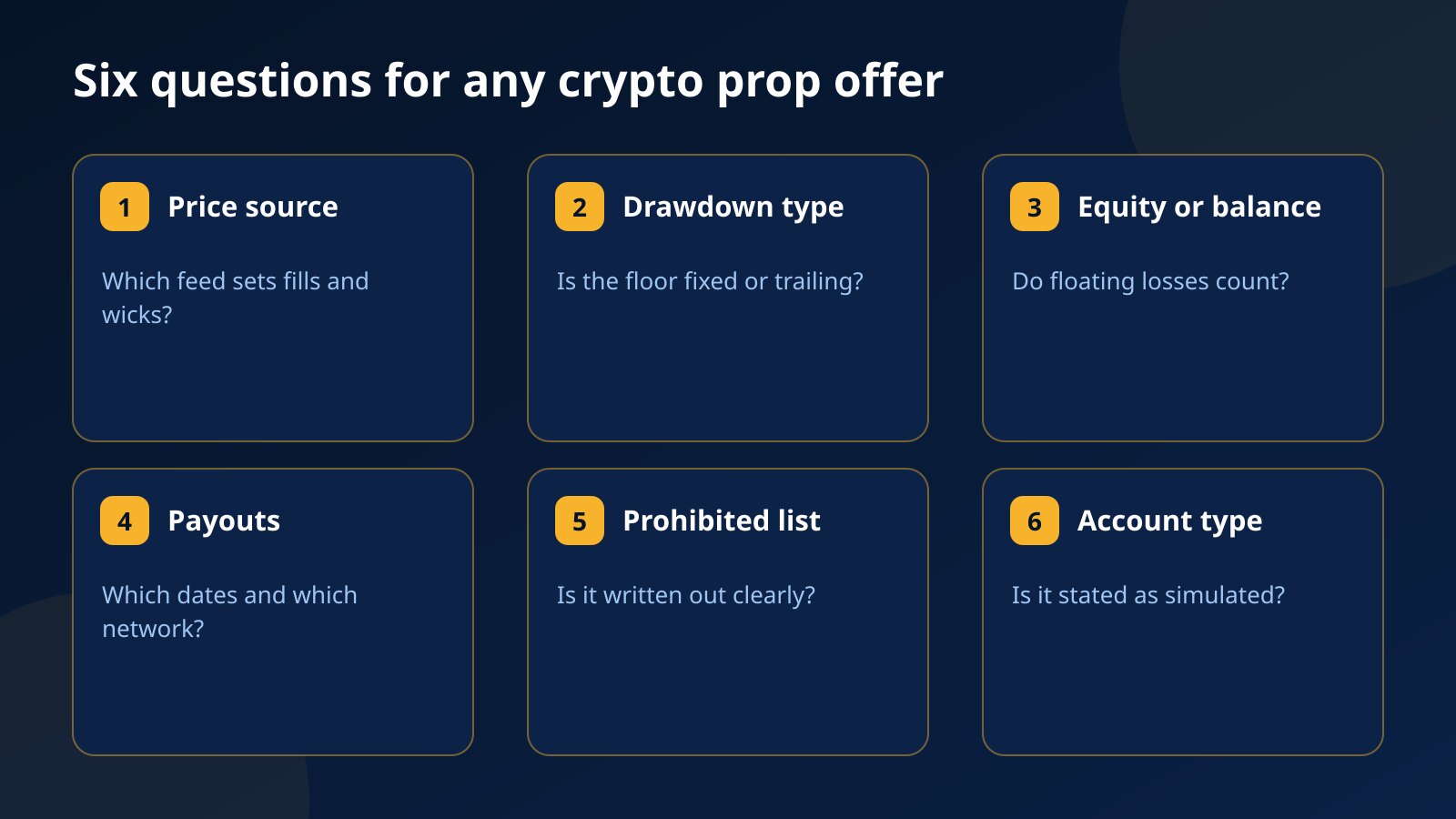
Headline numbers such as account size and split look similar across offers. The details below decide how the account behaves on a bad day, so ask them before you pay anywhere:
- Where do the prices come from? A known exchange feed makes wicks and fills easier to check. Fundex24 uses Binance Futures prices.
- Is the maximum drawdown static or trailing? A trailing floor rises with your profits and shrinks your room. Fundex24’s floor is fixed at 10% of the initial balance.
- Is equity watched, or only the closed balance? Equity rules are stricter, and you need to know which one applies. Fundex24 watches both.
- How and when are payouts made? Look for a fixed schedule and a named network. Here: the 12th and 28th, USDT on BEP20.
- Is the prohibited list written down? Vague “unfair trading” clauses are hard to plan around.
- Is the funded account real or simulated? Offers like this one run on simulated funded accounts for evaluation, which is fine as long as it is stated plainly.
The same account also trades gold, oil and stocks
A crypto prop account at Fundex24 is not limited to coins. The challenge and funded accounts also trade commodities such as gold and crude oil, US and Asian stocks, and ETFs, under the same limits and the same 1:10 cap. How those markets move and how to size them is laid out in the stocks and commodities guide.
Pick a challenge and start trading
Two-step evaluation, transparent rules, profit split up to 80%.
Not sure which size fits? Read the rules · Common questions
If you are unsure about any step, the challenge support chat answers around the clock.
Crypto markets can move sharply in minutes, and a single breach ends a challenge. Funded accounts at Fundex24 are simulated funded accounts for evaluation purposes, and no earnings are promised.
Frequently asked questions
How long does it take to go from purchase to a first withdrawal?
There is no fixed time. Each stage needs at least 5 trading days, and the first withdrawal needs at least 30 days since the first funded trade, so the path takes more than a month.
Does the maximum drawdown floor rise as I make profit?
No. It stays at 10% of the initial balance, which is $9,000 on a $10,000 account, for the life of the account.
Do I need KYC to buy a challenge?
No. Identity verification is only required when you request the funded account after passing stage 2.
Can I trade the news during the challenge?
Yes, news trading is allowed. Just remember that a sharp spike can take equity through the daily limit before a stop fills at the level you wanted.
Can I run two challenges at the same time?
Yes, but not with identical trades copied across them. Mirrored trades fail every challenge involved.
Questions about the Fundex24 challenges?
Open the support chat and ask — the team replies right there.
Chat with supportPrefer to read first? Browse the FAQ · Compare the challenges
Continue your learning path
Move from this article to the next useful action or topic.