




Trending: the lobster coin
The lobster coin, written 龙虾 in Chinese, is a BNB Chain meme coin that traded more than DOGE on Binance Futures on 12 and 13 September 2026. If that caught your eye but your budget is small, this guide covers what the coin is, how sharply it has moved and how to find it on Fundex24. It also explains how to trade it without risking your own money: you pay a one-time fee instead, and that fee is the most you can lose.
What is the lobster coin (龙虾)?
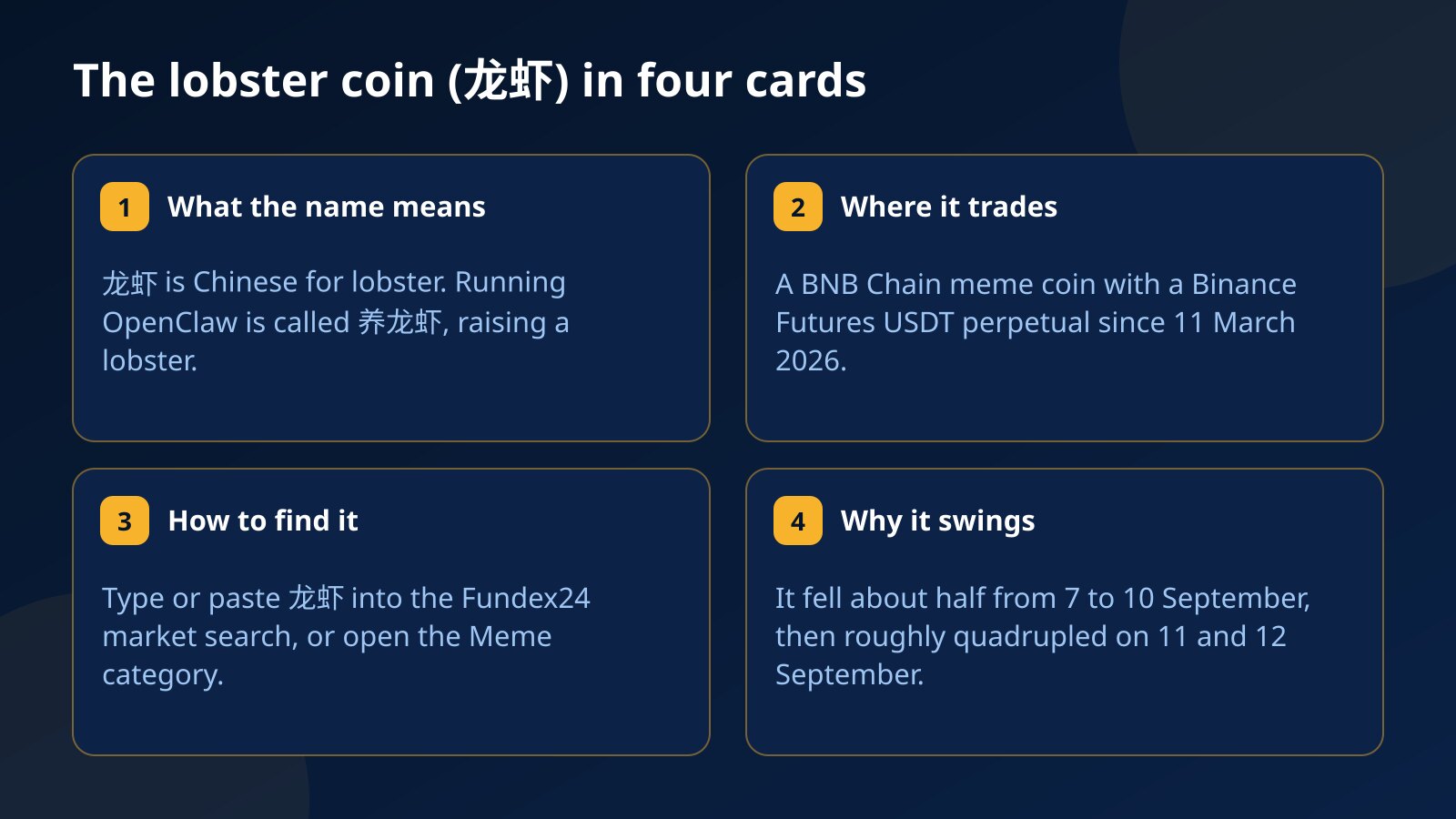
龙虾 is the Chinese word for lobster, and the coin carrying that name is a meme coin on BNB Chain. It took off in March 2026, riding China’s “lobster” trend around OpenClaw, an open-source AI agent: Chinese users call running it 养龙虾, “raising a lobster”. A USDT perpetual for the coin has traded on Binance Futures since 11 March 2026.
Like every meme coin, it has no cash flows behind it. Its price moves on attention, community and social media, which is how a catchy trend can turn into heavy trading within days. In mid-September 2026 it was among the most traded meme coin markets on Binance Futures.
If other Chinese names keep showing up in your feed as well, four Chinese-named meme coins explained covers what each one means.
How the lobster coin moved in September 2026
Between 7 and 10 September 2026, 龙虾 lost about half its value on Binance Futures daily candles. Over the next two days it roughly quadrupled, and on 13 September it set a new high since its futures listing. Those figures come from daily candles, so they hide the wicks inside each day, and long wicks are common on meme coins.
Put a position on each side of those moves to see what they mean in dollars. A $1,000 long opened on 7 September and held without a stop would have been down about $500 by 10 September. A $1,000 short opened on 10 September would have been down about $3,000 two days later, because a coin that quadruples has risen 300%, and a short loses as the price rises.
The point is not that one direction was right. On a coin able to halve and then quadruple inside a week, the stop and the position size decide the outcome far more than the entry does, and both are worked through with numbers below.
How to find the lobster coin on Fundex24
The quickest way is the market search: type 龙虾 and it finds 龙虾USDT. If you cannot type Chinese, copy the two characters from this page and paste them in. You can also scroll the Meme category of the market list, which holds more than 60 meme coin markets, or open the 龙虾/USDT trade page directly.
You do not buy the coin or keep it in a wallet. On Fundex24 you open positions that follow Binance Futures prices: a long gains if 龙虾 rises, a short gains if it falls, and each loses in the opposite case. Leverage goes up to 1:10 with isolated margin only, so every position carries its own margin.
Create your Fundex24 account
Takes a few seconds. You can pick a challenge and add your phone number later.
How to trade 龙虾 without risking your own money
Here is the idea in everyday terms. Instead of putting savings on 龙虾, you pay a one-time fee and trade an account balance you never deposit: $3,000 for $29, $6,000 for $59 or $10,000 for $89, paid in USDT. If your trading goes badly, the account closes and the fee is gone, with no refund. Nothing beyond that fee is at stake on that attempt.
It is not free, and it is not easy. The account is a two-stage test: grow the balance by 10% in stage 1, then by 8% in stage 2, with at least 5 trading days in each and no deadline. Two loss limits apply the whole time. You may not lose 5% of the balance you started the day with, and the account may never fall 10% below its starting balance. Open losses count, so a wick that touches a limit for a moment is enough to close the account.
Pass both stages and you can request a funded account, which keeps the same limits and pays you 80% of the profit you withdraw. Funded accounts at Fundex24 are simulated accounts used for evaluation. The full cost and every step to a withdrawal are laid out in what trading without savings really costs.
A worked example: $60 of risk on a $6,000 account
Say you pick the $6,000 account for $59 and decide to risk 1% per trade, which is $60. Position size is that risk divided by the distance to your stop, and on a coin that halved between 7 and 10 September, the stop deserves more thought than the entry.
With a 5% stop, $60 ÷ 5% gives a $1,200 position. With a 15% stop, $60 ÷ 15% gives $400. Hit either stop and you lose the same $60; the wider stop just means a smaller position. On a coin that quadrupled in two days, a 5% stop is easy for one wick to reach, while 15% leaves more room at the cost of size.
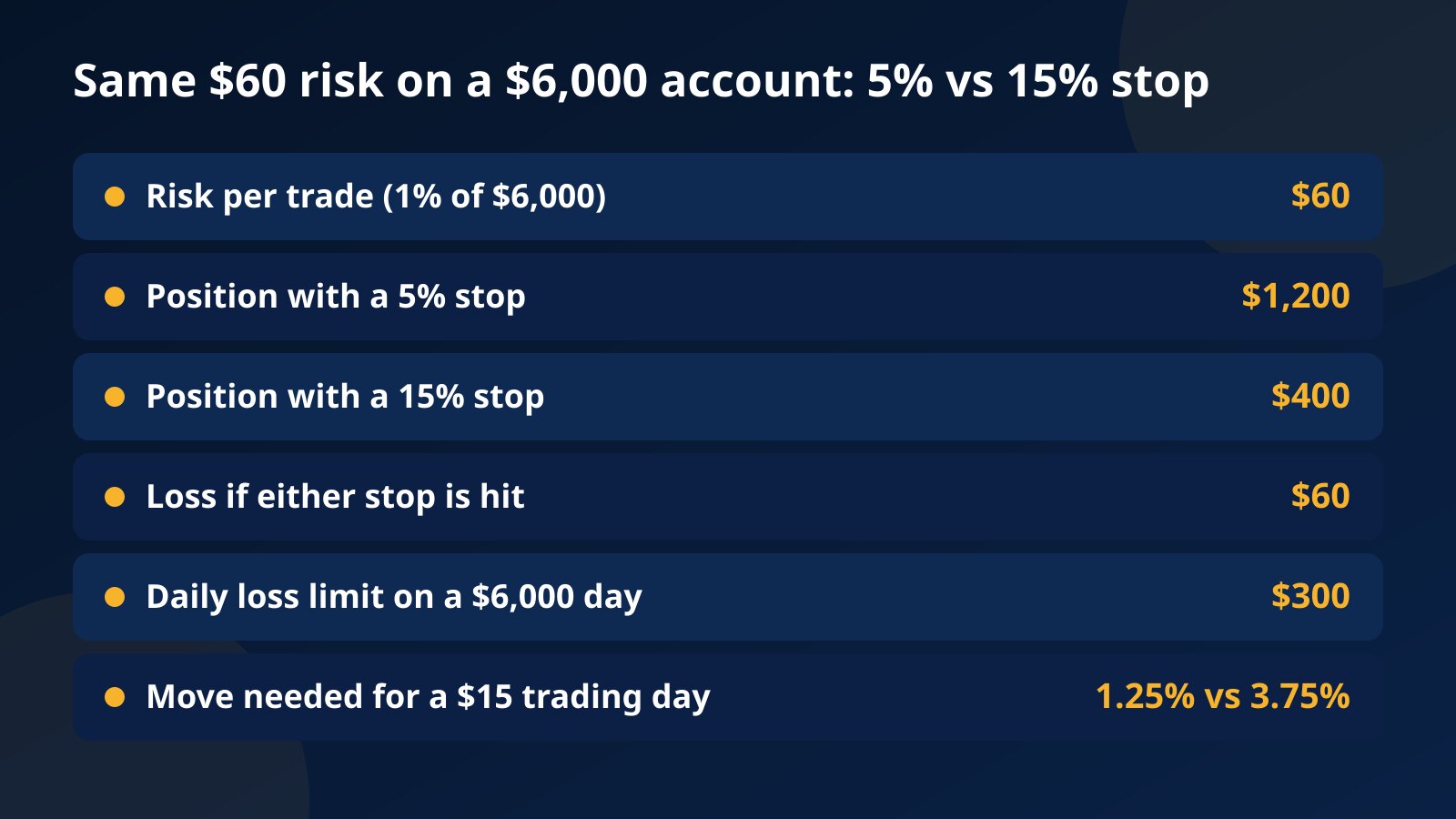
Now check the limits in dollars. A day that starts at $6,000 allows $300 of loss, so one $60 trade uses a fifth of it, and the floor sits at $5,400 however well the account does first. A trading day needs a closed trade with a profit or loss of at least $15, which is 0.25% of $6,000. On the $400 position that takes a 3.75% move; on the $1,200 position, 1.25%.
One more rule works against lucky pumps. In the test stages, a single position that makes more than 60% of the stage’s profit target does not have its profit counted. Stage 1 on $6,000 targets $600, so the line is $360, and the $1,200 position crosses it with a 30% move, which is small next to a quadrupling. Taking profit at a planned level keeps a good trade on the right side of that line.
Practice on 龙虾 first, then decide
Before paying anything, open the free practice account: a $10,000 virtual balance for a short run, currently 3 days, with leverage up to 1:10 and 3 resets in total. Meme coins trade there too, so you can put a small position on 龙虾, set a wide stop and watch what a single wick does to your open loss.
This way of trading has a name: it is called prop trading, and how the funding model works explains it in more depth. When you want to compare the sizes, the three accounts and their fees are listed on one page, and 牛来 and 哈基米 on a small budget applies the same approach to two younger Chinese-named coins.
The lobster coin is highly volatile, like every meme coin, and one wick can use up a day’s loss limit. Only pay a fee you can afford to lose; funded accounts are simulated for evaluation, and no earnings are promised.
Pick a challenge and start trading
Two-step evaluation, transparent rules, profit split up to 80%.
Not sure which size fits? Read the rules · Common questions
Frequently asked questions
Is the lobster coin the same thing as 龙虾USDT?
Yes. 龙虾 is the coin’s name and 龙虾USDT is its USDT market, which the market search finds when you type or paste 龙虾.
Can I trade the lobster coin with no money at all?
No. There is a one-time fee, from $29 for a $3,000 account, and that fee is the most a single attempt can cost you. The practice account uses virtual money only.
Can I short 龙虾?
Yes, every market on Fundex24 can be traded long or short. A short loses when the price rises, and after a run like 11 and 12 September that loss can be large, so set the stop before you enter.
Do I receive lobster coin tokens?
No. Your positions follow Binance Futures prices, and no tokens are bought, held or sent to a wallet for you.
What happens if I break a loss limit?
The account closes and the fee is not refunded. You can start a new attempt later, which means paying a new fee.
Questions about the Fundex24 challenges?
Open the support chat and ask — the team replies right there.
Chat with supportPrefer to read first? Browse the FAQ · Compare the challenges
Continue your learning path
Move from this article to the next useful action or topic.