




Volatility research
Meme coin volatility is why many forex and stock traders take a second look at a crypto prop challenge: a profit target needs price to move, and in Fundex24’s 30-day measurement meme coins covered several times the daily range of gold, and kept moving at weekends while the forex market was shut. That is only half the story. The same movement reaches a 5% daily drawdown limit far sooner, so the traders who gain from it are the ones who size their positions for it.
Why does a prop challenge need price movement?
A challenge rewards movement you manage to capture, and a market that barely moves gives you little to capture. On Fundex24, stage 1 asks for 10% profit and stage 2 for 8%, so on a $10,000 account you need $1,000 and then $800 before the funded account is on the table.
If prop trading is new to you, the model is simple. You pay a one-time fee for a challenge, from $29 for a $3,000 account to $89 for a $10,000 one, and trade a simulated account under fixed loss limits. Pass both stages without breaking those limits and you receive a funded account with an 80% profit split. Our complete guide to crypto prop trading walks through the whole model.
This is where a forex or stock trader often feels stuck. A major pair drifting sideways through a slow afternoon, or an index waiting for the next data release, does little for a 10% target. The trader starts wondering whether a faster market would get them there sooner, and meme coins are the obvious candidate.
Meme coin volatility in numbers: 30 days of daily ranges
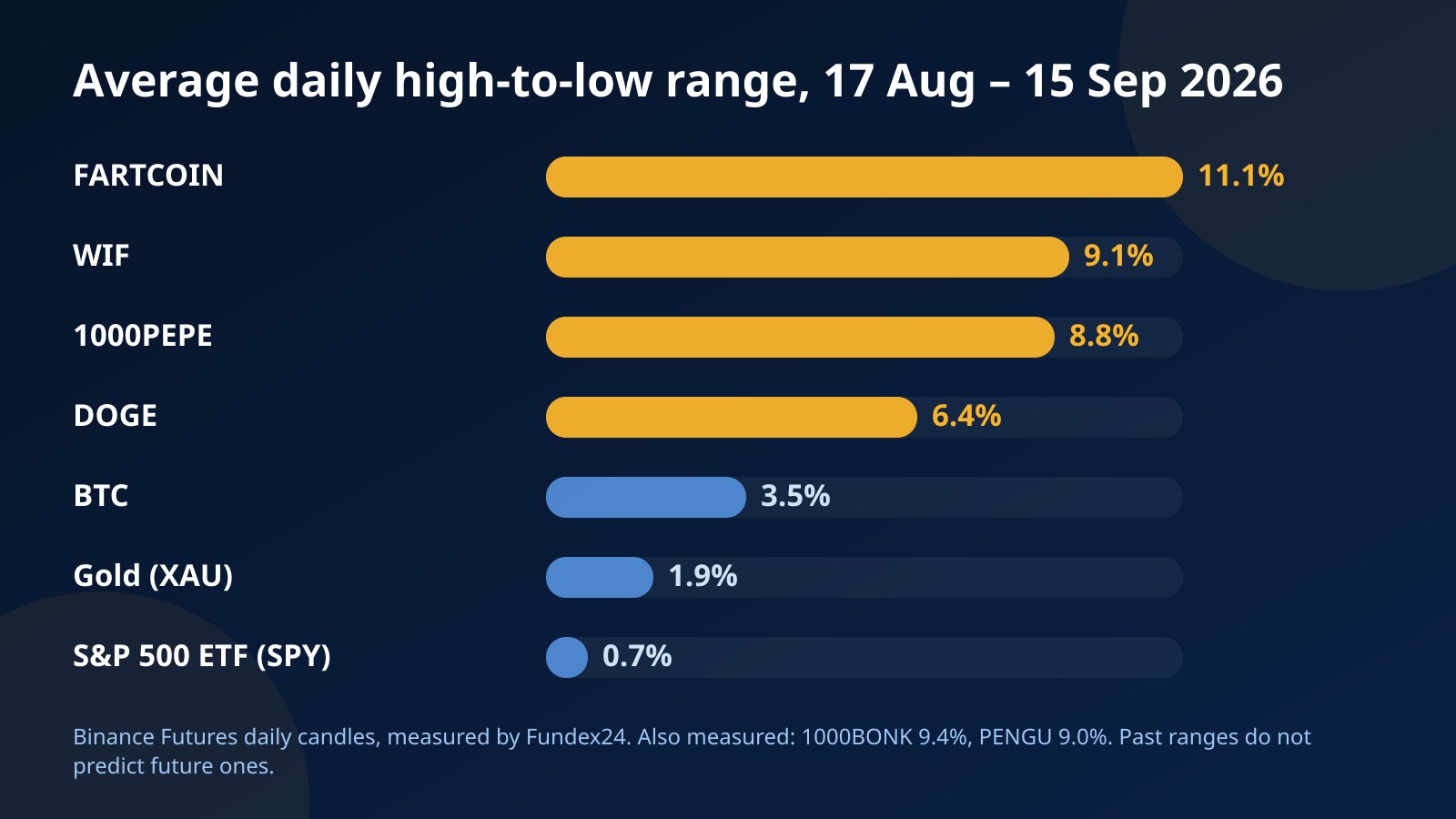
Between 17 August and 15 September 2026, the six meme coins Fundex24 measured moved between 6.4% and 11.1% from high to low on an average day. Over the same period BTC averaged 3.5%, gold 1.9% and the S&P 500 ETF just 0.7%.
Daily range here means the distance between a day’s highest and lowest price, shown as a percentage of price. The figures come from Binance Futures daily candles, the price feed Fundex24’s markets follow, averaged over 30 days. A range says nothing about direction: a coin with a 9% range may still have closed right where it opened.
- FARTCOIN: 11.1%
- 1000BONK: 9.4%
- WIF: 9.1%
- PENGU: 9.0%
- 1000PEPE: 8.8%
- DOGE: 6.4%
- BTC: 3.5%
- Gold (XAU): 1.9%
- S&P 500 ETF (SPY): 0.7%
Two cautions before anyone treats this as a shopping list. Past ranges do not predict future ones: a sleepy coin can wake up and a busy one can go flat within a week. And an average hides the extremes, since the widest single days in the sample were several times larger than the typical one. Open the DOGE/USDT chart or the 1000PEPE/USDT chart and look at the last few weeks of candles to see what the numbers feel like right now.
What happens in quiet forex hours and at weekends?
Forex trades around the clock on weekdays but closes from Friday evening to Sunday evening, New York time, while crypto never closes. That single difference shapes how much movement each market can offer a trader with limited hours.
Within the week, liquidity concentrates in the London and New York sessions, and the stretch when both are open tends to be the busiest. Between those sessions major pairs often drift for hours, which suits a patient swing trader and frustrates someone chasing a stage target. At the weekend there is nothing to trade, and a pair can open on Monday some distance from Friday’s close.
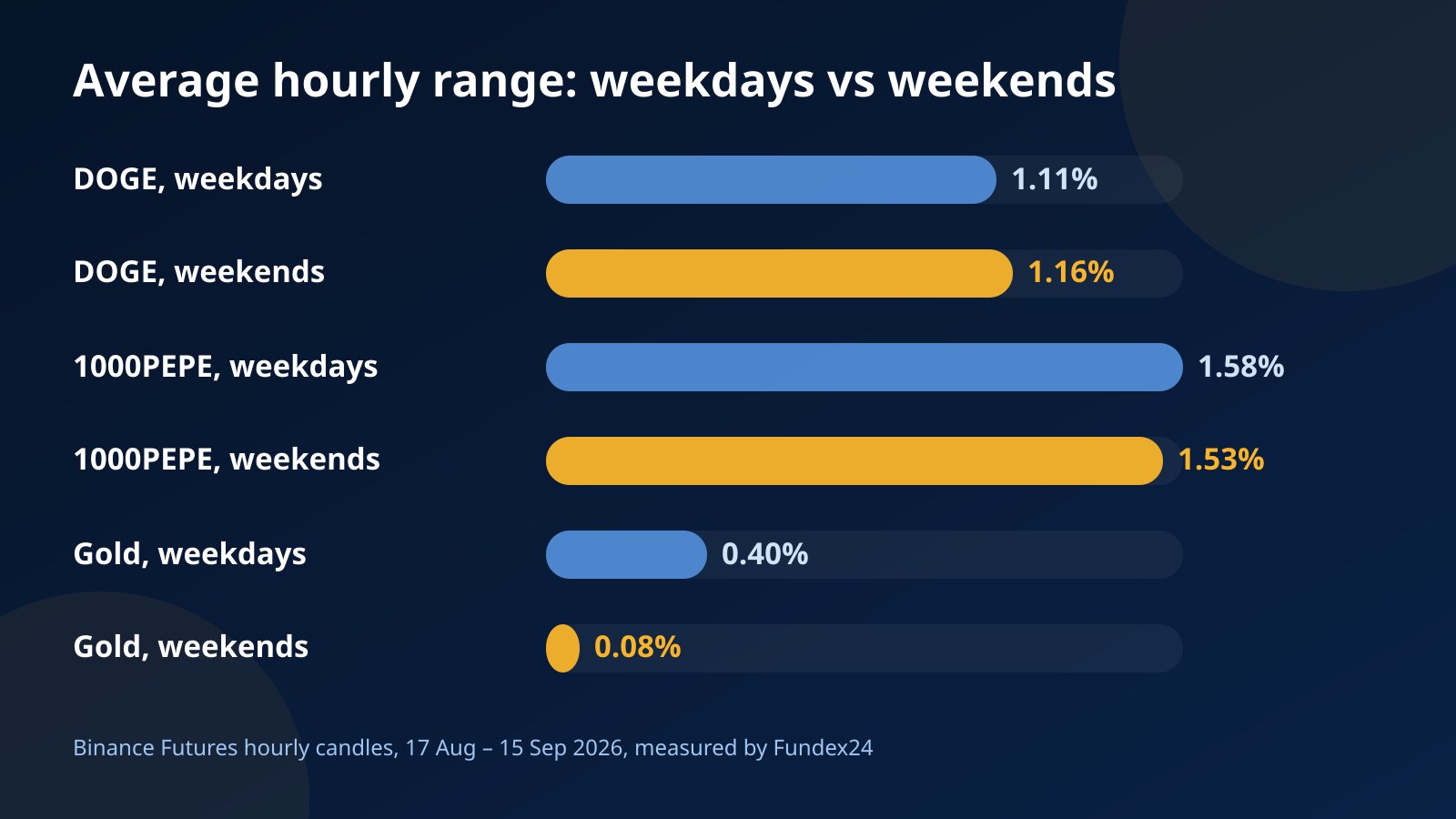
Fundex24 compared average hourly ranges on weekdays and at weekends over the same 30 days. DOGE moved about 1.16% an hour at weekends against 1.11% on weekdays, and 1000PEPE about 1.53% against 1.58%, practically no difference. Gold fell from about 0.40% an hour on weekdays to 0.08% at weekends, and tokenised stocks such as TSLA barely moved, because their prices follow underlying markets that are closed.
Crypto has a rhythm of its own, though, and “always moving” would overstate it. In the same data the busiest hours for BTC, DOGE and 1000PEPE fell around 12:00–16:00 UTC, when US markets open, and other hours were clearly calmer. That is a pattern measured over one month, not a timetable, and a headline can move a coin in the middle of the night. Put a weekend on the XAU/USDT gold chart next to the same days on DOGE and the contrast is plain to see.
Create your Fundex24 account
Takes a few seconds. You can pick a challenge and add your phone number later.
Why the same movement hits drawdown limits faster
Volatility does not care which side of the trade you are on: the range that can carry you toward a target can carry you through a loss limit just as quickly. This is the half of the story that ends most meme coin challenges.
On a $10,000 Fundex24 account the daily drawdown is 5% of the day’s starting balance, which is $500 on a day that starts at $10,000. The maximum drawdown is 10% of the initial balance, a fixed floor at $9,000. Both limits watch equity as well as balance, so a floating loss that touches either one breaks it even if price recovers straight afterwards, and breaking either closes the account. If the difference between the two limits is still hazy, read daily drawdown versus maximum loss first.
Now picture a forex-sized habit on a meme coin. A trader used to holding a $10,000 position in a calm market opens the same size on a coin with a 9% average range. A 5% move against the position, well within one ordinary day for that coin, is a $500 floating loss, and the account is closed before the stop they meant to add later ever exists.
Meme coins also move in bursts. A long wick can tag a stop or an equity limit and snap back within the same candle. And in the challenge stages, a single position that makes 60% or more of the stage’s profit target is not counted toward progress, so an oversized win during a pump does not rescue the stage either.
Position size, not direction, decides who survives
You cannot control how far a meme coin moves, but you decide how many dollars each percent of that move costs you. That decision is the position size, and it matters more than whether you called the direction right.
Take the same $10,000 account and a risk of 1% per trade, which is $100. On a meme coin, a stop 4% from entry gives a position of $2,500, because 4% of $2,500 is $100. On gold, a 1% stop allows a $10,000 position for the same $100. The two positions differ fourfold in size, yet the loss at the stop is identical.
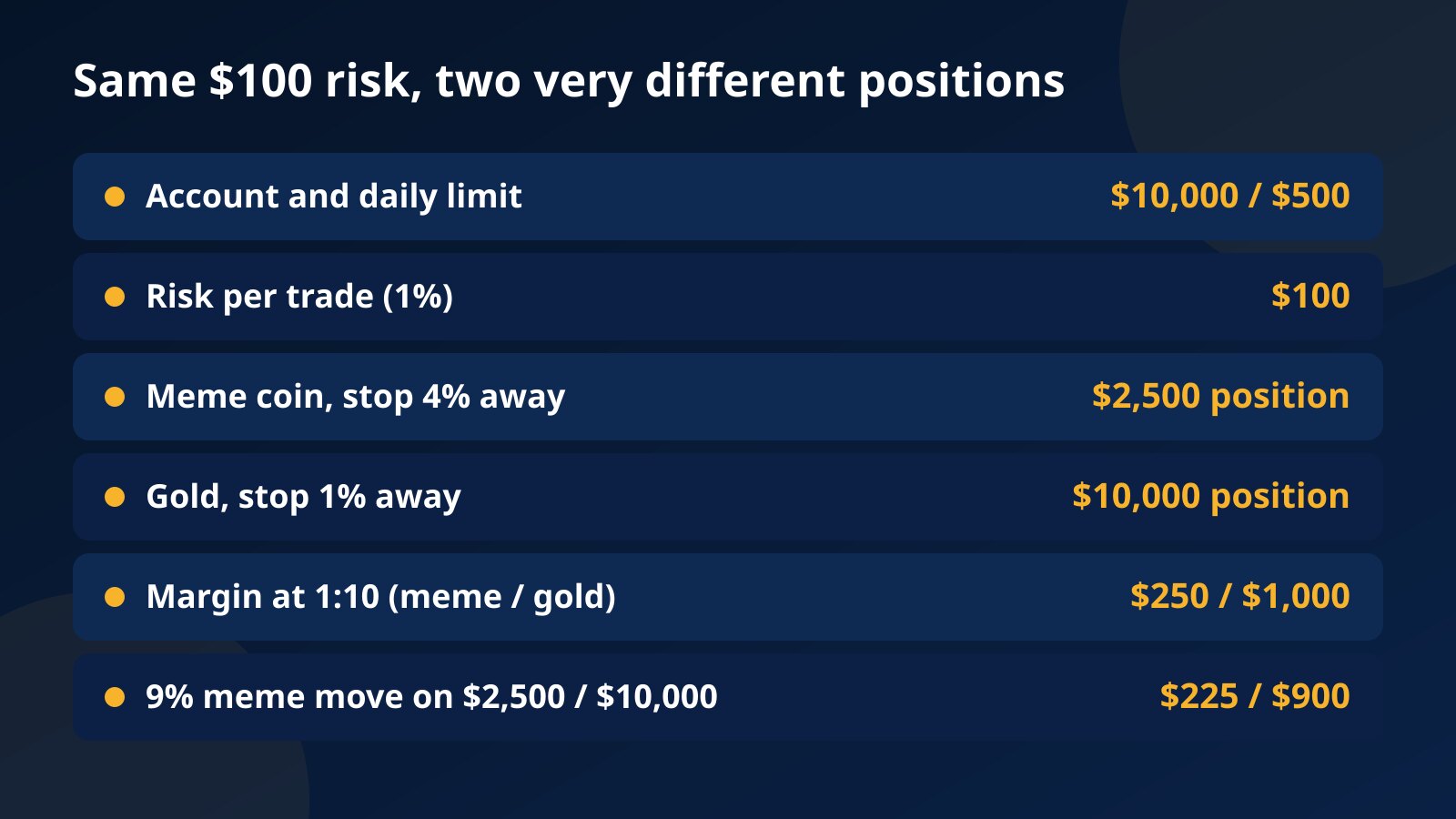
Leverage of up to 1:10 makes both trades possible: the gold position needs $1,000 of margin at 1:10 and the meme coin position only $250. Leverage changes the margin, not the risk, and the loss at the stop is still position size multiplied by stop distance.
Go back to that 9% day. If the whole range ran against the $2,500 position with no stop at all, it would lose $225, which hurts but leaves the $500 daily limit intact. The $10,000 position on the same coin would have lost $900. For position sizes at other stop distances and a full pre-trade checklist, see our meme coin risk management guide.
Five rules for trading meme coin volatility in a challenge
These rules turn the numbers above into habits. None of them needs a special tool, only the discipline to apply them before the trade rather than after it.
- Trade smaller on meme coins than on BTC or gold. Start from the dollars you are willing to lose and let the stop distance set the size, never the leverage.
- Place stops beyond the wicks the coin normally prints. Check how far recent candles reached before you pick a distance, then shrink the position to fit it.
- Avoid holding through the weekend if you cannot watch the position. Crypto keeps trading while you are away, and a Saturday move counts against the daily limit exactly like a Tuesday one.
- Count correlated meme coins as one bet. Longs on DOGE, 1000PEPE and WIF often fall together in a sell-off, and every one of those losses lands on the same $500.
- No revenge trades after a spike. A stop taken by a wick feels unfair, and doubling the size to win it back is how a $100 loss turns into a closed account.
The rules themselves are the same on every market; only the coins’ behaviour changes. What that means in practice, including shorting and news trading, is covered in trading meme coins in a Fundex24 challenge.
Who does meme coin volatility suit, and who should prefer slower markets?
It suits a trader who already sizes by stop distance, can check positions in the evenings and at weekends, and wants a market that is still moving outside the London and New York sessions. Someone whose job leaves only evenings and Saturdays for trading may find an always-open market a practical advantage rather than a temptation.
It does not suit a trader who needs a full night’s sleep and a clear calendar to trade well. If your plan is built around sessions and scheduled data releases, slower markets such as gold may fit you better, and a quiet chart is no flaw when your strategy expects one. The wider trade-offs between the two worlds are laid out in crypto prop trading versus forex prop trading.
Pick a challenge and start trading
Two-step evaluation, transparent rules, profit split up to 80%.
Not sure which size fits? Read the rules · Common questions
You do not have to pick one camp for good. Meme coins, BTC and gold all trade on the same Fundex24 challenge account under the same limits, so the choice can be made trade by trade. Once you have a sizing rule you trust, compare the Fundex24 challenge plans and pick the account size that matches your dollar risk.
Crypto trading with leverage is high risk, and volatility can turn against a position faster than any stop is adjusted. Fundex24 challenge and funded accounts are simulated accounts for evaluation, and no earnings are promised.
Frequently asked questions
Is meme coin volatility good for passing a prop challenge?
It can help you reach a profit target sooner, but only if each position is small enough that an ordinary day’s move stays well inside the 5% daily limit. Without that sizing, the extra movement ends challenges faster than it passes them.
Which coin moved the most in the Fundex24 measurement?
FARTCOIN, with an average daily high-to-low range of 11.1% between 17 August and 15 September 2026, followed by 1000BONK and WIF. Those are averages from one month and can look very different next month.
Does the forex market really close at weekends?
Yes. Spot forex stops trading from Friday evening to Sunday evening New York time, whereas crypto markets trade seven days a week.
Does higher leverage let me catch more of a meme coin move?
No. Leverage, up to 1:10 on Fundex24, only sets how much margin a position uses; the profit or loss depends on the position size and how far price moves.
Are the drawdown rules different for meme coins and gold?
No. The 5% daily and 10% maximum drawdown apply the same way to every market on the account, so a meme coin simply needs a smaller position to respect them.
Questions about the Fundex24 challenges?
Open the support chat and ask — the team replies right there.
Chat with supportPrefer to read first? Browse the FAQ · Compare the challenges
Continue your learning path
Move from this article to the next useful action or topic.