


Updated 16 November 2026
Prop firm leverage sets the margin a position ties up and its distance to liquidation; at Fundex24 the maximum is 1:10 on every market, isolated margin only. What it doesn’t set is how much you lose once the position size and the stop are fixed. That is the part most leverage questions skip, and the tables below show it in dollars on a $10,000 account, next to how far Bitcoin, Ether and four other contracts actually moved in the 365 days to 15 November 2026.
How does prop firm leverage work?
Leverage is the ratio between the position you open and the margin it locks. At 1:10, $500 of margin carries a $5,000 position; at 5x, the same position needs $1,000. The formula is margin = position ÷ leverage.
On a prop account the setting does two things and only two. It decides how much of your balance sits as margin, and it decides how far price can run against you before the position is liquidated. With isolated margin, the only mode Fundex24 allows, a liquidated position loses about its own margin and nothing more. At 1:10 that happens after roughly a 9.5–10% move against you, at 5x after roughly 19–20%. As a rule of thumb the distance is a little under 100% divided by the leverage.
The account’s loss limits ignore the ratio altogether. The 5% daily line and the 10% maximum-loss floor are measured on equity in dollars, so what pushes you toward them is position size multiplied by the price move.
Prop firm leverage calculator: one $5,000 position, four settings
Take a $10,000 account and a $5,000 position with a stop 2% from entry. Here is what each leverage setting changes, and what it leaves alone:
| Leverage | Margin locked | Liquidation after a move of about | Loss if the 2% stop is hit |
|---|---|---|---|
| 2x | $2,500 | just under 50% | $100 |
| 3x | $1,666.67 | just under 33% | $100 |
| 5x | $1,000 | 19–20% | $100 |
| 10x (1:10) | $500 | 9.5–10% | $100 |
The loss at the stop is the position times the stop distance, $5,000 × 2% = $100, plus trading costs, in every row. Leverage only changes the margin and the distance to liquidation. Without a stop it matters more: at 10x the worst case is about the $500 of margin, which also happens to be the whole daily allowance on a day that starts at $10,000. At 2x there is no liquidation in sight, yet a 10% move against the same $5,000 position costs that same $500, reaches the daily loss line, and a touch of that line fails the account.
What leverage do prop firms use?
It varies by firm and by market; Fundex24 offers up to 1:10 on every plan and every market, from crypto and memecoins to gold (XAU), silver (XAG), stocks and ETFs. Searches for 1:100 or even 1:500 prop firm leverage are common, so it is worth running the arithmetic above on them. At 1:100 about a 1% move is enough for liquidation, while Bitcoin’s median daily range over the 365 days to 15 November 2026 was 2.95%. That gap is why a crypto account needs a far smaller ratio to be usable at all.
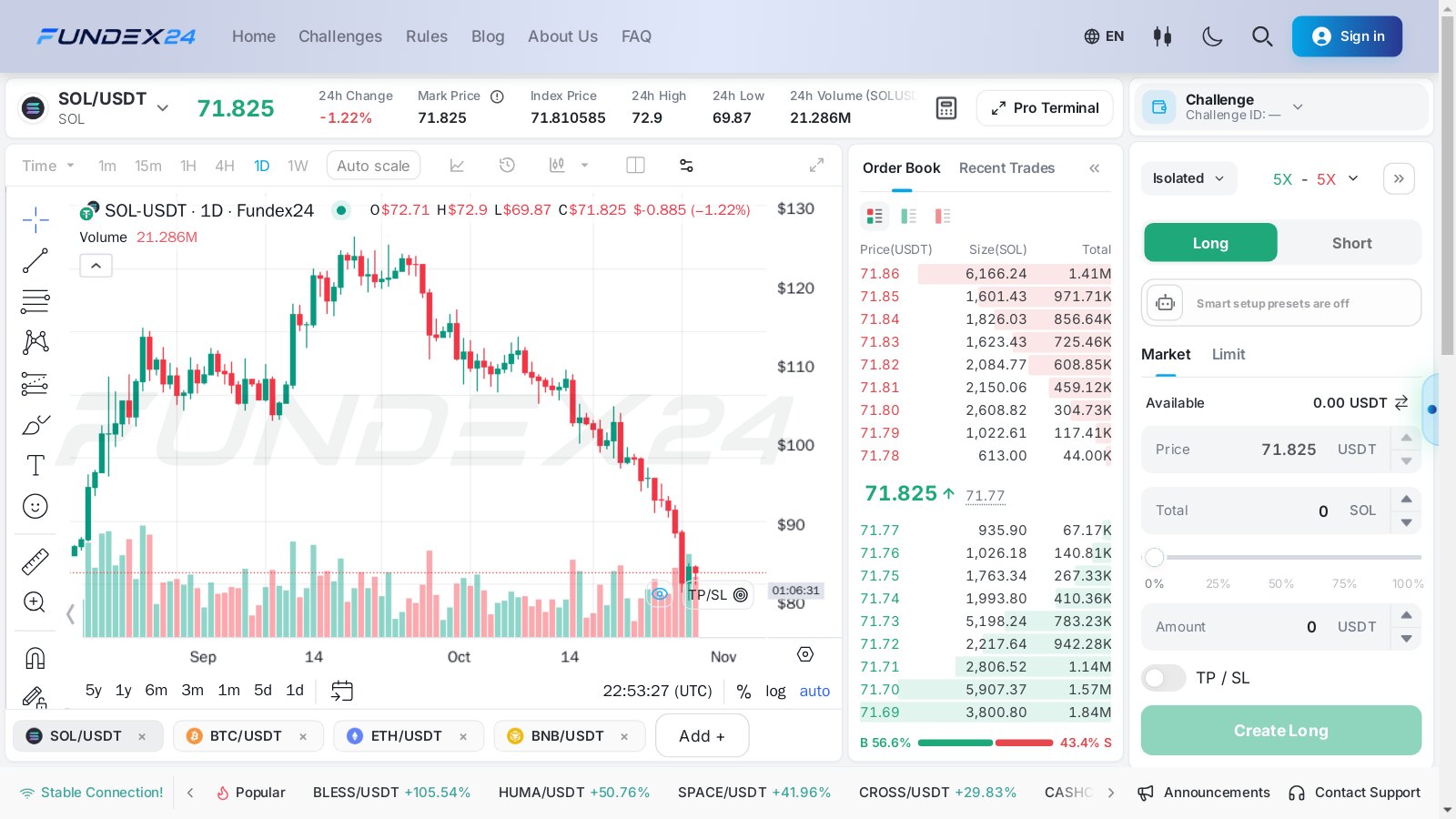
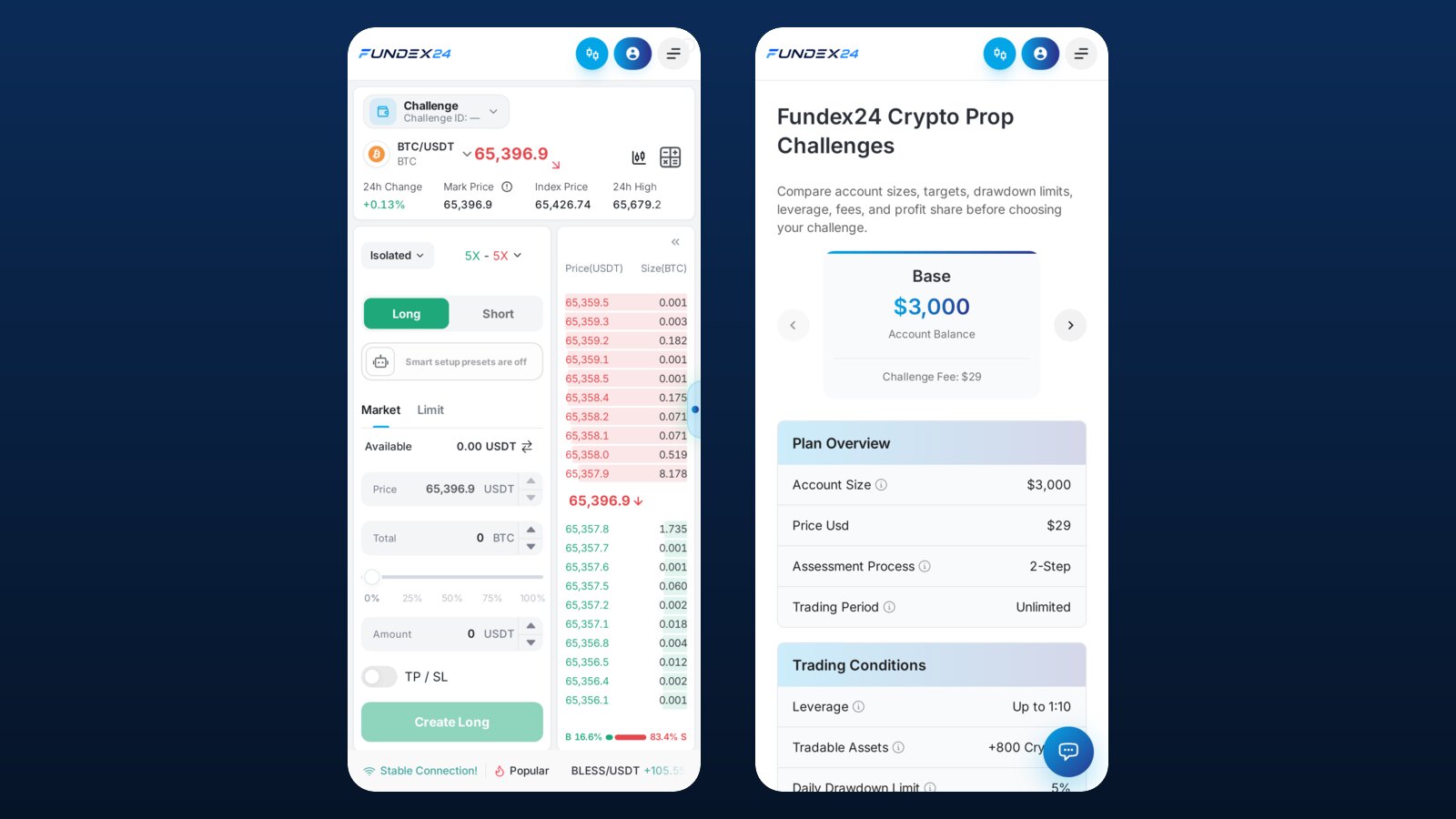
On Fundex24 the order panel opens with 5x preselected, and margin is isolated only. Cross margin is not allowed, so one position can never draw on the rest of your balance. The challenge plans list the same 1:10 cap for every account size.
Create your Fundex24 account
Takes a few seconds. You can pick a challenge and add your phone number later.
How far do coins move against a 10x position?
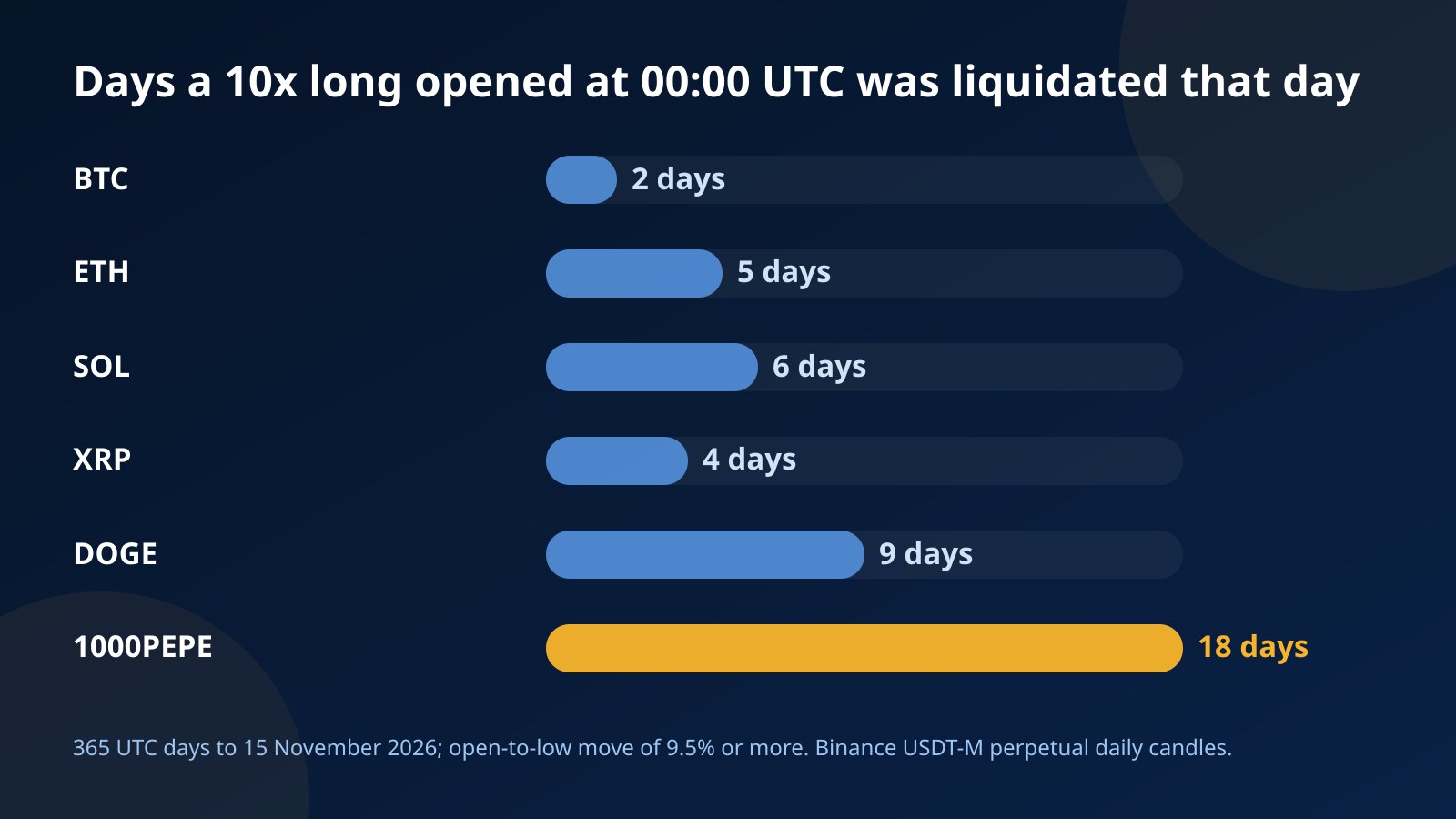
Far enough to matter on the more volatile contracts. In the 365 days to 15 November 2026, a 10x long opened at the 00:00 UTC open of Bitcoin (BTC) would have been liquidated by that day’s move alone on 2 days; on Pepe (PEPE), an Ethereum memecoin traded as the 1000PEPE-USDT contract for 1,000 PEPE, it would have happened on 18. The table adds Ether (ETH, the coin of the Ethereum network), Solana (SOL), XRP (XRP, the coin of the XRP Ledger) and Dogecoin (DOGE), and counts the days on which the move from the 00:00 UTC open alone would have liquidated a position opened at that open: 9.5% or more against it at 10x, 19% or more at 5x.
| Contract | Median day range | 10x long liquidated | 10x short liquidated | 5x long / short liquidated |
|---|---|---|---|---|
| BTC | 2.95% | 2 days | 1 day | 0 / 0 |
| ETH | 3.94% | 5 days | 7 days | 0 / 1 |
| SOL | 4.48% | 6 days | 6 days | 0 / 0 |
| XRP | 4.11% | 4 days | 12 days | 1 / 2 |
| DOGE | 4.70% | 9 days | 14 days | 0 / 0 |
| 1000PEPE | 6.46% | 18 days | 34 days | 1 / 6 |
Day range is (high − low) ÷ open for one UTC day. The count only covers single days measured from the open; positions opened at other times or held for several days meet different moves. One pattern stands out: shorts fared worse than longs on four of the six rows, even though all six contracts ended the period lower, with 34 days for a 10x short on 1000PEPE and 12 on XRP. At 5x the counts drop close to zero, but the dollar loss before liquidation is twice as large. Our look at the best crypto pairs for prop trading weighs these ranges against other factors.
Why leverage doesn’t change your dollar risk
Size the position from the stop and the money you are prepared to lose, then pick the leverage for the margin. Say you will risk $100 on a Solana trade and the stop sits 2.5% away, inside SOL’s 4.48% median day range. The position is $100 ÷ 2.5% = $4,000. At 10x it locks $400 of margin, at 5x $800, and either way the stop costs about $100.
What the account really measures is size against the daily line. On a day that starts at $10,000, the line sits $500 lower:
| Position | Margin at 10x | Margin at 5x | Move that uses the full $500 |
|---|---|---|---|
| $2,500 | $250 | $500 | 20% |
| $5,000 | $500 | $1,000 | 10% |
| $10,000 | $1,000 | $2,000 | 5% |
| $20,000 | $2,000 | $4,000 | 2.5% |
Move = $500 ÷ position. From $5,000 upward, the daily line arrives at about the same point as a 10x liquidation or earlier, so the stop and the size, not the leverage, are what protect the account. To pick the dollar figure itself, see how much to risk per trade; for the line, how the daily loss line works; and for the wider picture, risk management for crypto prop trading.
Setting leverage on the Fundex24 terminal
The leverage selector sits at the top of the order panel, next to the margin mode. It opens on 5x, and you can change it per trade up to 10x. Positions go long or short, and a stop loss and take profit can be set in the panel or dragged on the chart. Charts and prices follow Binance futures. A new position starts slightly negative because of the spread and the opening fee, with a closing fee still to come, so a trade at any leverage needs a little room before it breaks even.
Every account also gets an eagle on the trade page: a rule-based co-pilot, not an AI that predicts prices and not a trading bot. It shows the room left to the daily line and the distance to the maximum-loss floor, warns when a position has no stop, and warns again when one drifts close to liquidation. You can try the panel on the SOL/USDT trade page.
Data and sources
Day ranges and liquidation counts are measured on Binance USDT-M perpetual daily candles, UTC days, for the 365 days through the 15 November 2026 close: a long counts when the open-to-low move reached 9.5% (10x) or 19% (5x), a short when the open-to-high move did. The 1000PEPE row is the contract for 1,000 PEPE. Leverage, margin mode and loss limits are from the Fundex24 rules, FAQ and order panel as of November 2026; margin figures are position ÷ leverage and liquidation distances are approximate.
Leverage questions, answered
What is the maximum leverage at Fundex24?
1:10, on every market and every plan. The order panel opens at 5x and uses isolated margin only.
Pick a challenge and start trading
Two-step evaluation, transparent rules, profit split up to 80%.
Not sure which size fits? Read the rules · Common questions
Is higher leverage riskier on a prop account?
Not by itself. With the same position size and stop, 2x and 10x lose the same dollars; higher leverage only frees margin and brings liquidation closer.
Can I use cross margin on Fundex24?
No. Only isolated margin is allowed, so each position can lose about its own margin and no more.
Does leverage change the daily drawdown?
No. The daily loss limit is 5% of the 00:00 UTC balance in dollars, $500 when the day starts at $10,000, whatever leverage you choose.
How far can price move at 10x before liquidation?
Roughly 9.5–10% against the position. At 5x the distance is roughly 19–20%.
What does 1:10 leverage mean?
Each $1 of margin carries $10 of position, so $300 of margin opens a $3,000 position.
Questions about the Fundex24 challenges?
Open the support chat and ask — the team replies right there.
Chat with supportPrefer to read first? Browse the FAQ · Compare the challenges
Continue your learning path
Move from this article to the next useful action or topic.