


Updated 16 November 2026
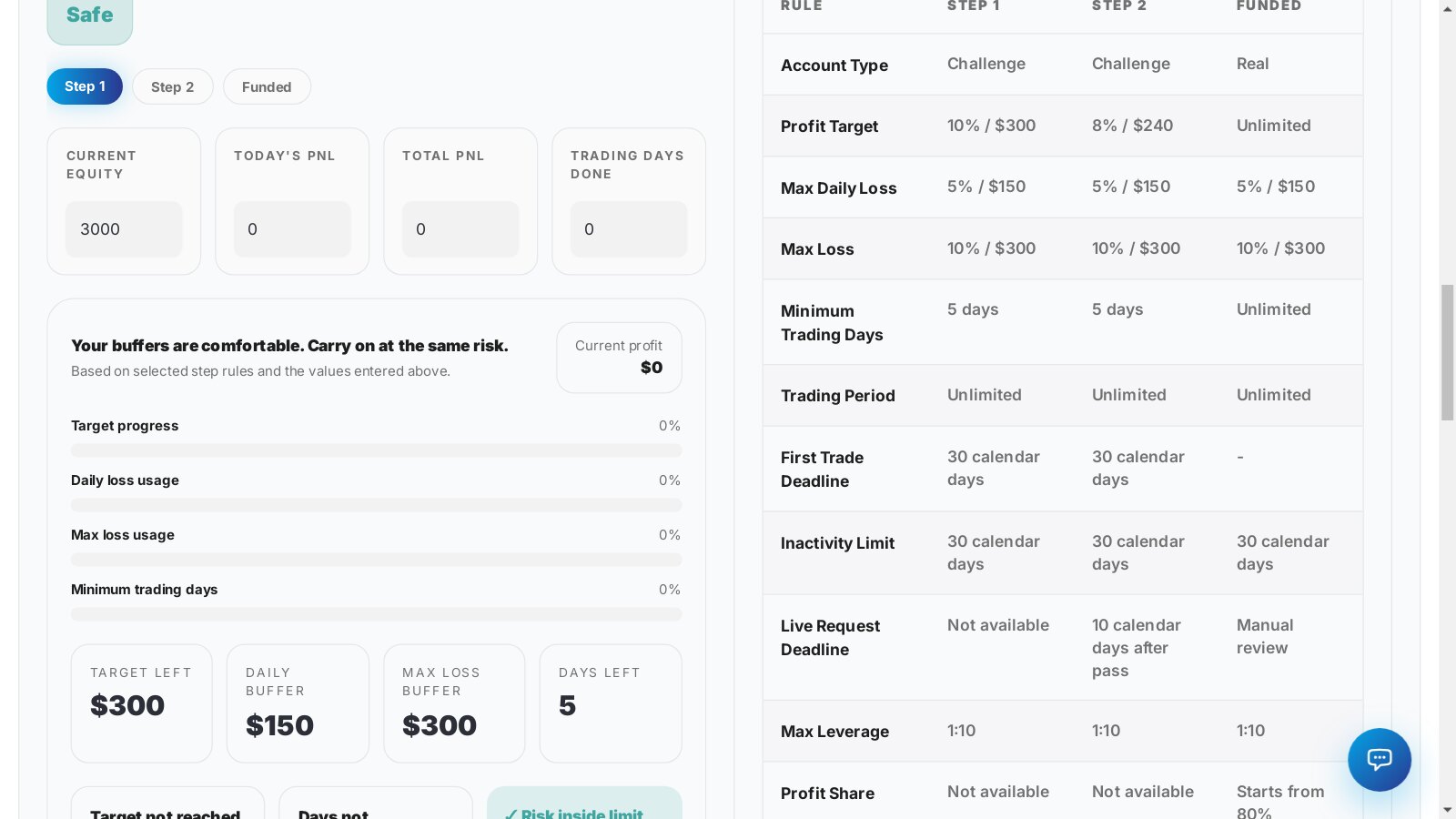
Fundex24’s minimum is 5 valid trading days in each challenge step, and a day counts only if one closed position gains or loses at least 0.25% of the stage balance. That single sentence is the whole prop firm minimum trading days rule, yet every part of it matters: one position, closed, net of fees, on a UTC calendar day. On a $10,000 account the bar is $25, and the quickest possible pass takes 10 valid days across the two steps.
What does prop firm minimum trading days mean?
It is the smallest number of separate days you must trade before a step can pass, even if you reach the profit target sooner. It is a floor, not a schedule: nobody asks you to trade every day, and there is no maximum. At Fundex24 the floor is five valid days in Step 1 and five more in Step 2, with no deadline for either. A step passes when three things are true at once: the target is reached (10% in Step 1, 8% in Step 2), at least five valid days are on the record, and no positions are open.
Step 1 moves into Step 2 automatically, so the shortest route through the whole challenge is ten valid days. Our explainer of the two-step challenge covers what else changes between the steps, and the rules page shows the day count for each plan.
What counts as a trading day?
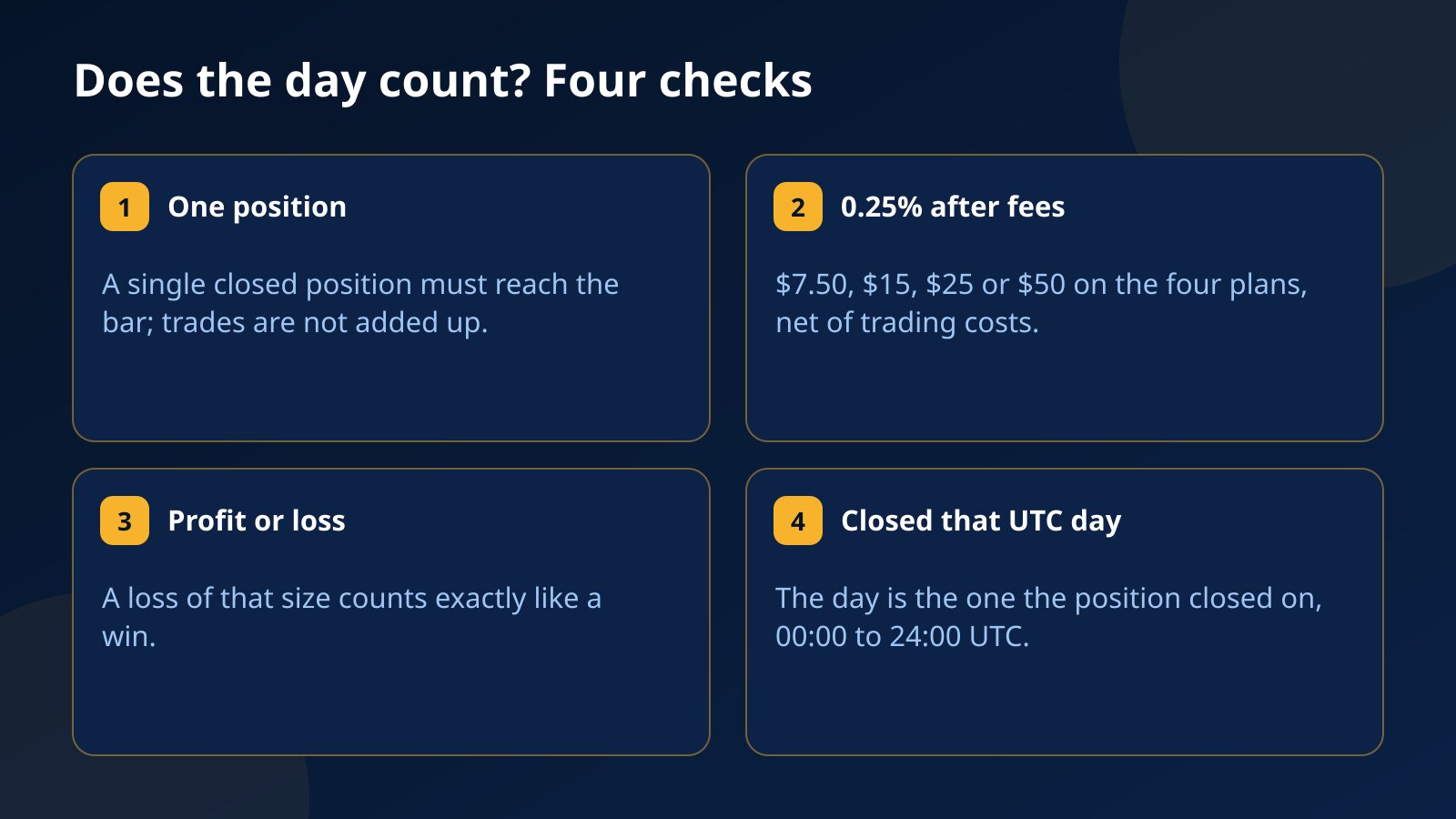
A trading day counts when one position closes on that UTC day with a net result, profit or loss after fees, of at least 0.25% of the stage’s starting balance. Four details follow from that wording:
- One position has to clear the bar on its own. Trades are not added up, so a handful of small closes doesn’t make a day.
- A loss counts as much as a win. A position that loses $25 on a $10,000 account makes the day valid.
- Only closed positions count, and the day belongs to the close, not to the open.
- Fees come off first. A close that only just clears the bar before costs can fall short after them.
The threshold is the same in both steps, because Step 2 starts again from the plan’s own balance. As of November 2026:
| Plan (fee) | Valid-day threshold | Step 1 target | Step 2 target |
|---|---|---|---|
| $3,000 ($29) | $7.50 | $300 | $240 |
| $6,000 ($59) | $15 | $600 | $480 |
| $10,000 ($89) | $25 | $1,000 | $800 |
| $20,000 ($159) | $50 | $2,000 | $1,600 |
Threshold = plan size × 0.0025. Put another way, the bar is one twentieth of the 5% daily loss allowance on a day that starts at the plan’s balance, so a stop-out or take-profit at a typical risk size clears it.
A sample week on a $10,000 Step 1
The bar here is $25. Six UTC days, six different outcomes:
Create your Fundex24 account
Takes a few seconds. You can pick a challenge and add your phone number later.
| UTC day | Closed positions | Counts? |
|---|---|---|
| Monday | Three scalps: +$9, +$11, +$8 | No: none reaches $25 alone |
| Tuesday | One short closed at −$31 | Yes: a loss of $25 or more counts |
| Wednesday | A long opened, still open at 00:00 UTC | No: nothing closed |
| Thursday | Wednesday’s long closes at +$140 | Yes: it counts on the day it closed |
| Friday | One position at +$24 | No: $1 short of the bar |
| Saturday | One position at +$60 | Yes |
Three valid days out of six, and the week nets +$221. Two more valid days are still needed before Step 1 can pass, however close the $1,000 target might be by then.
When does a trading day start in your time zone?
At 00:00 UTC, and it ends at 24:00 UTC. A position belongs to the UTC day on which it closes, which is not always your local calendar day:
| City | Local time at 00:00 UTC | Local date |
|---|---|---|
| New York | 19:00 | The evening before |
| London | 00:00 | Same day |
| Istanbul | 03:00 | Same day |
| Dubai | 04:00 | Same day |
| Singapore | 08:00 | Same day |
So a trader in New York who closes a position at 20:30 on a Monday evening has made it count for Tuesday. In Singapore the trading day runs from 08:00 to 08:00 the next morning. The same 00:00 UTC moment resets the daily loss line, which is 5% of the balance recorded then.
Is there a prop firm without minimum trading days?
People search for one often, and some evaluation models do drop the requirement. Fundex24 keeps it, for a reason that shows in the numbers: without a minimum, one oversized position could hit the target in a single session, which says nothing about whether the result repeats. The 60% rule closes the same door from the other side, since a single position making $600 or more on a $10,000 Step 1 doesn’t count toward the $1,000 target.
The minimum is also lighter than it sounds. Five valid days need five positions of at least $25 each on a $10,000 account, and there is no deadline for them; the only clocks are a first trade within 30 days of buying and never 30 days without a trade. Our guide to a prop firm with no time limit goes through those clocks.
Banking valid days without forcing trades
- Size so your normal stop clears the bar. With $50 of risk on $10,000, even a stopped-out trade makes a valid day, so you never need a trade just for the calendar.
- Don’t split one idea into many small trades. Five $10 scalps leave the day empty; one $50 trade fills it.
- Watch the clock late in the session. A winner closed at 23:50 UTC counts for that day; the same close at 00:10 UTC counts for the next one.
- Remember that a valid losing day still costs target. A $25 loss buys a day and puts you $25 further from the goal.
- Check the count before the last trade. A step can’t pass with positions open, so close everything once the target and the fifth day are both in.
The guide to passing without overtrading builds a calm week around these habits, and how to pass a crypto prop challenge covers the strategy side. If a day you expected to count is missing, ask in the challenge support chat and include the position details.
Where the rule numbers come from
Fundex24’s rules page and FAQ, as they stood in November 2026, supply the 0.25% threshold, the five-day minimum per step, the UTC day boundary and the targets. Thresholds are plan size × 0.0025, and the sample week is a worked example rather than a real account. Local times assume New York on Eastern Standard Time and London on Greenwich Mean Time, both in force in November; Istanbul, Dubai and Singapore keep the same UTC offset all year.
Trading-day FAQ
Does a losing day count as a trading day?
Yes, if one closed position loses at least 0.25% of the stage balance after fees, which is $25 on a $10,000 account. The rule measures the size of the result, not its direction.
Pick a challenge and start trading
Two-step evaluation, transparent rules, profit split up to 80%.
Not sure which size fits? Read the rules · Common questions
Do weekends count as trading days?
Yes. The rule uses UTC calendar days and crypto contracts trade all week, so a Saturday or Sunday close of the right size counts.
Do multiple trades add up to a trading day?
No. At least one single position has to reach the threshold by itself; smaller results on the same day are not combined.
Do the trading days have to be in a row?
No. Valid days can be spread out with gaps between them, as long as you never go 30 days without a trade.
When does a trading day start and end?
It runs from 00:00 to 24:00 UTC. In November 2026 that start is 03:00 in Istanbul, 08:00 in Singapore and 19:00 the evening before in New York.
How many trading days does a funded account need?
At least 5 trading days on the funded account before a payout, along with at least 30 days since its first trade.
Questions about the Fundex24 challenges?
Open the support chat and ask — the team replies right there.
Chat with supportPrefer to read first? Browse the FAQ · Compare the challenges
Continue your learning path
Move from this article to the next useful action or topic.