


Updated 16 November 2026
Static drawdown means the maximum-loss floor never moves: on a $10,000 Fundex24 account it sits at $9,000 from the first trade to the last, profits or not. That is what traders mean by a prop firm without trailing drawdown. A trailing floor does the opposite and follows your best result upward, so every winning run shrinks your room. Below, one three-day equity path shows how a static floor, an intraday trailing floor and an end-of-day trailing floor react to the same trades, and why Fundex24’s 5% daily line is the limit you are more likely to meet first.
What is a prop firm without trailing drawdown?
It is a firm that measures your maximum loss from a fixed point, normally the starting balance, instead of from the best result you have reached. At Fundex24 the maximum loss is 10% of the initial balance in every stage, funded account included, and the floor it creates stays where it is:
- $3,000 account: floor at $2,700
- $6,000 account: floor at $5,400
- $10,000 account: floor at $9,000
- $20,000 account: floor at $18,000
Profit never lifts it, whether that profit is still open or already banked. Grow a $10,000 account to $11,000 and the floor is still $9,000, so you have $2,000 of room instead of $1,000. What a fixed floor doesn’t do is forgive. The Fundex24 FAQ says balance or equity must never fall below it, and a single touch fails the account even if the price snaps back a minute later. If you are comparing firms, our list of prop trading rules to check covers the other terms worth reading before you pay.
Trailing drawdown explained: why the floor chases your peak
A trailing drawdown uses the same allowance but measures it from your high-water mark. With a $1,000 allowance, a $10,000 account that reaches $10,600 sees its floor move from $9,000 to $9,600. The floor only ever moves up. When you lose, it stays where your best moment left it.
There are two common versions. An intraday trailing floor follows equity tick by tick, open profit included, so a trade that runs $600 in your favor lifts the floor by $600 even if you never close it. An end-of-day trailing floor waits for the daily close and moves only on the closing balance. Some firms also stop the trail once the floor reaches the starting balance, after which it behaves like a static one.
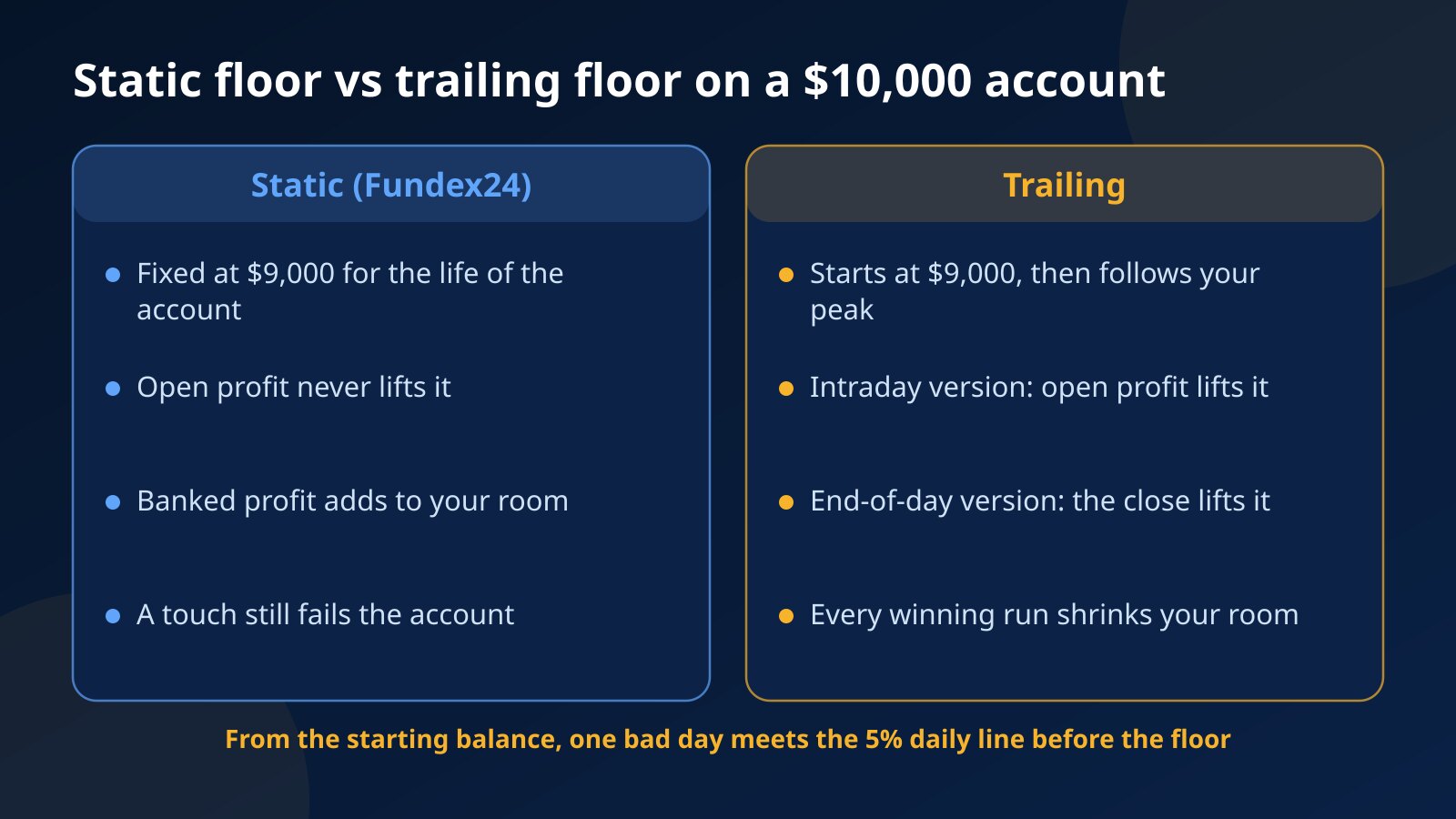
The practical result is that a trailing floor punishes giving back open profit. You can be up on the account and still fail it, because the floor climbed while the trade was green.
What is end-of-day drawdown?
End-of-day drawdown is a trailing floor that updates once a day, from the balance at the close. Swings during the session don’t touch it, so a winner that runs and comes back before the close leaves the floor where it was. A strong day that you actually bank still raises it.
Traders also use the phrase for a daily loss limit set from the previous close. That second meaning is close to how Fundex24’s daily line works, since it is drawn from the closed balance at 00:00 UTC. The difference lies in what happens during the day, and the next two sections put numbers on it.
One $10,000 account, three floors, three days
Here is the same account under all three models. Each has a $1,000 allowance, 10% of the starting balance. To keep the arithmetic clean, every position is closed before 00:00 UTC, so each day’s close is also the next day’s starting balance.
Create your Fundex24 account
Takes a few seconds. You can pick a challenge and add your phone number later.
| Day | Equity during the day | Static floor | Intraday trailing floor | End-of-day trailing floor |
|---|---|---|---|---|
| Day 1 | High $10,500, low $9,900, close $10,400 | $9,000 | $9,000, rising to $9,500 at the high | $9,000, then $9,400 after the close |
| Day 2 | High $11,000, low $9,950, close $10,050 | $9,000 | $10,000 at the high, so the $9,950 low fails the account | $9,400 |
| Day 3 | Low $9,980, close $10,600 | $9,000 | Account already closed | $9,400, then $9,600 after the close |
The formulas: static floor = $10,000 − $1,000; intraday trailing floor = highest equity reached − $1,000; end-of-day floor = highest closing balance − $1,000.
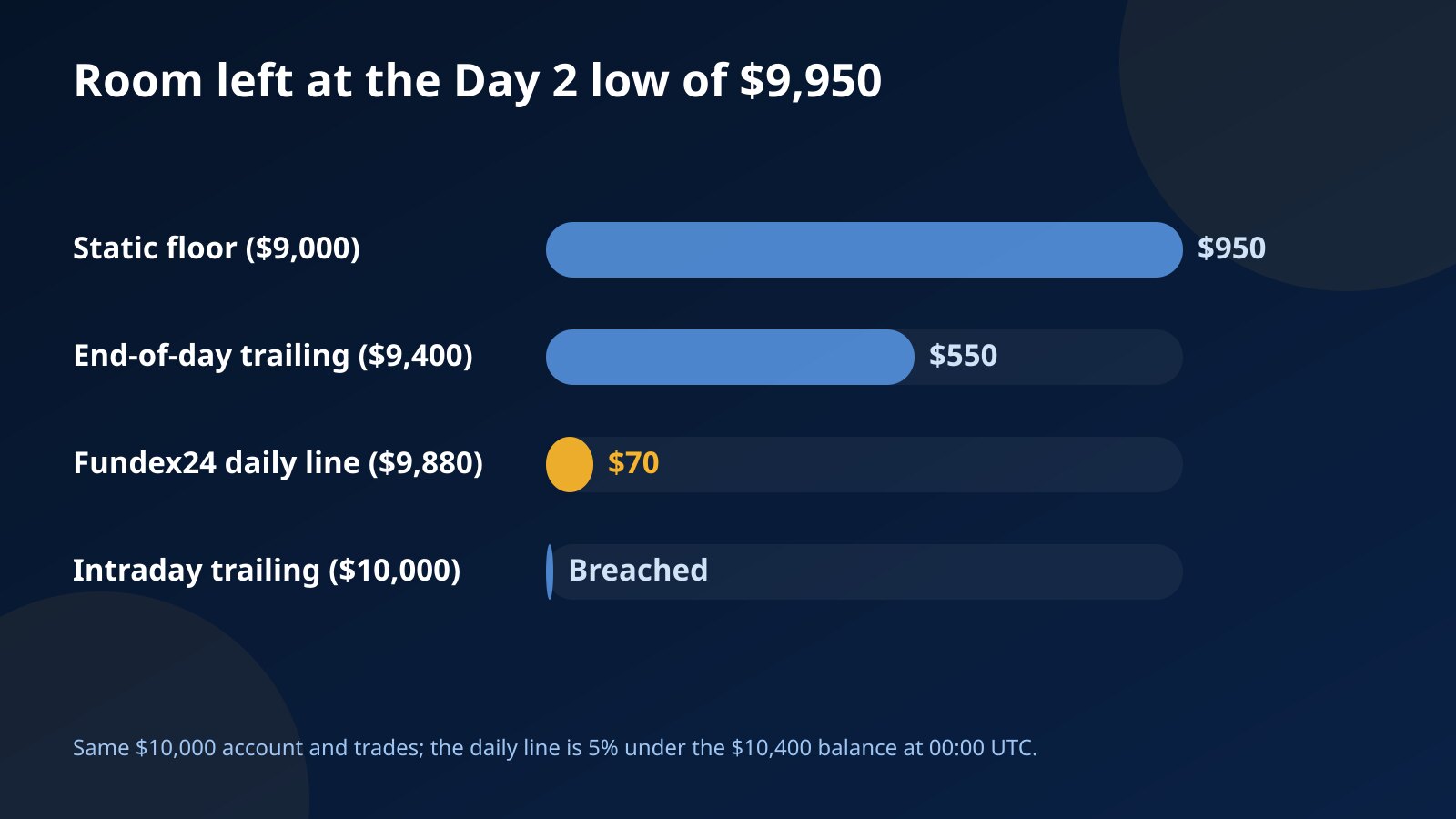
Day 2 decides it. A trade carries equity to $11,000, $600 of it open profit, and then turns. Under intraday trailing the floor climbed to $10,000 at that high, so the dip to $9,950 ends the account on a day the trader closes $50 above the starting balance. The end-of-day floor never saw the $11,000 peak and sits at $9,400, $550 under the low. The static floor is $950 away.
Is Fundex24’s daily drawdown static too?
Within a day, yes. The daily loss limit is 5% of the balance recorded at 00:00 UTC, and that balance counts closed trades only. The line is drawn once at midnight UTC and stays put until the next midnight, however much open profit you build in between. Your equity, the balance plus or minus whatever is open, has to stay above it the whole time.
Across days the line moves, because every day starts from a new balance. Here are the same three days again:
| Day | Balance at 00:00 UTC | Daily line | Lowest equity | Room left at the low |
|---|---|---|---|---|
| Day 1 | $10,000 | $9,500 | $9,900 | $400 |
| Day 2 | $10,400 | $9,880 | $9,950 | $70 |
| Day 3 | $10,050 | $9,547.50 | $9,980 | $432.50 |
Daily line = balance at 00:00 UTC − 5% of that balance. On Day 2 the static floor had $950 to spare at the low, while the daily line had $70. That is no accident of this example: from any balance at or above the starting one, a single bad day reaches the 5% line before the 10% floor, so the daily limit is the number to size from. Our guide to daily drawdown vs max loss puts the two limits side by side.
Two details catch people out. Profit still open at 00:00 UTC is not part of the recorded balance, so it doesn’t widen the next day’s room. A loss still open at midnight works against you: if a Bitcoin (BTC) long is $200 under water when the day turns on a $10,000 balance, the line is $9,500, equity is $9,800, and you start the day with $300 of room rather than $500. In November 2026, 00:00 UTC is 19:00 the previous evening in New York (EST) and midnight in London (GMT).
What a fixed floor changes in how you trade
A static floor doesn’t make the account easier, but it does change which habits pay off.
- Letting a winner run costs you nothing on the floor. Under intraday trailing, every dollar of open profit is also a dollar of room you can lose; here it is simply profit.
- Banked profit becomes a cushion. After a good week that ends at $10,600, a static account sits $1,600 above its floor, while a trailing one would still have $1,000.
- The daily line resets from the closed balance, so an open loss carried past 00:00 UTC eats into the next day’s room. Close or cut what you don’t want to carry.
- Size from the day, not from the floor. At $100 of risk per trade on a $10,000 account, five full stop-outs in a row reach the $500 line; at $50, it takes ten.
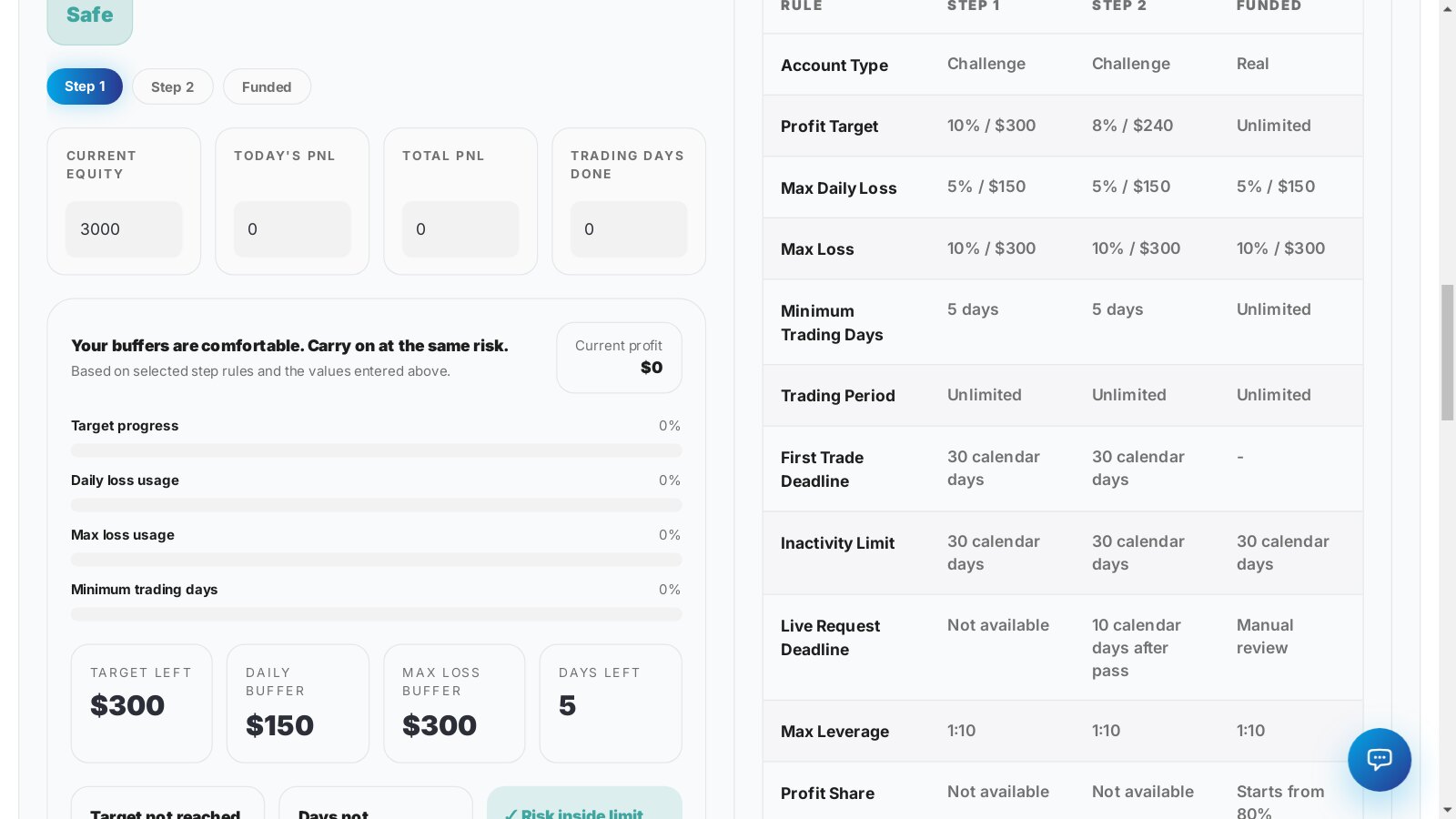
Our piece on risk per trade on a funded account works through that choice, and the crypto risk management guide covers stops and position sizing more broadly. Because the limits are identical in every stage, the habits you build in Step 1 carry straight into the funded account; the challenge rules page lists every figure by plan.
Where these figures come from
The rule numbers (a 10% maximum loss as a fixed floor, a 5% daily loss from the 00:00 UTC balance, equity watched in real time, failure on a touch) come from the Fundex24 rules page and FAQ as of November 2026. The equity path is a worked example, not a real trader’s account, and the two trailing models are generic descriptions of how such floors work rather than any particular firm’s terms. Trading costs are left out; on a real account each new position starts slightly negative because of the spread and the opening fee.
Static and trailing drawdown: quick answers
Does Fundex24 use trailing drawdown?
No. The maximum loss is a fixed floor 10% under the initial balance, $9,000 on a $10,000 account, and no amount of profit moves it.
Pick a challenge and start trading
Two-step evaluation, transparent rules, profit split up to 80%.
Not sure which size fits? Read the rules · Common questions
Is static drawdown better than trailing drawdown?
For the trader, a static floor leaves more room after a winning run, because profit adds to the cushion instead of lifting the floor. It is just as strict at the line itself: touching it still ends the account.
Does unrealized profit raise the drawdown floor?
Not at Fundex24. Neither the maximum-loss floor nor the daily line rises with open profit, but an open loss counts against both in real time.
What time does the daily drawdown reset?
At 00:00 UTC, from the closed balance at that moment. In November 2026 that is 19:00 in New York and midnight in London.
Is Fundex24 a prop firm without daily drawdown?
No. Every stage, the funded account included, has a 5% daily loss limit next to the 10% maximum loss.
What happens if equity touches the floor and bounces back?
The account fails anyway. Both limits are broken by a touch, and a recovery a minute later doesn’t undo it.
Questions about the Fundex24 challenges?
Open the support chat and ask — the team replies right there.
Chat with supportPrefer to read first? Browse the FAQ · Compare the challenges
Continue your learning path
Move from this article to the next useful action or topic.