


Updated 16 November 2026
If you fail a prop firm challenge, the account closes, the fee isn’t refunded and you owe nothing more; at Fundex24 a new challenge starts at $29. That is what happens if you fail a prop firm challenge at Fundex24, as of November 2026, whether it ends on day two or in week six. The useful part is knowing which line you crossed, because only four things end a challenge, and two rules that are easy to mistake for failures never end one at all.
What happens if you fail a prop firm challenge at Fundex24?
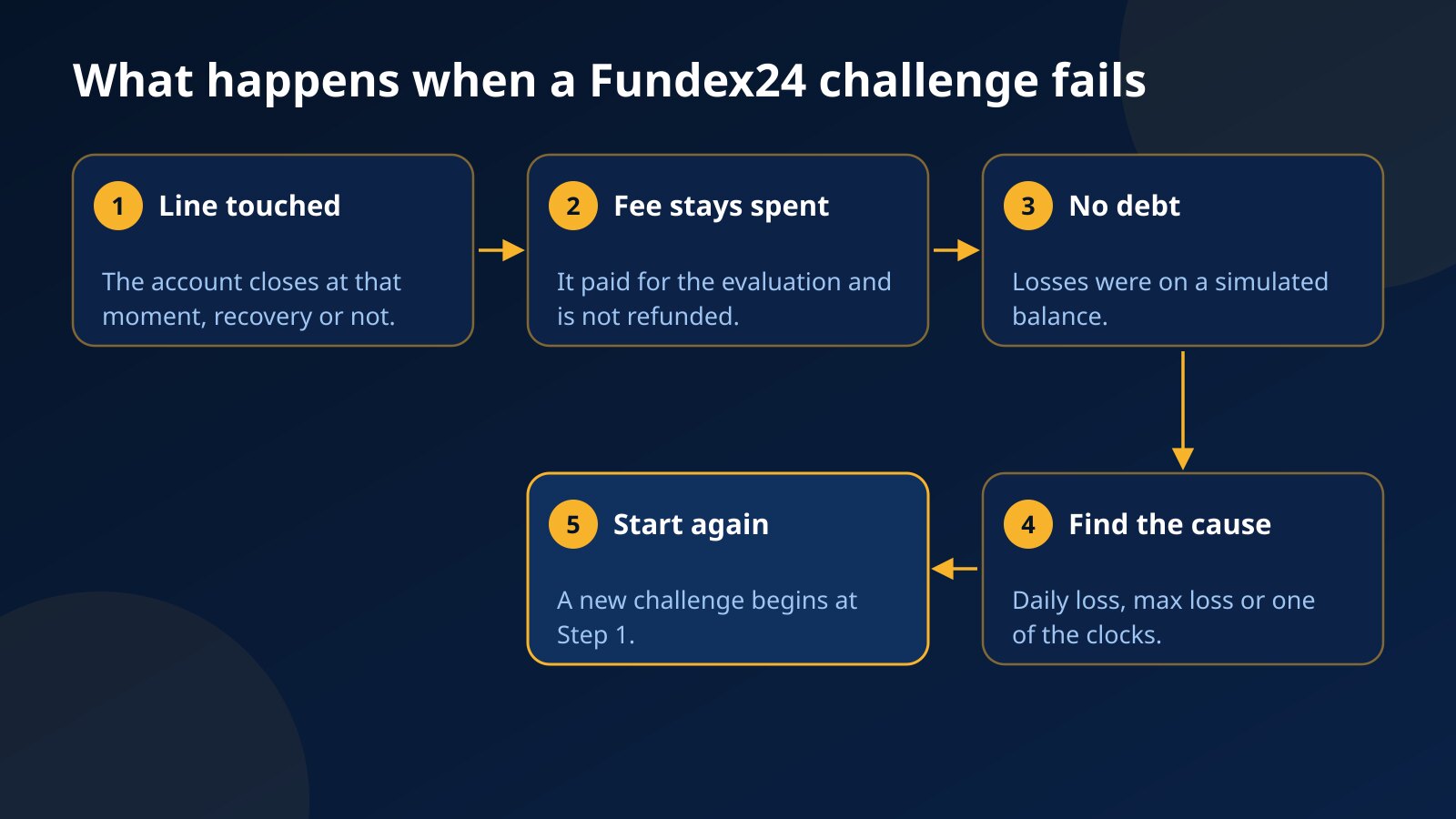
The account stops at the moment of the breach. If equity touches a loss limit at 14:02 and the price comes back at 14:30, the challenge still ended at 14:02. Recovering afterwards doesn’t reopen it.
The fee is the one thing that doesn’t come back: the FAQ calls it the cost of taking part in the evaluation and says it is non-refundable. You didn’t need an identity check to buy, so there’s no paperwork to undo either.
What happens if you lose money on a prop firm account?
Nothing leaves your pocket after the fee. The loss is recorded on the simulated account and counts against your limits, but you never repay it, and Fundex24’s FAQ says the entry fee is the only capital at risk.
Then the choice is yours. Fundex24 lets a trader who failed buy a new challenge and start over, and the FAQ adds one piece of advice before you do: find and fix the weakness that ended the last one.
A second attempt is a new purchase. As of November 2026 that is $29, $59, $89 or $159 depending on the size. The code PROPOFF10 takes 10% off the three smaller plans once per user, so a first $3,000 challenge at $29 followed by a second at $26.10 would come to $55.10 in total.
The four ways a Fundex24 challenge ends
Two are loss limits and two are clocks. The loss limits are the same in Step 1, Step 2 and on the funded account; the clocks apply to the challenge steps. In dollars, assuming a day that starts at the account’s initial balance:
| Line you cross | $3,000 | $6,000 | $10,000 | $20,000 |
|---|---|---|---|---|
| Daily loss: 5% below the 00:00 UTC balance | $150 | $300 | $500 | $1,000 |
| Maximum loss: fixed equity floor | $2,700 | $5,400 | $9,000 | $18,000 |
| No first trade after purchase | 30 days | 30 days | 30 days | 30 days |
| No trade at all | 30 days | 30 days | 30 days | 30 days |
The daily line moves with your balance. Each day at 00:00 UTC, which is 19:00 the previous evening in New York, the balance from closed trades is recorded, and equity must stay above that figure minus 5% all day. Say a $10,000 account starts a day at $10,200: 5% is $510, so equity has to stay above $9,690. A loss still open at midnight already counts against the new day’s room.
The maximum-loss floor never moves. It is 10% under the initial balance, $9,000 on $10,000, and it doesn’t trail your profits upward. Our explainer on daily drawdown vs max loss works through both limits on the same account.
Create your Fundex24 account
Takes a few seconds. You can pick a challenge and add your phone number later.
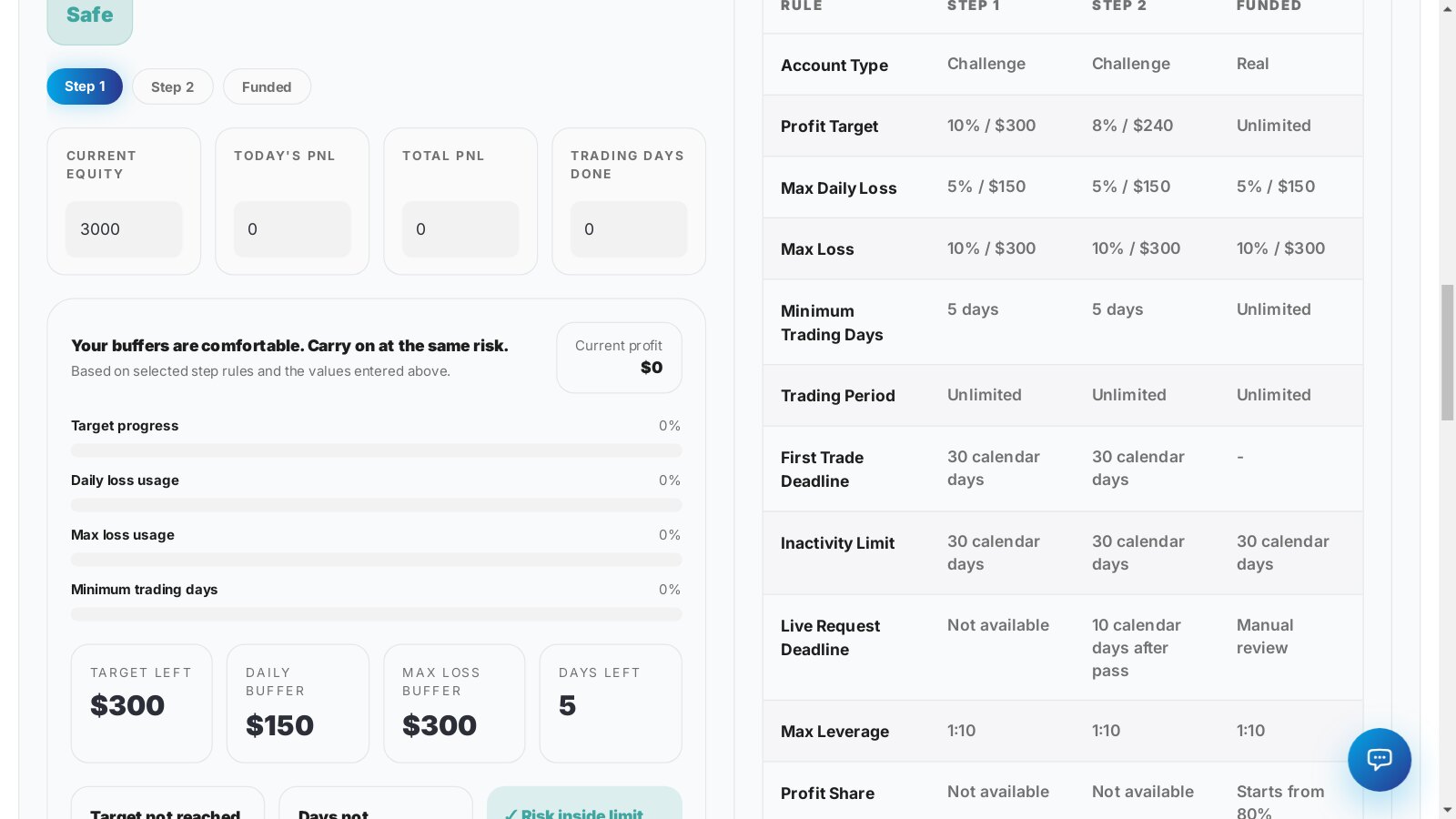
The clocks are simpler. Your first trade must come within 30 days of buying, and again within 30 days of entering Step 2; after that, 30 days without a trade voids the challenge. There is no deadline for reaching the 10% or 8% target itself. The full list sits on the Fundex24 rules page, with each figure filled in per plan.
Rules that cut profit but never fail the account
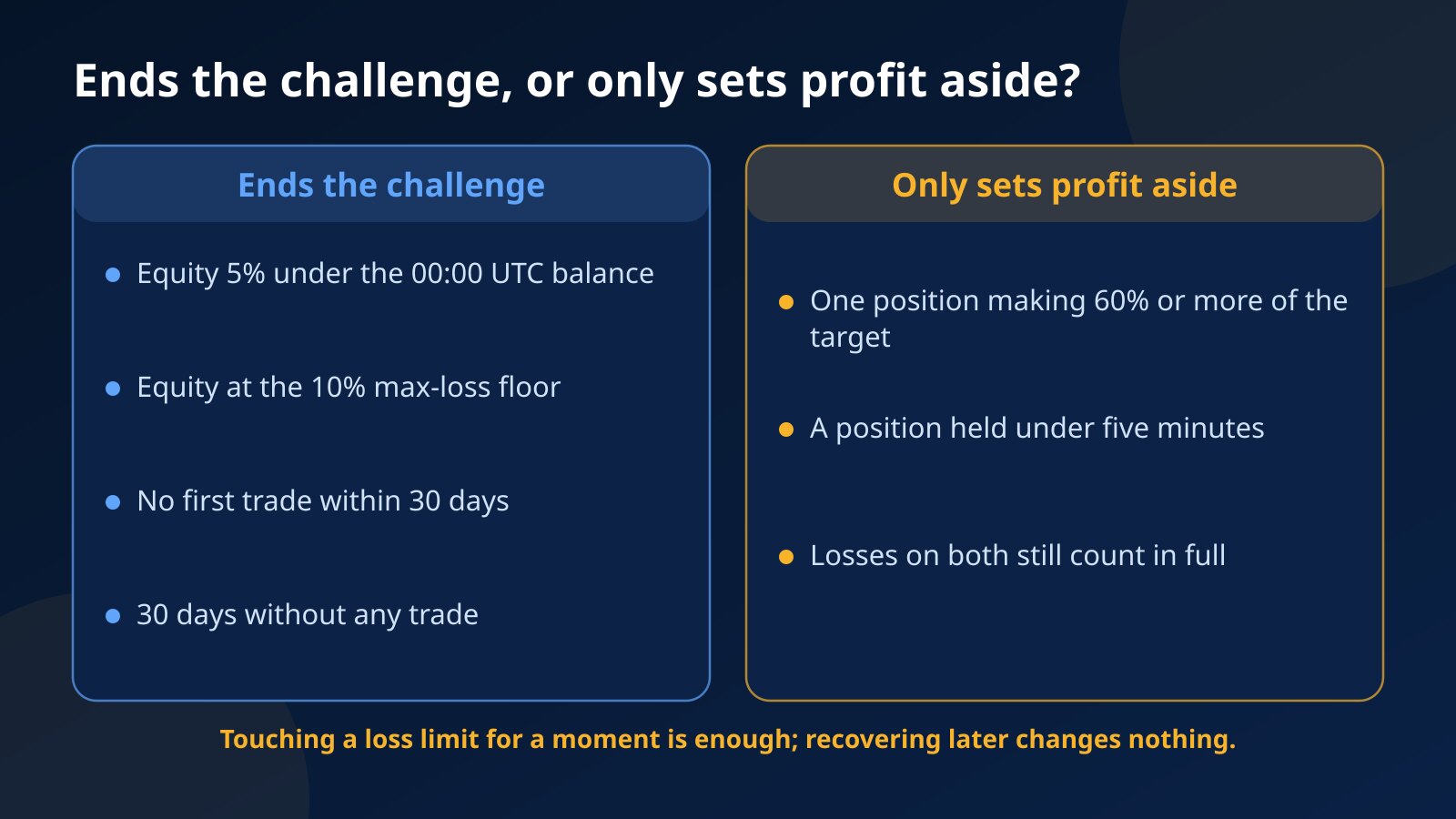
Two challenge rules sound like failures but aren’t. Neither ends anything; each only keeps some profit out of the count, while losses on the same trades always count in full.
The first is the 60% rule. In the challenge steps, one position whose profit after fees is 60% or more of the stage’s target is marked High risk, and its profit doesn’t count toward the target. A position closed in parts is still one position, so the parts are added up. The threshold is 0.6 × the target:
| Plan | Step 1 target | 60% of it | Step 2 target | 60% of it |
|---|---|---|---|---|
| $3,000 | $300 | $180 | $240 | $144 |
| $6,000 | $600 | $360 | $480 | $288 |
| $10,000 | $1,000 | $600 | $800 | $480 |
| $20,000 | $2,000 | $1,200 | $1,600 | $960 |
The second is the five-minute rule, which applies at every stage. A position held under five minutes, counted from the last time you added to it, keeps no profit for the target. Doing it again and again is a different matter: the FAQ warns that repeated early closes may be treated as prohibited behaviour.
What happens if you blow a funded prop firm account?
It ends, and any profit you hadn’t withdrawn is no longer withdrawable. A funded account at Fundex24 is a simulated account on live prices with the same 5% daily and 10% maximum loss, and breaching either one closes it just as in the challenge. Thirty days without a trade deactivates it too.
One funded rule behaves differently. Since 11 November 2026, if your open positions together are down more than 3% of the day’s starting balance ($300 on $10,000), no profit from that UTC day is paid out, yet the account stays active. Profit lost to a rule is painful; an account lost to a limit is worse, and it can happen right after the hard part is done. Our look at why traders lose funded accounts covers that pattern.
Before you buy the next challenge
Start with the line you crossed. If it was the daily loss, look at position size before you look at the setup; the market’s ordinary daily swing shows why. Over the 365 UTC days to 15 November 2026, Bitcoin (BTC) had a median day range of 2.95%, while Pepe (PEPE), an Ethereum memecoin traded as the 1000PEPE-USDT contract, had 6.46%. The table holds a $10,000 position against those ranges on a $10,000 account, whose daily limit is $500. The swing is the position size × the median range.
| Contract | Median day range | Swing on $10,000 | Share of the $500 daily limit |
|---|---|---|---|
| BTC-USDT | 2.95% | $295 | 59% |
| ETH-USDT | 3.94% | $394 | 79% |
| SOL-USDT | 4.48% | $448 | 90% |
| DOGE-USDT | 4.70% | $470 | 94% |
| 1000PEPE-USDT | 6.46% | $646 | 129% |
A range runs from the day’s high to its low, so no single trade loses all of it unless it is caught at the wrong end. The point is scale: with Ethereum (ETH), Solana (SOL) and Dogecoin (DOGE) in between, a position as large as the account can spend most of a day’s limit on an ordinary day. Halve the size and the same day costs half as much.
Then rehearse before paying again. The free practice account gives you $10,000 of virtual money, leverage up to 1:10, three days and three resets once you open a free account, and our guide to the crypto demo account shows how to use it. If the cause was a habit rather than one bad day, the list of common challenge mistakes is a fair mirror.
Where the numbers come from: rule figures are from Fundex24’s rules page and FAQ as of November 2026; the ranges are Binance USDT-M perpetual daily candles, UTC days, through the 15 November 2026 close, with range = (high − low) ÷ open. The 1000PEPE contract prices 1,000 PEPE, which doesn’t change its percentage range. When you’re ready, the challenge sizes and fees are listed side by side. Leveraged trading can lose money quickly; none of this is investment advice.
Pick a challenge and start trading
Two-step evaluation, transparent rules, profit split up to 80%.
Not sure which size fits? Read the rules · Common questions
Failed challenge: common questions
Is a prop firm challenge fee refundable?
Not at Fundex24. The fee pays for the evaluation itself, so it stays spent whether the challenge passes or fails.
Can you retry a prop firm challenge?
Yes. You buy a new challenge and start again from Step 1, and you can even hold several challenges at the same time.
Do you have to pay back losses on a prop firm account?
No. Losses are recorded on a simulated balance, so the one-time fee of $29 to $159 is the most a failed Fundex24 challenge costs.
What happens if you fail Step 2?
The challenge ends there, even though Step 1 was passed. A new challenge begins at Step 1 with its 10% target.
What happens if you don’t trade for 30 days?
The challenge is voided. The same 30-day count applies to your first trade after buying and after entering Step 2.
Can one big winning trade fail the challenge?
No. If one position makes 60% or more of the stage’s target, its profit simply doesn’t count toward that target; the account carries on.
Questions about the Fundex24 challenges?
Open the support chat and ask — the team replies right there.
Chat with supportPrefer to read first? Browse the FAQ · Compare the challenges
Continue your learning path
Move from this article to the next useful action or topic.