



Starting with little money
Can you trade crypto without capital? Not with literally zero dollars in a real market. What you can do is learn with virtual money for nothing, or pay a small one-time fee instead of putting your savings on the line. Here are the three realistic routes, what each one really costs, and the offers to walk away from.
Can you trade crypto without capital? The honest answer
Every real trade needs money behind it. If a website says you can trade crypto without capital and without paying anything, one of two things is true: the money is virtual, or someone else sets the rules and you pay for the chance to trade under them.
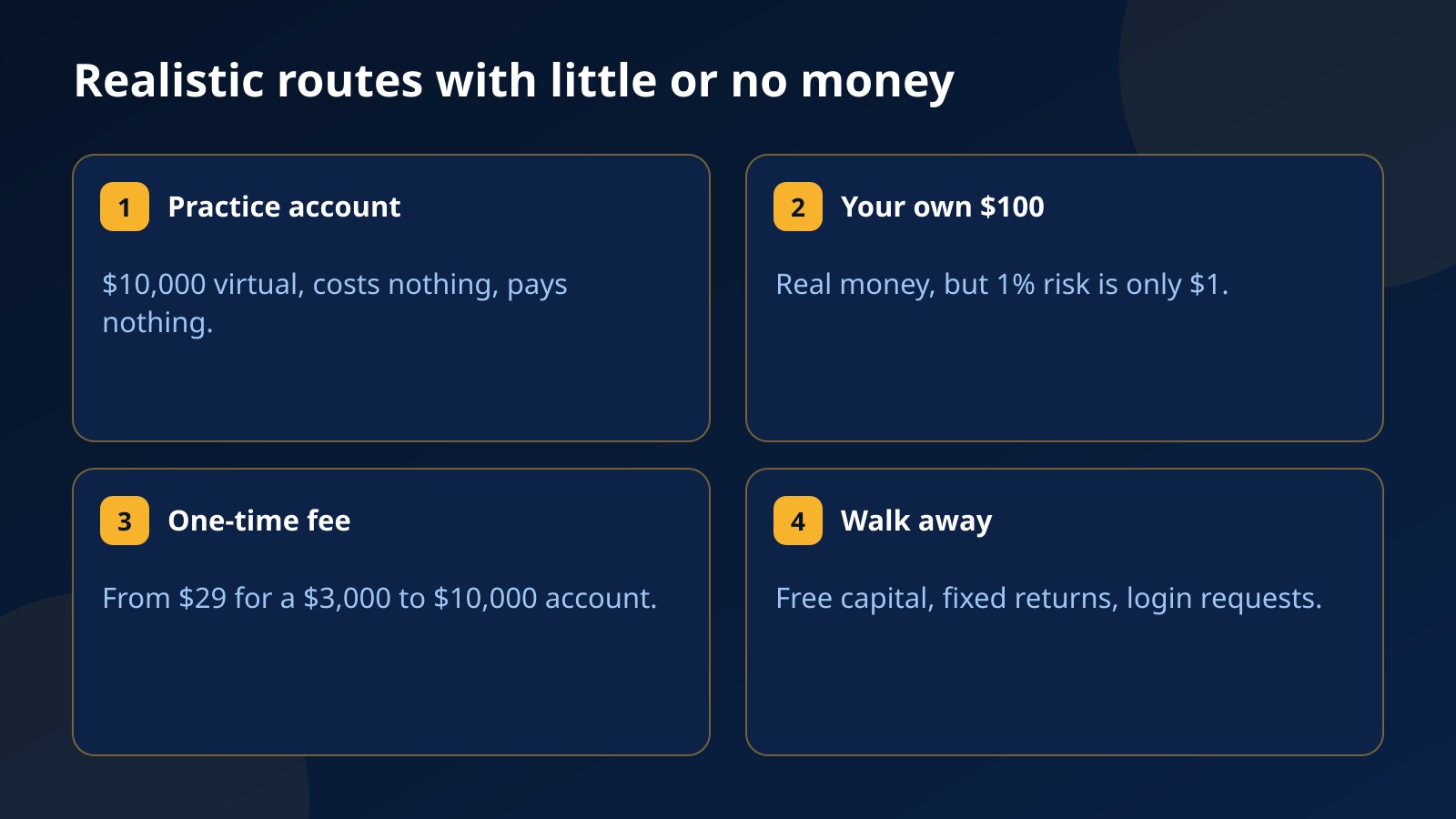
That second option is not a scam in itself. It just has a price, and you should know the price before you start. There are three routes that people with little or no savings actually use:
- A practice account with virtual money. It costs nothing, and nothing you earn is real.
- A tiny account of your own, say $100. Real money, real results, very little room.
- A one-time fee, from $29, for an evaluation account of $3,000, $6,000 or $10,000. The fee is the most you can lose.
Route 1: learn with virtual money first
The only truly free option is a practice account. On Fundex24 it gives you a $10,000 virtual balance for a short run, currently 3 days, with leverage up to 1:10 and 3 resets in total. Prices are live, so you see real volatility, but the profits and losses are not money.
Use it to learn the mechanics: how to open a long or a short, where to put a stop, and how fast a 5% move eats a position. A plan for those days is in a 3-day demo trading plan.
The limit is obvious. Virtual money cannot pay out, and it rarely feels the same as a trade where something is at stake. Treat it as a school, not as income.
Route 2: grow a tiny account with your own money
Many people start by sending $100 to an exchange. It is real trading, and anything you make is yours. The problem is the math of small numbers.
A common rule is to risk about 1% of the account on one trade. On $100 that is $1. With a stop 2% away from the entry, the position can only be $50, and a good trade might make $2 or $3. That feels pointless, so the temptation is to raise the risk or the leverage, and that is how a small account can disappear within days.
A 10% drawdown on $100 is $10 out of your pocket. That sounds small, but it is 10% of everything you put in, and you still have not learned whether you can trade.
Create your Fundex24 account
Takes a few seconds. You can pick a challenge and add your phone number later.
Route 3: pay a one-time fee instead of risking your savings
The third route turns the numbers around. You pay a fee once and get an evaluation account with a set balance: $3,000 for $29, $6,000 for $59 or $10,000 for $89, paid in USDT. You trade it under clear rules. If you break them, the account closes and you lose the fee, nothing more.
To pass, you reach a 10% profit in stage 1 and 8% in stage 2, with at least 5 trading days in each, while staying inside two loss limits: 5% of the day’s starting balance per day and 10% of the initial balance overall. After passing, you get a funded account and keep 80% of the profit you make on it. These funded accounts are simulated for evaluation purposes, so read the rules as a test with a payout, not as a job.
The fee is not refunded if you fail, and failing is a real possibility on any attempt. You can lower the first fee with the PROPOFF10 discount code, which takes 10% off, but it is still money you should be ready to lose.
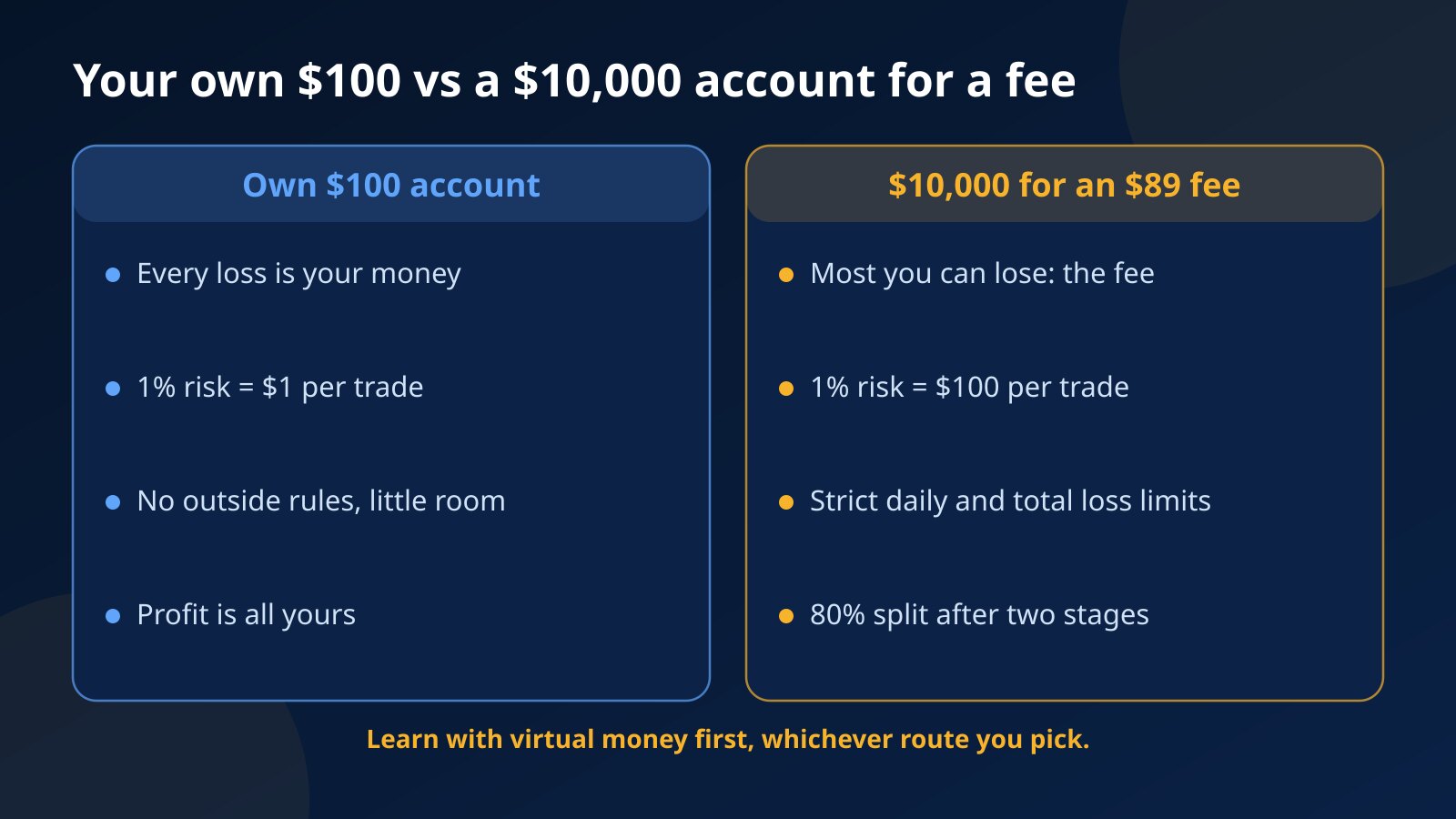
The same 1% risk on $100 and on a $10,000 account
Put both routes side by side with the same habit: risking 1% per trade.
- On your own $100, 1% is $1. On a $10,000 evaluation account, 1% is $100.
- With a 2% stop, that means a $50 position on the small account and a $5,000 position on the large one. With leverage up to 1:10, the $5,000 position ties up $500 of margin.
- A 10% drawdown costs you $10 of real money on the small account. On the evaluation account it is $1,000 of the account balance, and reaching it closes the account, but the money you actually lose is the fee: $89, or $80.10 with the code.
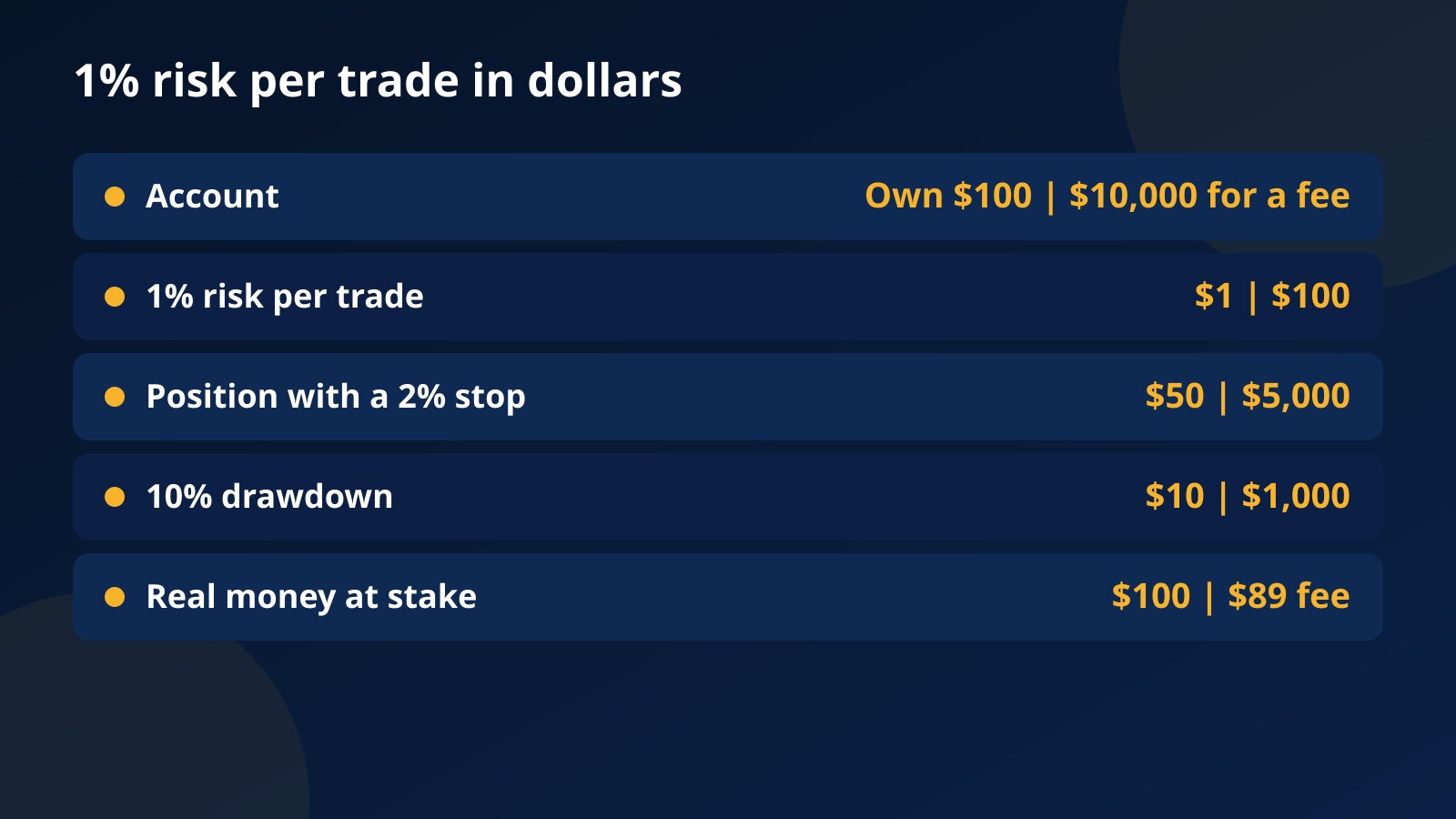
Notice what the table does not say. A 1% risk is still too much for most beginners on a volatile coin, and ten full losses in a row are enough to reach the 10% limit. Starting at 0.5% gives you twenty.
Offers to walk away from
People searching for trading without their own money are a favorite target. Walk away from anyone who:
- Promises “free capital” with no fee and no rules. Somebody pays for the account, and if it is not you, ask who and why.
- Sells a copy-trade or signal group with fixed monthly returns. No one can promise returns in crypto.
- Asks for your exchange login, your seed phrase or remote access “to trade for you”.
- Offers a discount code or a funded account through a private message, especially if you have to pay a person instead of the official site.
A real offer shows its price, its rules and its payout conditions in writing before you pay, and it never needs your password.
Which route to start with
If you have never placed a trade, start with virtual money and stay there until you can follow a written plan for the full run. If you already trade a small account and keep hitting the problem of tiny positions, the fee route gives you room while capping what you can lose.
That fee-based model has a name: prop trading. The full picture of how it is structured is in this guide to the funding model, and if you want every step from purchase to first withdrawal in dollars, read the step-by-step account walkthrough. The rules themselves are on the Fundex24 rules page.
Crypto is volatile, and prices can move far enough in minutes to wipe out a small account or break a loss limit. No route here promises earnings, and you should only pay a fee you can afford to lose.
Pick a challenge and start trading
Two-step evaluation, transparent rules, profit split up to 80%.
Not sure which size fits? Read the rules · Common questions
Frequently asked questions
Is there a way to trade crypto with no money at all?
Only with virtual money on a practice account. Any route with real payouts involves either your own funds or a fee.
What is the most I can lose on the fee route?
The fee you paid for that account: $29, $59 or $89 before any discount. You never owe more than that if the account closes.
Can I skip the practice account and pay right away?
You can, but a few days with virtual money shows you the platform and your own habits before any money is involved.
Do I need to verify my identity to start?
Not to buy or trade the evaluation account. Identity verification comes later, when you request the funded account after passing both stages.
Is $100 of my own money enough to learn on?
It is enough to lose, but hard to learn on, because a sensible risk per trade is about $1. The temptation is to raise the risk far past what the account can take.
Questions about the Fundex24 challenges?
Open the support chat and ask — the team replies right there.
Chat with supportPrefer to read first? Browse the FAQ · Compare the challenges
Continue your learning path
Move from this article to the next useful action or topic.