


China’s AI listings, by the numbers
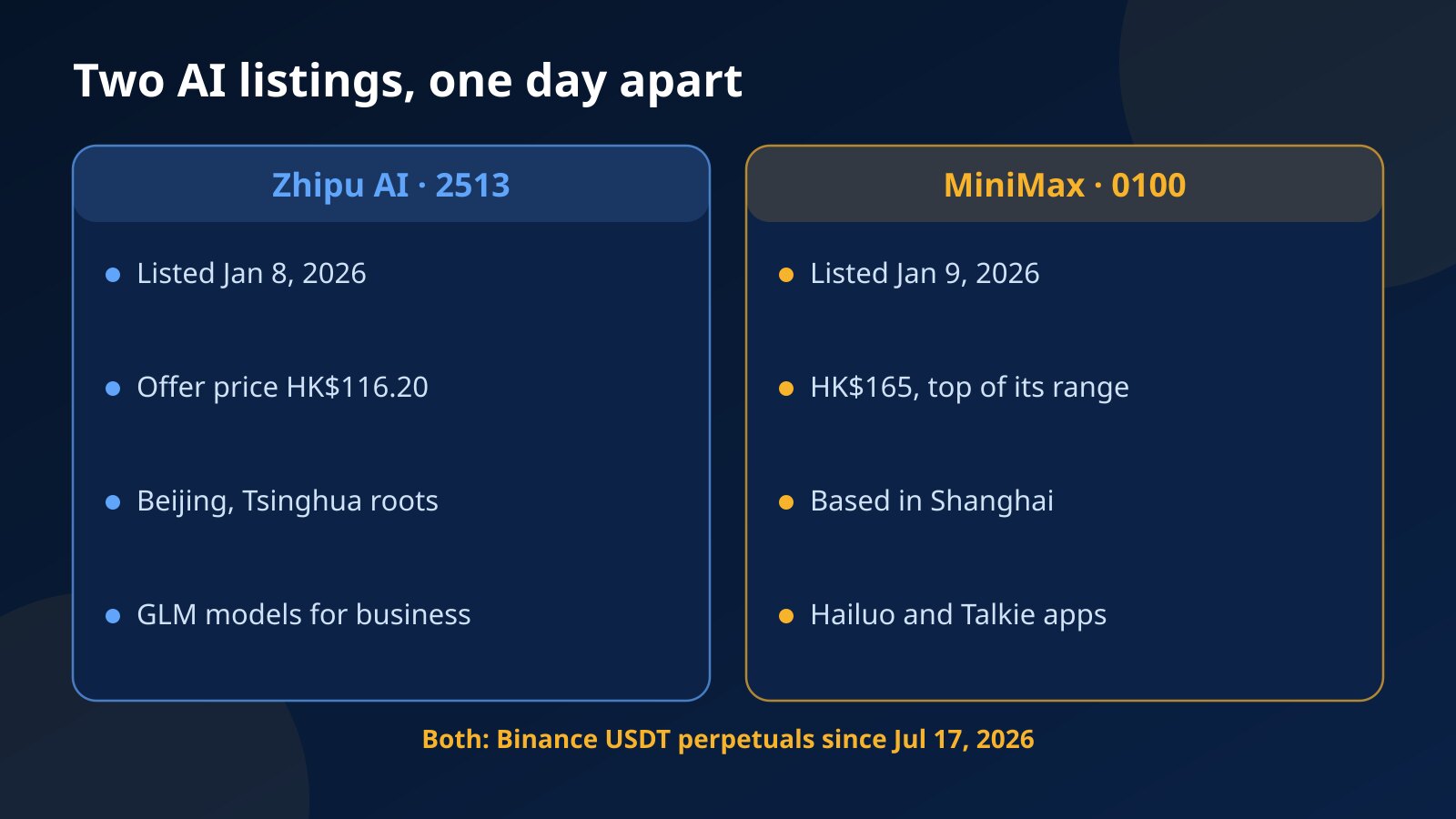
Yes, MiniMax stock is publicly traded: the Shanghai AI company listed on the Hong Kong Stock Exchange on January 9, 2026, under the code 0100, one day after its Beijing rival Zhipu AI listed as 2513. Both are priced in Hong Kong dollars, and since July 17, 2026, both have had USDT-settled perpetual contracts on Binance that you can trade long or short around the clock. Before you touch either, know one number: an average day moves about 8%, nearly four times as much as Nvidia’s contract, so the only sensible position is a small one.
MiniMax stock and Zhipu stock: two listings, one day apart
Zhipu went first. The Beijing company, formally Knowledge Atlas Technology and branded Z.ai outside China, began trading on January 8, 2026, at an offer price of HK$116.20, which made it the first of China’s so-called AI tigers to go public. It was founded in 2019 out of research at Tsinghua University and sells its GLM family of models to businesses and developers, through an API and as on-premise installations.
MiniMax followed on January 9, priced at HK$165, the top of its HK$151 to HK$165 range. It is the more consumer-facing of the two, known for the Hailuo AI video generator and Talkie, an app for chatting with AI characters.
Two young listings in the same hot theme: that is the setup. What it does to a price is the rest of this article.
The MINIMAX and ZHIPU contracts: what you get and what you don’t
Binance launched MINIMAXUSDT and ZHIPUUSDT on July 17, 2026, as perpetual futures on the Hong Kong-listed shares. They settle in USDT, have no expiry date and keep trading through the nights and weekends when HKEX is closed.
What you do not get is the share. There is no ownership, no vote, no dividend and no claim on either company, and neither MiniMax nor Zhipu issues or sponsors the contracts. You are trading a price with leverage, and leverage works against you exactly as fast as it works for you.
Do not try to match the contract’s number to the Hong Kong quote. The contracts are quoted in USDT, the shares in Hong Kong dollars, and the two figures on your screens will not line up. Compare percentage moves instead, because a position’s profit and loss depends on nothing else.
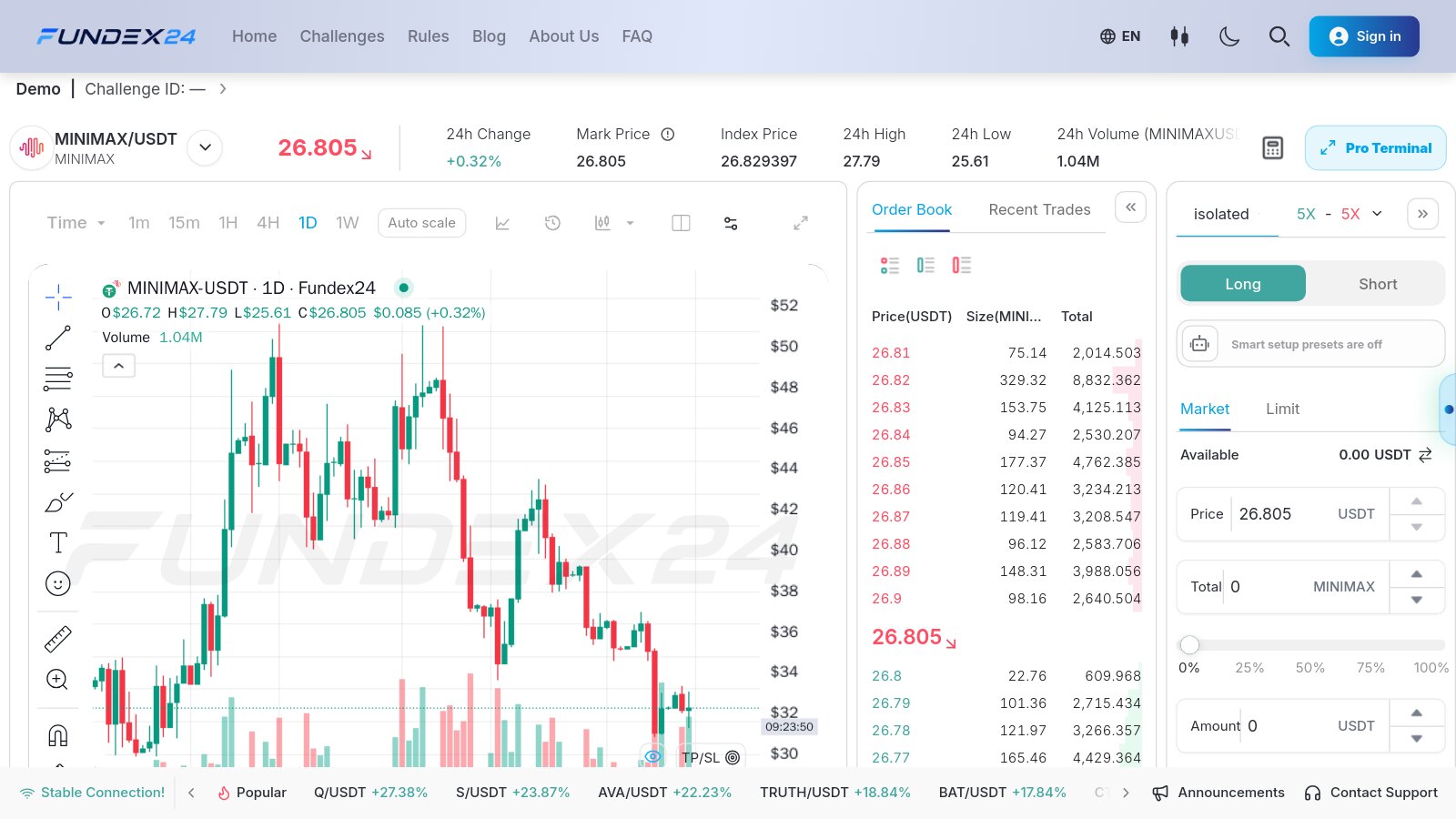
On Fundex24 both pairs sit in the trade page’s market list under Stocks; type MINIMAX or Zhipu into the search box. Leverage goes up to 1:10 and the page opens at 5x. Both have live pages: the MINIMAX/USDT trade page and the ZHIPU/USDT chart.
How wild is wild? MiniMax and Zhipu since July
Over the last 60 days the average MiniMax day covered 8.1% from low to high, and the average Zhipu day 7.8%. Over the same stretch Bitcoin’s contract averaged 3.0%, Nvidia’s 2.2% and gold’s 1.6%.
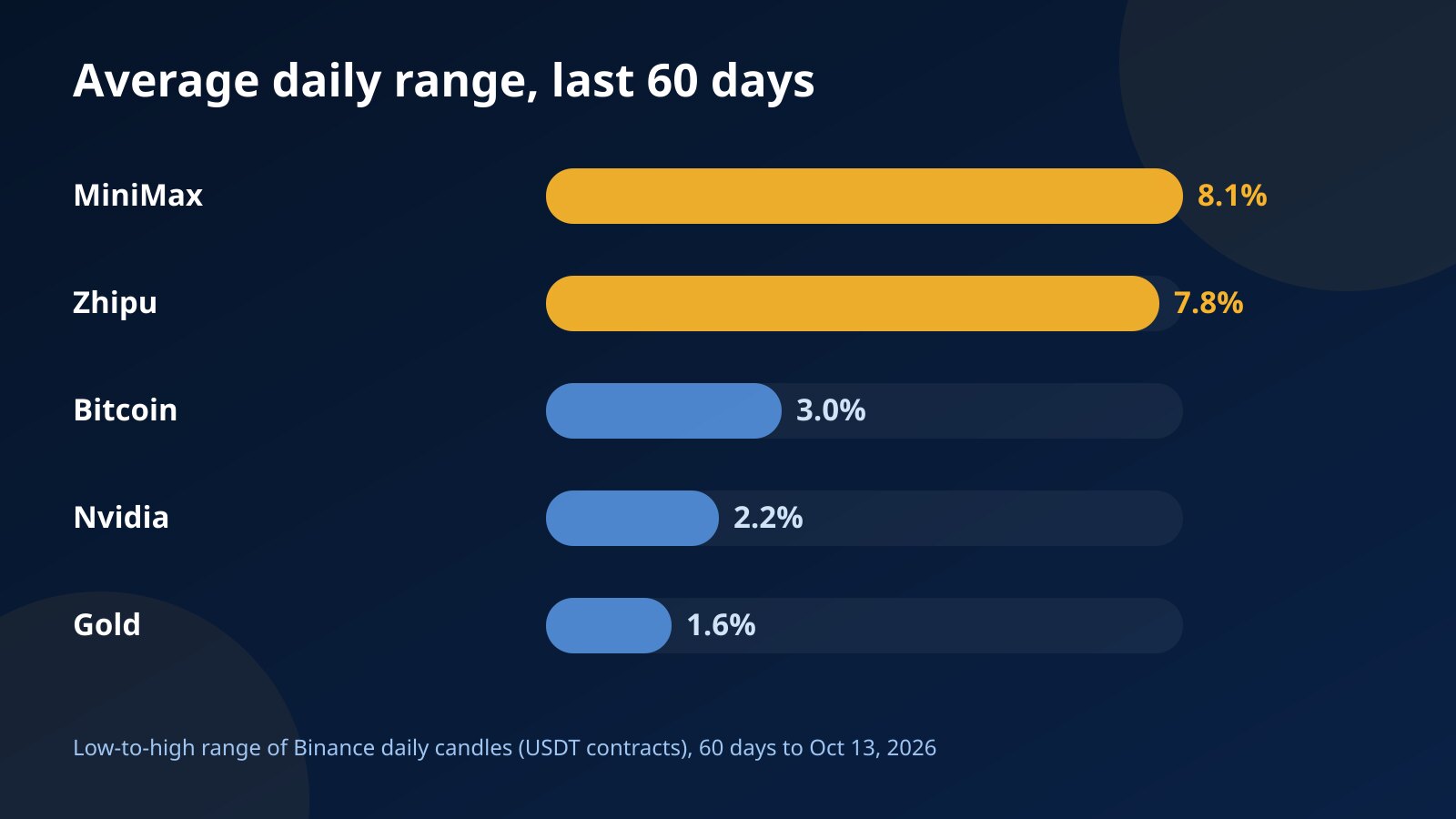
The averages hide the tails. MiniMax’s widest day in that window ran 20.2% and Zhipu’s 19.1%, and about one day in three moved more than 10%: 20 of the 60 for MiniMax, 19 for Zhipu.
MiniMax’s contract opened at 28.40 USDT on July 17, dipped to 23.85 a week later and then more than doubled, to 50.49 on August 14. It has since given almost all of that back: 26.81 on October 13, 47% under the peak and down 17.5% over 30 days. Its best day was +17.1% on August 31, its worst −16.7% on October 8.
Create your Fundex24 account
Takes a few seconds. You can pick a challenge and add your phone number later.
Zhipu’s ride has been rougher. Its contract opened at 159 USDT, lost 20.4% on July 20 and gained 36.3% the next day, the biggest one-day move of either contract. It peaked at 181.33 on August 14, the same day as MiniMax, and set a new low of 73.14 on October 13: 52% under its first price and 58% under the top.
Why a long on each is often one bigger bet
MiniMax and Zhipu tend to move together. On the 78 days since July when both moved by more than 0.2%, they closed in the same direction 59 times, roughly three days in four.
The bad days line up too. On September 10 MiniMax fell 11.8% and Zhipu 13.0%; on October 8 they fell 16.7% and 11.0%. They do split now and then, as on September 18, when MiniMax rose 12.6% while Zhipu slipped 2.3%, but you cannot count on it.
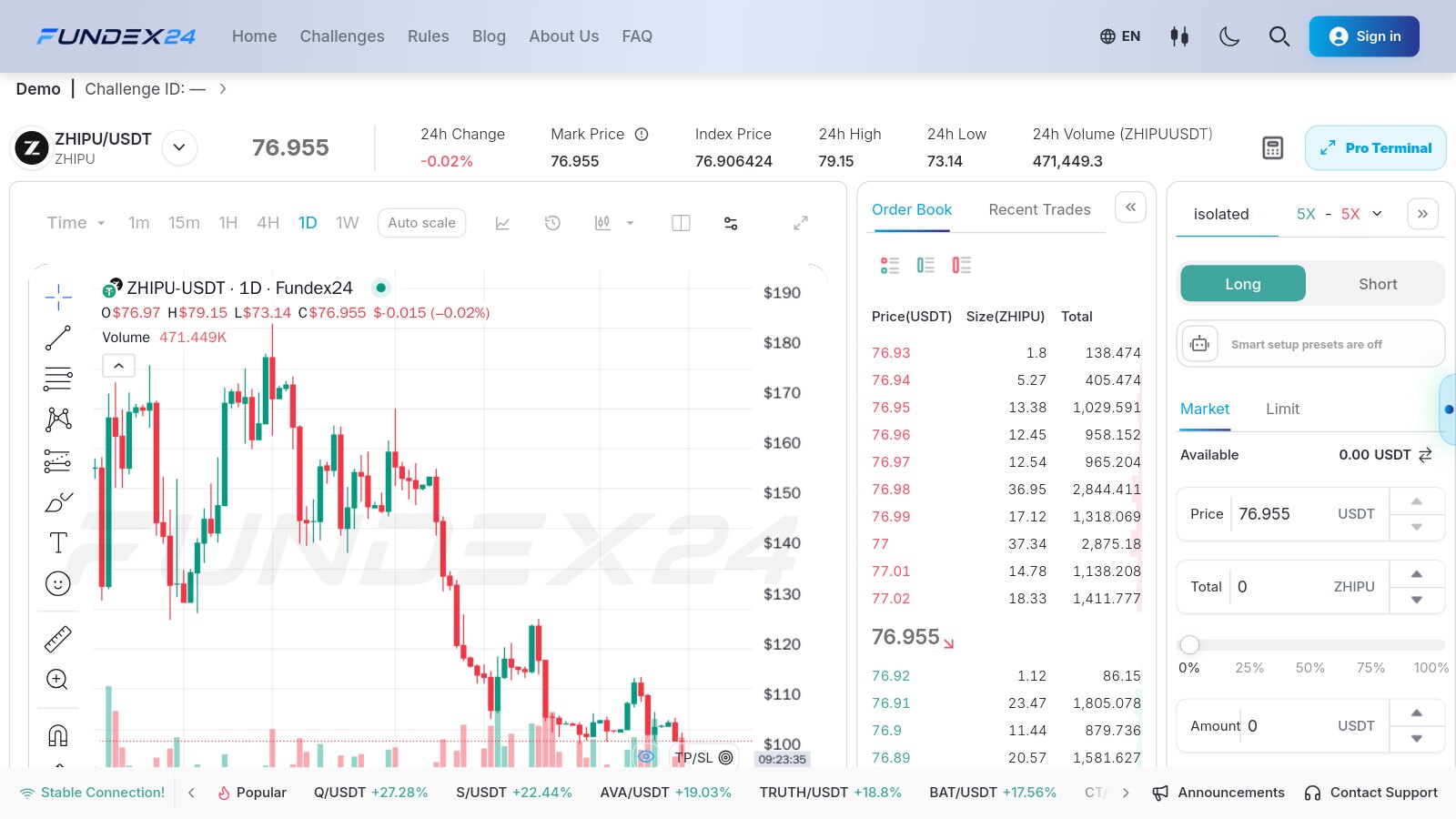
The practical rule follows from that. A position in each is closer to one double-sized trade than to two separate ideas, so count them together against your daily limit.
Quiet weekends, loud Mondays
Both contracts keep trading while Hong Kong is shut, but they barely move. Over the last 60 days MiniMax’s average range was 10.2% on weekdays and 2.7% on weekends; Zhipu’s was 9.9% and 2.4%.
Then Hong Kong opens. In the 30 days to October 13, the first hour of the Hong Kong day, 9 to 10 a.m. local time or 9 p.m. Eastern while daylight saving lasts, averaged a 3.6% move on MiniMax and 3.0% on Zhipu. On Mondays that move can come all at once: by 11 a.m. Hong Kong time on September 28, MiniMax stood 9.8% below Friday’s Hong Kong close, and on September 14 Zhipu was 6.9% lower.
So a weekend position carries a risk that is easy to miss: two calm days, then a gap-sized move in the first hour. A stop limits the damage, but in a move that fast it can fill well beyond its level.
How small is small enough on a $3,000 account?
The $3,000 challenge allows a daily loss of $150 and a maximum loss of $300, both counted on equity, open positions included. Work backward from the $150 and the ceilings appear fast:
- An average 8% day costs $150 on a position of about $1,850.
- A 20% day, MiniMax’s widest in 60 days, does it at $740.
- Zhipu’s 36% day does it at about $410.
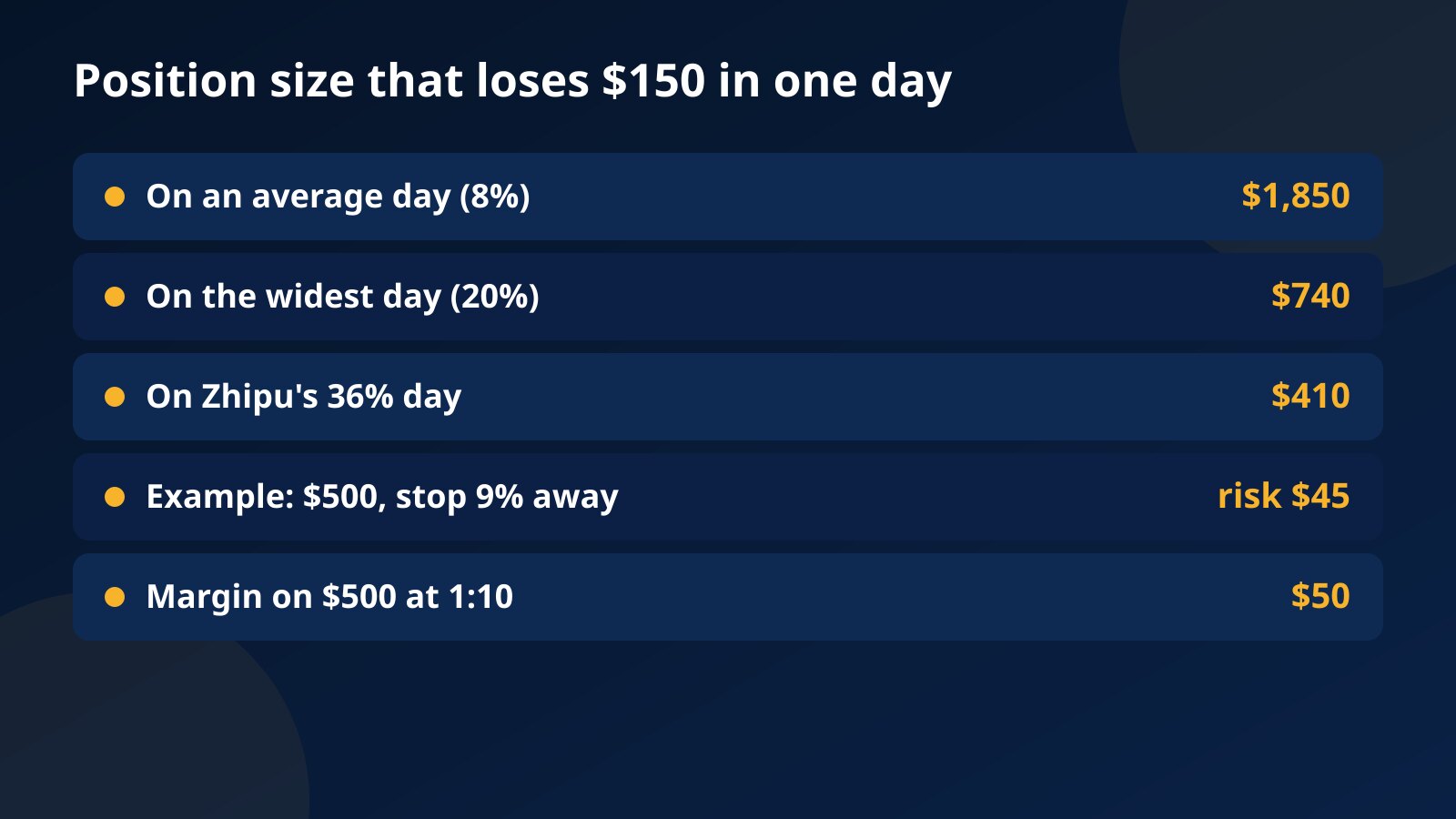
A size that respects those numbers: a $500 position with a stop 9% from entry, just beyond an average day. If the stop is hit you lose $45, or 1.5% of the account, and the margin is $50 at 1:10, $100 at the default 5x. Without a stop, MiniMax’s widest day would cost $101 and stay under the daily line, but a short held through Zhipu’s 36% day would have lost about $182 and failed the account at this “small” size.
Run both at once and the cushion shrinks again. Two $500 longs on October 8 would have lost $84 and $55, or $139 of the $150 a day allows. The same logic is worked through for meme coins in our guide to sizing for wicks and loss limits.
The challenge rules add a twist on the winning side. A single trade that makes 60% or more of the stage target, $180 in Step 1, does not count toward it, so Zhipu’s best day would have made about $182 on a $500 long and still been left out. Profit from trades held under 5 minutes is not counted either, which matters when a spike tempts a quick in-and-out.
Practice on virtual money first, then decide on $29
None of this needs money yet. Sign up for free and open a practice account with $10,000 of virtual money and leverage up to 1:10 for 3 days. A $1,700 position there is about the same share of the balance as $500 on a $3,000 challenge, so you can feel a 10% MiniMax day before it costs anything. Our practice account walkthrough shows the screens.
Pick a challenge and start trading
Two-step evaluation, transparent rules, profit split up to 80%.
Not sure which size fits? Read the rules · Common questions
If you then buy the $3,000 challenge, it costs $29, or $26.10 with the code in our PROPOFF10 discount guide. Step 1 asks for 10%, Step 2 for 8%, with at least 5 valid trading days in each and no time limit; the challenge rules in full cover the rest.
Most challenge buyers do not pass, and the fee is not refunded when you fail. Funded accounts are simulated and used for evaluation; traders who reach one get an 80% profit split, and none of this is a promise of income. On markets this volatile, skipping a trade is often the best decision of the day. Check the rules that apply where you live before you trade.
MiniMax and Zhipu FAQ
Is MiniMax a publicly traded company?
Yes. MiniMax has been listed on the Hong Kong Stock Exchange since January 9, 2026, under the code 0100, after pricing its shares at HK$165. The shares trade in Hong Kong dollars during Hong Kong market hours.
What is Zhipu’s stock code?
Zhipu AI trades in Hong Kong as 2513, under its formal name Knowledge Atlas Technology. The USDT contract that follows it is ZHIPU/USDT.
Does the MINIMAX contract price match the Hong Kong share price?
No. The contract is quoted in USDT and the share in Hong Kong dollars, so the numbers differ. Follow the percentage changes, which are what a position’s result depends on.
Why do MiniMax and Zhipu often move on the same days?
Whatever the cause on a given day, the pattern since July is clear: they closed in the same direction on about three of every four days when both moved. Treat a position in each as one larger bet.
What leverage can I use on MiniMax and Zhipu at Fundex24?
Up to 1:10, as on every Fundex24 market, and the trade page opens at 5x. With 8% average days, the position size you pick matters far more than the leverage setting.
Questions about the Fundex24 challenges?
Open the support chat and ask — the team replies right there.
Chat with supportPrefer to read first? Browse the FAQ · Compare the challenges
Continue your learning path
Move from this article to the next useful action or topic.